
What’s Inside
- Maximize Vertical Hanging Space with Double Rods
- Modular Systems Are Essential Nursery Closet Organization Ideas
- Utilize Drawer Dividers for Tiny Garments
- Sort and Store Clothes by Size with Closet Dividers
- Opt for Slim, Non-Slip Baby Hangers
- Use Over-the-Door Organizers for Small Items
- Utilize Clear, Stackable Bins for Bulk and Backstock
- Create a Ready-To-Go Station
- Incorporate Closed Storage to Combat Visual Clutter
- Anchor All Furniture for Safety
- Label Everything with a Label Maker
- Dedicate a Shelf for Keepsakes and Sentimental Items
- Use Rolling Carts for Mobile Storage
- My Favorite Nursery Closet Organization Ideas Include a Donation Bin
- Install Motion-Sensor Lighting for Late-Night Changes
I stood in my daughter’s nursery at 2 AM last November with a blowout diaper in one hand and a collapsed closet rod in the other. I needed practical nursery closet organization ideas immediately. The flimsy plastic builder-grade rod couldn’t hold the weight of fifty tiny velvet hangers and three bulk boxes of Costco wipes I’d stacked on the top shelf. That night ended with me crying on a pile of scratchy 0-3 month onesies while my husband tried to duct-tape a wooden dowel rod back to the wall. It wasn’t my finest hour. But it forced me to rethink how a baby’s space functions. A baby’s closet isn’t just for clothes. It’s a diaper pantry, a toy garage, and a holding zone for stuff they’ll grow into. Set it up poorly, and you’ll spend your days digging through piles of identical socks. Let’s fix that. Here’s the setup I use to keep the chaos contained.
1. Maximize Vertical Hanging Space with Double Rods

Baby clothes are tiny. Most newborn onesies measure about ten inches long. If you hang them on a standard single rod at adult eye level, you’re wasting four feet of usable space underneath. I tried stacking cardboard boxes on the floor for months before figuring it out. The boxes just became a dusty dumping ground for random toys and loose pacifiers. To fix this, you need a second rod. You can buy a basic adjustable rod doubler from Target for $14.99 that hangs from your existing top rod. It takes two minutes to install. For a permanent fix, I installed the Elfa Classic system from The Container Store. It cost me $345 for a four-foot closet, but I can adjust the rod height every few inches. Right now, I keep her current size tops on the upper rod and her pants on the lower. The dual-rod setup means I don’t dig through bins for matching sets when she spits up on her shirt right before daycare. The only negative? Cheaper hanging rods sway when you grab clothes quickly. If you pull too hard, the hangers get tangled. Learned that the hard way.
2. Modular Systems Are Essential Nursery Closet Organization Ideas

Ditch the fixed wooden shelves that come in most homes. They won’t adapt when your baby moves from tiny sleepers to bulky toddler coats. I made the mistake of leaving the builder-grade shelf in my son’s room. By the time he hit two, his pants dragged on the floor bins and the shelf bowed under the weight of heavy wipes. I replaced it with the ClosetMaid Selectives kit from Walmart. The basic tower starts at $139.00 and provides a sturdy framework for bulk items. It comes with three adjustable shelves and two fixed ones. Rubbermaid Configurations is another option that runs around $115.00. Both let you move shelves in one-inch increments. You just snap the metal brackets into the tracks. Be warned, the metal tracks have sharp edges. I sliced my thumb open installing them because I didn’t wear gloves. Wear thick leather work gloves. The tracks hold up to 50 pounds per shelf, which easily supports the massive 900-count boxes of Kirkland wipes I buy at Costco.
3. Utilize Drawer Dividers for Tiny Garments

Baby socks and mittens are impossibly small. Throw them into a drawer without boundaries and they turn into chaotic fabric soup. I spent the first three months of my daughter’s life digging blindly for matching socks. It was a waste of time. You need physical boundaries. I bought the mDesign Fabric Drawer Organizer Bins in a set of eight for $22.99 on Amazon. They’re soft, structured fabric squares that fit perfectly inside standard drawers. I use the small 5.5-inch squares for socks and the 11-inch rectangles for rolled pajamas. If you prefer a rigid option, the Brightroom 4-pack Natural Expandable Drawer Dividers from Target cost $24.00. These are spring-loaded bamboo planks that snap into place. You just squeeze them and wedge them between the front and back of the drawer. The bamboo looks nicer, but the spring mechanism occasionally pops loose if you slam the drawer. I had one snap back and pinch my finger last Tuesday. Trust me. Stick to rolling the clothes into tight little burritos and filing them upright. You’ll see every pattern at a glance.
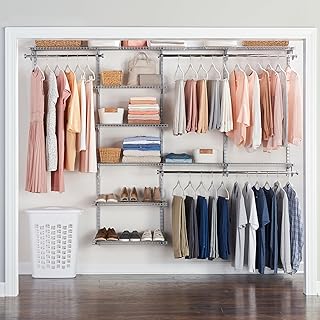
Rubbermaid Configurations Deluxe Custom Closet Kit 4-8 Ft.
Rubbermaid Configurations Deluxe Custom Closet Kit 4-8 Ft. Adjustable has been one of the most consistently praised picks in this category. 81 reviewers averaged 4.5/5.
4. Sort and Store Clothes by Size with Closet Dividers

A common trap is hanging all the shower gifts in one giant row. Mix newborn sleepers with 12-month sweaters and you’ll miss the window to wear half the outfits. Babies grow overnight. You need physical markers on the rod. I use baby closet size dividers from 3 Sprouts. You can get a set of 12 for $14.99. They’re thick plastic rings that snap directly onto the rod, printed with ranges like 0-3 months and 3-6 months. Minnebaby also makes a great set for $11.99 if you want a cleaner look. I keep the current size in the center. The next size up stays on the far right side behind the divider. I learned not to buy cheap cardboard dividers. I bought a paper set from a boutique, and they warped from the humidity when I ran the humidifier during a bad cold last winter. Stick to the hard plastic rings. They slide easily across the metal rod.
5. Opt for Slim, Non-Slip Baby Hangers

Standard plastic baby hangers are thick, slippery, and take up way too much space. The slick plastic means wide-neck sweaters constantly slide off and land in a wrinkled heap. I switched to slim, velvet non-slip baby hangers after finding my daughter’s favorite cardigan under her shoe rack. The 3 Sprouts velvet hangers cost $24.99 for a pack of 30. They measure 11.5 inches across, the perfect width for newborn through 2T clothing. The velvet grips the fabric, keeping everything in place. The slim profile means I can fit forty outfits in the space where twenty plastic ones used to sit. The only downside? The velvet attracts lint like a magnet. I have to run a sticky lint roller over the empty hangers once a month to remove dog fur. If you hate velvet, WJWSKI makes a 50-pack of adjustable width plastic hangers for $32.99. The arms slide out from 11 inches to 14 inches, so you don’t have to buy new ones when your kid hits preschool.
6. Use Over-the-Door Organizers for Small Items

The back of the nursery closet door is prime real estate. I used to leave it blank while complaining I didn’t have space for rash cream, bows, and shoes. Hanging a simple organizer over the door solves this. I use the Univivi Over Door Hanging Organizer Storage, which I grabbed for $24.99. It has 24 clear plastic pockets. Get one with transparent pockets. I tried a canvas one first and kept forgetting what I put in it because I couldn’t see through the fabric. The clear vinyl lets you spot exactly what you need. I keep 3 oz tubes of Aquaphor, a digital thermometer, and spare pacifiers in the top row at eye level. The bottom rows hold soft-soled shoes and extra burp cloths. One negative: the metal hooks. The Univivi hooks are thick. When I first installed it, the metal scraped the white paint off my door frame every time I closed the closet. I had to stick a small felt furniture pad under the hook to stop the scraping. You might also like: 20 Charming Aesthetic Closet Organization Ideas You Need to See

Timate P3 Wall Mounted Closet Organizer System with 5
If you want something that just works, Timate P3 Wall Mounted Closet Organizer System with 5 Hanging Rods is a safe bet (7 reviews, 4.5 stars).
7. Utilize Clear, Stackable Bins for Bulk and Backstock

Babies require an absurd amount of bulk supplies. You’ll quickly find yourself drowning in extra wipes, bags of out-of-season clothes, and giant boxes of diapers. Don’t leave these loose on the top shelf. I use clear, stackable plastic bins. The Container Store sells nice ones, but I prefer their basic Clear Weathertight Totes. The 41-quart size costs $21.99 and fits two jumbo packs of diapers perfectly. Clear plastic is non-negotiable for high shelves. If you use opaque bins, you’ll forget what’s up there. I once bought three extra boxes of size 2 diapers because I couldn’t see inside a gray fabric bin. We donated them because my son outgrew them before I realized we had them. To avoid this, I label the outside of every bin with white masking tape and a black Sharpie. Write the size and season on the tape. It takes ten seconds and saves you from pulling down a heavy bin of winter coats in July. You might also like: 15 Gorgeous Hacks Home Organization to Inspire Your Next Project
8. Create a Ready-To-Go Station

Most people don’t think about this until they’re sweating by the front door trying to pack a bag while a baby screams. You need a staging area right inside the closet. I cleared off a 12-inch section on a waist-high shelf for this. This spot holds my fully packed diaper bag. I use the Jujube Be Right Back diaper backpack, which retails for $165.00. Next to the bag, I keep a small plastic basket holding backup supplies. It holds a half-empty pack of wipes, three spare newborn onesies, and two clean pacifiers in a ziplock bag. When I get home, I immediately restock the bag from this basket. It forces me to clean out the trash and replace dirty clothes right away. I started this after a disastrous trip to Kroger last spring. I reached into my bag for a wipe and pulled out an empty wrapper. I had to wipe my son’s sticky hands with a dry fast-food napkin. Having a staging area guarantees you never leave the house empty-handed. You might also like: 15 DIY Closet Organization Ideas Worth Trying
9. Incorporate Closed Storage to Combat Visual Clutter

Social media makes us think we need styled open shelves with color-coordinated wooden toys. In reality, open shelving is a clutter magnet. I tried the open shelf aesthetic for three weeks. The shelves just collected dust, and every time I shoved a stack of receiving blankets onto the shelf, it looked messy. You need closed storage to hide the ugly realities of baby gear. I bought the mDesign Stackable Fabric Baby Storage Organizers for $34.99. It’s a set of two drawers wrapped in gray linen with a rigid frame. I stack them on the middle shelf at eye level. They hide breast pump parts, neon plastic toys, and half-used tubes of diaper cream. By hiding the visually loud items, the closet feels calmer. The fabric looks clean and uniform. If you insist on open shelves, limit them to three or four decorative items. I keep a single wooden stacking ring and one framed photo. Everything else gets shoved into a drawer.
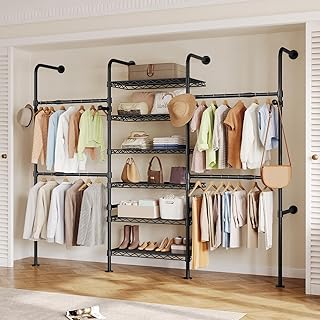
Closet Organizers and Storage
Honestly, Closet Organizers and Storage surprised me — sturdier than it looks in the photos, and over 39 buyers gave it 4.5 stars.
10. Anchor All Furniture for Safety

This isn’t just an organization tip. It’s a mandatory safety requirement. If you put a dresser, bookshelf, or cube organizer inside the closet, you must anchor it to the wall studs. Babies turn into toddlers who love to climb. A heavy dresser full of clothes can tip forward if a toddler pulls out all the drawers at once to reach a toy. I bought a 10-pack of Safety 1st Furniture Wall Straps for $14.99 at Walmart. They’re heavy-duty nylon straps that screw into the back of the furniture and into the wall stud. Do not use drywall anchors. I made that mistake in my old apartment. I used cheap plastic anchors to secure a tall bookcase. When I pulled on it, the anchors ripped right out of the drywall, leaving two massive holes. Use a stud finder. Drill a pilot hole, drive a 2-inch wood screw through the strap, and secure it tightly. It takes twenty minutes and guarantees the furniture won’t crush your child.
11. Label Everything with a Label Maker

I used to think label makers were just for office supplies. Then I had a baby and realized my husband couldn’t figure out where anything belonged. He constantly put burp cloths in the swaddle drawer and shoved 6-month pants in with the newborn socks. It drove me crazy. I finally bought the Brother P-Touch PT-D210 Label Maker for $34.99 at Target. I printed clear labels with black text for every drawer, bin, and shelf edge. The labels provide a strict boundary. When a drawer says 0-3M Pajamas, you can’t just toss a random sweater in there. It forces everyone in the house to stick to the system. The P-Touch tape is laminated, so it doesn’t peel off in humid rooms. One frustrating thing: the label maker wastes about an inch of blank tape on either side of the text. You have to manually trim the edges if you want a clean label. I wasted half a cartridge before I realized I could change the margin settings in the menu. Took me years to figure that out.
12. Dedicate a Shelf for Keepsakes and Sentimental Items

You’ll collect items your baby has outgrown but you can’t bear to toss. The hospital blanket, the tiny newborn hat, the first pair of hard-soled shoes. If you don’t have a specific place for these, they end up scattered across the closet. I dedicated the highest shelf entirely to sentimental storage. I use the Lineco Archival Document Storage Boxes, which cost $26.50 each at The Container Store. They’re acid-free, which prevents fabric from yellowing. I fold special outfits in acid-free tissue paper before placing them in the box. I learned about acid-free storage the hard way. I stored my own childhood baptism gown in a regular cardboard box in my mother’s attic for thirty years. When I pulled it out for my daughter, the lace was permanently stained brown from the acid. Don’t risk ruining the important pieces. Buy the proper archival boxes, label them clearly with the year, and shove them on the top shelf.

Ulif E10 Clothes Rack(With Stretchable Hanger
If you want something that just works, Ulif E10 Clothes Rack(With Stretchable Hanger Rod)Freestanding Clothin is a safe bet (958 reviews, 4.5 stars).
13. Use Rolling Carts for Mobile Storage

Sometimes you need items from the closet, but you can’t walk away from the baby on the changing table. A mobile solution fixes this. I park an IKEA Raskog utility cart inside the bottom of the closet. It costs $39.99 and has three deep metal tiers. I keep the top tier loaded with diapers, wipes, and a tube of Boudreaux’s Butt Paste. The middle tier holds rolled swaddles, and the bottom tier holds extra changing pad covers. The cart has heavy-duty caster wheels, so I can grab the handle and roll the entire setup out of the closet and next to the changing table. When I’m done, I roll it back inside. It eliminates the need for a bulky diaper caddy on the dresser. The assembly for the Raskog is annoying. The tiny hex key they provide will cramp your hand, and the metal baskets require forceful pushing to line up with the screw holes. I spent forty-five minutes sweating on the floor trying to put it together. Use a real screwdriver with a hex bit if you have one.
14. My Favorite Nursery Closet Organization Ideas Include a Donation Bin

Babies outgrow clothes at a terrifying speed. One day a onesie fits perfectly, and three days later you can’t snap the buttons over their diaper. If you put that outgrown onesie back in the drawer, you’ll accidentally try to put it on them again next week. You need a system to immediately remove outgrown items. I keep a large canvas laundry bin on the floor in the back corner of the closet. I bought a basic Threshold Canvas Hamper from Target for $20.00. Whenever I try to dress my daughter and realize a shirt is too tight, I toss it into the canvas bin. I don’t wash it, I don’t fold it, I just throw it in. Once the bin is full, I sort the items. The stained clothes go in the trash, and the good clothes get washed and packed into clear bins for storage or donation. I used to just toss the small clothes onto a chair in the corner of the room. It created a massive, ugly pile of fabric that stressed me out. The dedicated bin keeps the mess contained and hidden behind the closet door.
15. Install Motion-Sensor Lighting for Late-Night Changes

The final piece of the puzzle is lighting. When you’re dealing with a leaky diaper at 3 AM, you can’t flip on the harsh overhead light without waking up the baby. But you also can’t dig through a dark closet looking for a clean sleep sack. The solution is battery-operated motion-sensor lights. I bought a 3-pack of GE Wireless LED Puck Lights for $15.99 on Amazon. I stuck one to the underside of the top shelf and one on the side wall near the drawers. They attach with double-sided 3M tape. The second I open the closet door, the lights click on with a soft glow. It’s just enough light to see the labels on the drawer dividers without blinding myself. The motion sensor turns them off automatically after thirty seconds. The only negative? The adhesive tape is aggressively sticky. When I tried to move one of the puck lights to a different shelf last month, it ripped a chunk of white paint right off the drywall. If you install these, make sure you know exactly where you want them before you press them into the wall.
Organizing a nursery closet doesn’t have to be a stressful chore. It just requires functional systems that handle the tiny clothes and bulky supplies efficiently. Skip the aesthetic open shelves and focus on double rods, drawer dividers, and clear bins. I’ve used this exact setup for two years now, and it still keeps the chaos contained. Pin this guide so you can reference these systems when you’re ready to tackle your own space. Putting in the work before the baby arrives will save your sanity during those exhausting midnight diaper changes.

Yociyoga 4-Tier Stackable Closet Organizers and Storage
Yociyoga 4-Tier Stackable Closet Organizers and Storage Basket punches above its price — 427 buyers rated it 4.5 stars. I would buy it again.
Frequently Asked Questions
What is the best way to organize tiny baby clothes?
Use slim velvet hangers for tops and dresses to prevent slipping. For drawers, use structured fabric dividers to file rolled onesies and tiny socks upright so you can see every pattern at a glance.
How do you store baby clothes that are too big?
Sort future sizes into clear, stackable plastic bins on the highest closet shelf. Label the outside of each bin with the specific age range and season using masking tape and a black marker so you don’t forget what you have.
Are modular closet systems worth the money for a nursery?
Yes. Fixed shelves won’t adapt as your child grows. A modular system lets you adjust rod heights and shelf spacing in one-inch increments, accommodating everything from short newborn sleepers to bulky toddler winter coats.
Where should I put a diaper bag in the nursery?
Create a dedicated staging area on a waist-high shelf inside the closet. Keep your fully packed diaper bag here alongside a small basket of backup supplies like extra wipes and pacifiers for quick restocking after outings.
