
What’s Inside
- Prioritize a Ruthless Purge and Categorization
- Measure for Custom Velvet-Lined Modular Inserts
- Stack Trays to Maximize Deep Drawer Vertical Space
- Dedicate Long Compartments to Prevent Necklace Tangling
- Separate Your Metals to Halt the Tarnishing Process
- Use Clear Acrylic for Your Daily Top Layer
- Repurpose Ceramic Egg Cartons for Large Statement Rings
- Switch to Sustainable Bamboo Dividers for Durability
- The Silicone Ice Cube Tray Hack for Tiny Studs
- Anchor Pinned Earrings into Upcycled Wine Corks
- Utilize High-Density Ring Rolls Instead of Flat Trays
- Dismantle Box Packaging for Bulky Watch Storage
- Install Anti-Tarnish Strips in Every Closed Compartment
Last Tuesday, I spent twenty-five minutes using two sewing needles to pry apart a delicate silver chain from a heavy brass hoop earring. That morning panic forced me to finally organize my jewelry drawer. If you’re staring at a tangled mass of tarnished metal and missing backs, a proper system is the only way to stop the daily frustration. I spent months tossing everything into a ceramic bowl before realizing that horizontal, compartmentalized storage is the only way to prevent damage. Stacking pieces in a dish creates a knot of metal that scratches gold and chips stones. I’m going to show you how I structured my vanity drawers, including the interior measurements, the velvet trays I bought, and why certain metals shouldn’t touch. This isn’t about making a drawer look pretty for Instagram. It’s about protecting things you spent hard-earned money on.
1. Prioritize a Ruthless Purge and Categorization

Before you buy a single tray, dump the drawer out. I learned that the hard way. I bought $24.99 worth of acrylic dividers from Target, only to realize half the compartments were filled with single earrings and broken necklaces I meant to fix years ago. Clea Shearer suggests four piles: keep, repair, donate, and sentimental. I do this on a clean bath towel on my floor. Grouping by category is non-negotiable. You need to know if you own more studs or dangles. If you have forty pairs of studs and only two necklaces, a tray built for long chains won’t work. I spent three hours sorting my collection last November. I tossed fourteen pieces of costume jewelry that had turned green and smelled like pennies. Don’t skip this. Organizing trash just gives you structured trash. Once you have your count, you can measure for the right inserts.
2. Measure for Custom Velvet-Lined Modular Inserts

Hard plastic scratches soft metals. I ruined a $150 sterling silver cuff by letting it slide around in an acrylic bin. You need velvet to create friction and protect finishes. I use Organize-It black velvet trays. They measure 21.5 inches wide by 2 inches high by 11.25 inches deep. I bought a set of four on Etsy for $68.00. The velvet grips the metal so rings and chains don’t shift when you open the drawer. Before ordering, use a tape measure on your drawer. Check the width, depth, and vertical clearance. My drawer has exactly 3.25 inches of space. If I’d bought 2-inch trays and stacked two, the drawer wouldn’t close. I made that mistake in my bathroom last year. If your dimensions are weird, companies like Beauty By Eden make custom inserts, though they cost upwards of $120.
3. Stack Trays to Maximize Deep Drawer Vertical Space

If your drawer has more than three inches of clearance, a single layer of trays wastes space. You need stackable systems. I use WOLF 1834 Vault Standard Trays. They’re an investment at $79.00 each, but the wood construction is rigid and won’t warp like cardboard. Each tray is 14.75 inches by 8.25 inches with a 1-inch depth. I stack them three high in my deepest drawer. Put items you rarely wear on the bottom. My bottom tier holds bulky watches and heavy winter pieces. The middle holds rigid bracelets. The top holds daily studs and my wedding band. If $79 is too much, Glenor Co makes a decent set for $35 on Amazon. Just watch out for cheaper plastic trays—they often warp in the center. I tried a $17.85 set from Walmart, and the top tray kept sliding off the tracks.

【Military Grade】A-LuGei Clear Drawer Organizer
A dependable everyday pick — 【Military Grade】A-LuGei Clear Drawer Organizer pulls in 724 ratings at 4.5 stars. Not flashy, just solid.
4. Dedicate Long Compartments to Prevent Necklace Tangling

Necklaces need their own space. If you put two chains in one compartment, they’ll knot within forty-eight hours. I use the Rev-A-Shelf 24-inch necklace insert. It costs $84.99 and has long channels for chains. You lay the pendant at the top and stretch the chain down. I used to hang necklaces on a corkboard, but dust meant constant polishing. Drawer storage stops the dust, but only if you separate the chains. When I first set this up, I tried looping necklaces into circles. I spent forty-five minutes untangling a 14k gold chain the next morning. The Rev-A-Shelf insert has a flocked base that keeps chains from sliding. If your drawer isn’t 24 inches wide, you can buy 12-inch necklace trays from The Container Store for $19.99 each. You might also like: 16 Home Document Organization Worth Trying
5. Separate Your Metals to Halt the Tarnishing Process

Mixing metals is a chemical mistake. I ignored this advice until my silver started turning black. Storing sterling silver next to brass, copper, or zinc accelerates tarnishing. The sulfur in cheap metals reacts with silver on a molecular level. I keep a strict boundary now. The left side holds fine jewelry—gold, platinum, and silver. The right holds costume jewelry. I bought a $12.50 acrylic divider from Target to create a wall between them. I ruined a silver ring from my grandmother by letting it touch a flea-market copper cuff. It took three rounds of harsh polishing to restore it, and the metal is permanently pitted. Keep $5 fast-fashion earrings away from your investment pieces. It saves you hours of work. You might also like: 14 Office Organization Home Worth Trying
6. Use Clear Acrylic for Your Daily Top Layer

While I love velvet for fine jewelry, clear acrylic is great for the top layer. Transparency helps you find things when you’re rushing. I use the Mebbay Acrylic Jewelry Organizer, which I found for $20.99 on Amazon. It’s 9.25 by 5.25 inches, so it fits next to my velvet trays. I use this only for daily items: two pairs of gold hoops, my smartwatch, and my wedding ring. Acrylic is hard, so don’t put delicate pieces in it. I noticed micro-scratches on a 24k gold band I kept in a hard bin for six months. Acrylic wipes clean with a damp cloth. Dust and makeup powder settle into velvet, so having an acrylic tray for pieces you take off while doing your makeup saves the velvet from looking dirty. You might also like: 12 Closet Organization Ideas Small Space Worth Trying

Manalete Drawer Organizers Set of 15
Honestly, Manalete Drawer Organizers Set of 15 surprised me — sturdier than it looks in the photos, and over 999 buyers gave it 4.5 stars.
7. Repurpose Ceramic Egg Cartons for Large Statement Rings

Sometimes the best tools aren’t found in the closet aisle. I bought a ceramic egg crate at Anthropologie for $14.99, and it’s perfect for chunky rings and thick hoops. Standard ring rolls are for thin bands. If you jam a turquoise ring into a velvet slot, you ruin the foam. The ceramic divots cradle large pieces without pressure. I also use a clean cardboard egg carton to sort glass beads and charms I plan to string later. It costs nothing, and the rounded cups keep beads from rolling when you slam the drawer. It’s a simple fix that works better than most high-end organizers.
8. Switch to Sustainable Bamboo Dividers for Durability

Sustainable materials are practical for jewelry. Cheap plastic can off-gas chemicals that leave a sticky residue on metal. I recently swapped my plastic dividers for solid bamboo. I found a bamboo organizer at Whole Foods for $24.00. It measures 12 inches by 8 inches with six deep compartments. Bamboo is rigid and antibacterial. It won’t warp like plastic or bend like cardboard. I use the bamboo tray for bulky wooden bangles and leather bracelets. The wood grain looks better than cloudy, scratched plastic. I tried a recycled felt organizer last year, but it shed tiny fibers all over my black onyx. I spent ten minutes picking lint off with tweezers. Bamboo gives you a clean surface. Just check the height; bamboo is often thicker, sometimes needing 2.5 inches of clearance.
9. The Silicone Ice Cube Tray Hack for Tiny Studs

If you own dozens of studs, traditional boxes are a nightmare. The compartments are too big, and you end up digging around while scratching the metals. My fix is a silicone ice cube tray. I bought a dark gray one at Walmart for $3.99. It has fifteen small, square cavities. I put one pair of studs in each. The silicone is soft, so it won’t scratch the metal or dull the stones. Because the cavities are deep, the earrings don’t jump around when you open the drawer. I used a hard plastic tray once, but it rattled and felt too rough against my pearls. The flexible silicone grips the metal. It’s a $4 fix that works better than $40 specialty organizers. I keep this right at the front of my drawer.
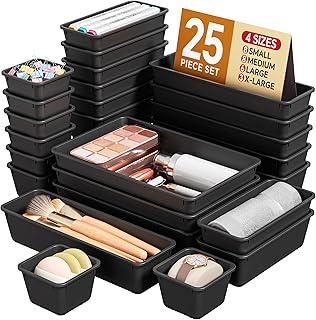
KEMETHY 25 PCS Plastic Drawer Organizers Set
If you want something that just works, KEMETHY 25 PCS Plastic Drawer Organizers Set is a safe bet (331 reviews, 4.5 stars).
10. Anchor Pinned Earrings into Upcycled Wine Corks

Loose earring backs are the bane of my existence. I lose at least three a month to the vacuum. A great way to organize post earrings is using natural wine corks. I save corks from bottles I buy at Kroger. Take the cork, lay it flat in your tray, and push the post directly into the cork. The dense material grips the post, so you don’t even need the back to keep the pair together. You can fit four pairs of studs on one cork. I line up five corks in a narrow acrylic tray. It creates a neat row. Don’t use synthetic plastic corks; they’re too dense and you’ll bend the posts. I ruined a pair of silver earrings trying to jam them into a fake cork. Stick to natural cork. It’s soft, porous, and free.
11. Utilize High-Density Ring Rolls Instead of Flat Trays

Laying rings flat is a mistake. They slide, scratch each other, and you can’t see the stones. You need high-density ring rolls. These are the wavy, foam-filled velvet channels you see in stores. I bought the WOLF 1834 Ring Insert for $22.00. It’s 7 by 6 inches and holds about thirty rings vertically. By slotting the band into the velvet, the ring stays upright. When I open my drawer, I see every ring instantly. I used a cheap knockoff before, but the foam inside was too soft. After a month, the slots stretched out and my heavy rings fell over. The WOLF rolls use high-density EVA foam that keeps its shape. If you wear rings daily, a 6×7 inch zone for rolls will save you from digging through a pile of metal.
12. Dismantle Box Packaging for Bulky Watch Storage

Watches are hard to store because of their rigid bands and thick faces. Standard 1-inch deep trays won’t close if you put a chronograph in them. I bought a wooden watch box at Costco for $39.99, but it was too tall for my vanity drawer. My solution was to unscrew the hinges, remove the glass lid, and drop the bottom half of the box into my deep drawer. It fits perfectly. The box came with six velvet pillows. Wrapping the watch around a pillow keeps the band in its natural shape, preventing leather straps from cracking. Before this, I laid watches flat in an acrylic tray. The stiff strap on my $200 Fossil watch warped and cracked because it was forced flat. Keep watches on pillows and use your deepest drawer.
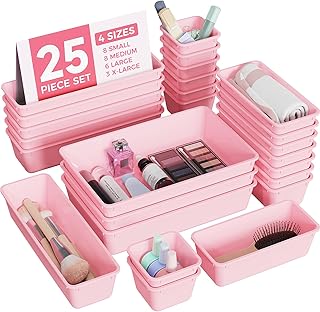
BiuLeon 25 PCS Plastic Drawer Organizers Set
A dependable everyday pick — BiuLeon 25 PCS Plastic Drawer Organizers Set pulls in 703 ratings at 4.5 stars. Not flashy, just solid.
13. Install Anti-Tarnish Strips in Every Closed Compartment

The final step is atmospheric control. Drawers trap moisture and sulfur, which tarnish silver and dull gold. I place 3M Anti-Tarnish Strips in every tray. A pack of 25 costs $6.50 on Amazon. They’re small, black squares of paper that absorb sulfides from the air. I tuck one under the ring roll, one in the necklace channel, and one under the ice cube tray. You have to replace them every six months. I set a calendar reminder. I skipped this last summer, and by October, my silver hoops needed a chemical dip to remove the black oxidation. It’s a $6 investment that saves hours of polishing. Keep the drawer closed to trap the absorption properties inside.
Organizing your jewelry isn’t a one-time aesthetic project; it’s preventative maintenance for things you spent hard-earned money on. I spent years replacing tarnished chains and lost earrings before I finally measured my drawers and bought rigid, velvet-lined compartments. If you’re tired of untangling knots at 7:00 AM, start with a purge, measure your clearance, and invest in trays that separate your metals. I recommend starting with WOLF stackable trays if your budget allows—the construction changed how my drawer functions. Pin this guide so you have the dimensions and brand names handy when you’re at Target. Trust me on this.
Frequently Asked Questions
How do I start jewelry drawer organization?
Empty the entire drawer onto a towel. Categorize everything into keep, repair, donate, and sentimental piles. Measure your drawer’s exact interior dimensions before buying any trays.
What is the best material for jewelry drawer organization?
Velvet-lined inserts are the safest option. The soft material creates friction so pieces don’t slide around, and it prevents hard metal from scratching against acrylic or plastic bins.
How do I stop necklaces from tangling in my drawer?
You must use dedicated, long compartment trays. Assign one necklace per channel. Never loop chains into circles or store multiple pendants in the same square compartment.
Does jewelry drawer organization prevent tarnishing?
Yes, if done correctly. Keep silver separated from base metals like brass to stop chemical reactions. Add 3M anti-tarnish strips to closed compartments to absorb sulfur gases.
