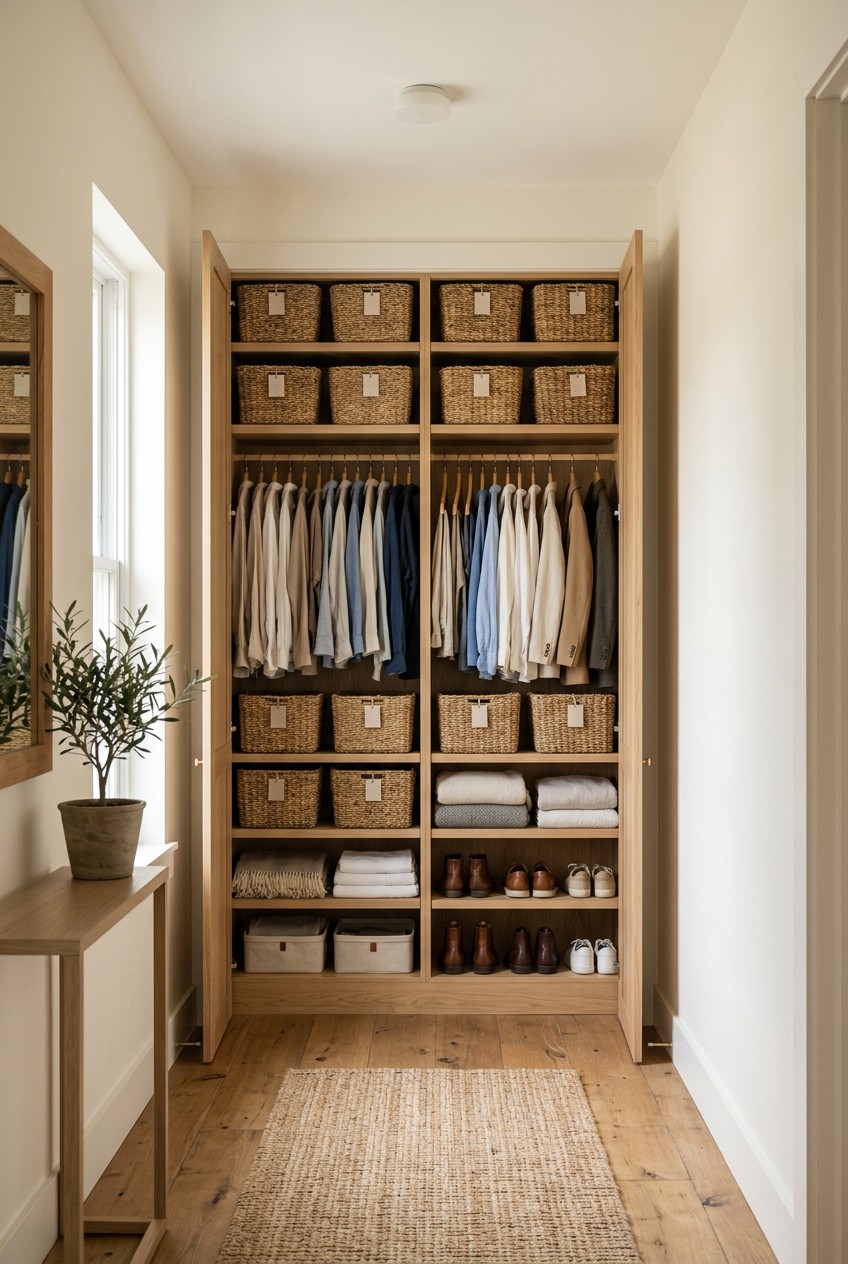
What’s Inside
- Execute a Full Decluttering Audit with the MVP Method
- Maximize Vertical Space with Adjustable Systems
- Implement Double Hanging Rods for Clothing
- Utilize Over-the-Door Organizers for Small Items
- Contain Clutter with Clear Stackable Bins
- Relocate Non-Hallway Items Out of the Space
- Embrace Smart Hallway Closet Organization Technology
- Adopt the One In, One Out Rule
- Optimize Deep Shelves with Pull-Out Drawers
- Install a Pegboard for Tools and Oddly Shaped Items
- Choose Uniform, Slim-Profile Hangers
- Create a Closet Behind Curtains for Alcoves
- Implement the 80/20 Rule for Accessibility
- Conceal Cords with a Clever Drill Hole
Last Tuesday at Whole Foods, I bought a $6.99 cinnamon-scented pinecone bag. It smelled so strong my eyes watered. When I got home, I tried to shove it onto the top shelf of my coat closet. A 12-pound Costco bulk pack of paper towels immediately fell, hitting me square on the head. That moment of minor concussion is why my massive hallway closet project started. If your setup looks like a dark, terrifying cave where winter coats go to die, you’re not alone. I’ve spent six months ripping out cheap wire shelving, testing expensive bins, and figuring out what actually works. Let’s fix that disaster zone. Here are 14 rules I swear by.
1. Execute a Full Decluttering Audit with the MVP Method

Emptying the closet completely is non-negotiable. I tried doing it wrong for months. I used to just shuffle things around on the rod. Total waste of time. You have to drag every item into the hallway. I dump everything onto my living room rug. The pile is always horrifying. Professional organizer Shaniece Jones calls her strategy the MVP approach. It stands for Mindset, Vision, and Plan. You address the emotional attachment to that $45.00 ugly puffy coat you never wear, then envision the clean space. Be brutal. If you haven’t worn it since last December, toss it.
I grabbed a box of 30-gallon Hefty trash bags from Walmart for $11.94 and started sorting. I threw out three broken umbrellas and a moldy pair of rain boots that smelled like wet dog. It’s wild how much junk we hide behind closed doors. Don’t skip this. If you buy organizers before purging, you’re just organizing your garbage. I learned that the hard way when I bought a $25.00 bamboo shoe rack from Target and realized I only had three pairs of shoes worth keeping. Save your money and do the dirty work first.
2. Maximize Vertical Space with Adjustable Systems

Builder-grade wire shelving is my enemy. It leaves massive gaps of wasted space. The first time I ripped out the single wire shelf in my entryway, the drywall crumbled everywhere. It was a dusty, chalky mess. But replacing it was worth the headache. I recommend installing an adjustable system to use every inch from floor to ceiling. I’m obsessed with Elfa wall-mounted systems from The Container Store. A basic starter kit runs about $300 to $600 depending on dimensions. It’s an investment, but the metal tracks let you move shelves as your needs change.
If you have tall ceilings, the IKEA PAX system is another fantastic option. I bought two PAX frames for $110.00 each last year for my upstairs hallway. I stacked them with sliding wire baskets for hats and gloves. The solid wood-look shelves feel much sturdier than cheap wire. Just measure your baseboards before sliding a heavy wardrobe frame into a tight nook. I scratched my freshly painted white trim pretty badly because I rushed the installation on a Sunday afternoon. Take your time and measure twice.
3. Implement Double Hanging Rods for Clothing

Most standard closets have one rod at eye level. This leaves a massive cavern of empty air near the floor. If you store short jackets or kids’ coats, you need double hanging rods. This doubles your capacity in one afternoon. I bought a heavy-duty chrome closet rod from Home Depot for $18.98 and a set of $5.48 mounting brackets. Position the top rod at 70 to 72 inches from the floor. Then, install the lower rod 35 to 40 inches below it. This spacing is perfect.
The top tier holds my long wool winter coats, and the bottom tier holds denim jackets and hoodies. Before I did this, I had a pile of shoes getting crushed under my coats. Now, nothing drags on the ground. I even bought a $12.99 adjustable tension rod from Target to test the height before drilling holes. It’s a great temporary hack if you’re renting. Just don’t overload a tension rod with heavy leather jackets. I did that once and it crashed down at night. It sounded like a gunshot and scared my dog to death.
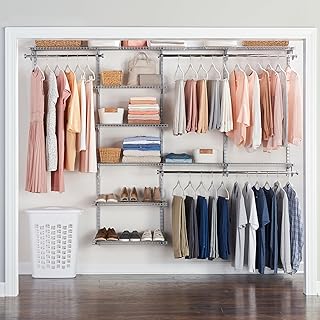
Rubbermaid Configurations Deluxe Custom Closet Kit 4-8 Ft.
Honestly, Rubbermaid Configurations Deluxe Custom Closet Kit 4-8 Ft. Adjustable surprised me — sturdier than it looks in the photos, and over 81 buyers gave it 4.5 stars.
4. Utilize Over-the-Door Organizers for Small Items

The back of your closet door is wasted real estate. Leaving it blank is a rookie mistake. I used to throw my winter gloves into a random cardboard box. I could never find a matching pair when it snowed. Installing an over-the-door organizer fixed this. I bought an Elfa Utility Door and Wall Rack for about $140.00. It clamps onto the door without any drilling. The metal baskets are perfect for 4 oz bottles of dog shampoo, leashes, and my collection of wrinkled canvas tote bags.
If you’re on a budget, a standard metal shoe organizer works wonders. You can find them at Walmart or Target for between $20.00 and $40.00. They usually hold up to 24 pairs of shoes. I use a $22.99 Whitmor clear pocket organizer from Amazon for cleaning supplies. I slide a 16 oz bottle of Windex in one pocket and a roll of garbage bags in another. Just make sure your closet door has enough clearance. I bought a chunky wooden rack once that was too thick. The door wouldn’t shut, and I had to drive back to the store to return it.
5. Contain Clutter with Clear Stackable Bins

I hate opaque storage bins. I bought six dark grey plastic totes from Target a few years ago. I thought they looked sleek. Two months later, I forgot what was inside them. I had to pull down heavy boxes and pop off stiff plastic lids just to find a roll of packing tape. It was infuriating. Switch to clear, stackable bins. You need to see your stuff. I swear by the OXO Good Grips POP containers. The BPA-free plastic is durable and crystal clear. You might also like: 15 Inspiring Small Space Laundry Room Ideas to Steal Right Now
A 2.7 Qt container costs around $15.00 to $20.00. I use these for small, annoying items. One bin holds a tangle of phone chargers. Another holds three 2-inch rolls of masking tape and a handful of dried-out Sharpies. Because they’re square, they stack flush against each other. No wasted gaps. If you must use opaque baskets, you have to label them. I bought a Brother P-Touch label maker for $34.99 at Staples. I print out bold, black-on-white labels for everything. Skip the cute handwritten chalkboard tags. They smear the second you touch them with wet hands. I learned that after grabbing a towel post-shower. You might also like: 20 Creative DIY Garage Organization Ideas That Changed Everything
6. Relocate Non-Hallway Items Out of the Space

Stop treating this space like a dumpster for random household junk. This is the most common mistake I see. A hallway closet is meant for coats, shoes, and maybe a vacuum. It’s not an attic. Last month, I was putting away groceries from Kroger. I had a heavy gallon of milk in one hand and tried to shove a 12-pack of paper towels onto a shelf. I knocked over a giant box of my high school yearbooks. Why were my yearbooks sitting next to the Swiffer pads? It made zero sense. You might also like: 15 Stunning Home Storage Ideas to Transform Your Space
You have to relocate items that belong elsewhere. Take your heavy luggage to the basement. Move your taxes and important documents into a desk drawer or a fireproof safe. I spent a Saturday moving my bulk cleaning supplies. I took three 32 oz bottles of bleach and a box of dishwasher pods to the laundry room. Suddenly, my closet felt twice as big. Keep only what you need when you’re walking out the front door. If an item doesn’t serve a purpose for your daily routine, get it out of there.

AMKUFO 6 Pack-Closet-Organizers-and-Storage
Honestly, AMKUFO 6 Pack-Closet-Organizers-and-Storage surprised me — sturdier than it looks in the photos, and over 52 buyers gave it 4.5 stars.
7. Embrace Smart Hallway Closet Organization Technology

We’re moving into a new era of home storage. Smart tech is a big trend for 2026, and I’m here for it. My closet used to be a dark, miserable cave. I couldn’t tell my navy blue coats from my black ones. I’d leave the house wearing mismatched shoes. I finally bought a set of EZVALO motion-sensor LED light bars from Amazon for $39.99. They stick under the shelving with magnets.
Every time I open the door, the light clicks on. It feels like a boutique. You don’t even need to hardwire anything. They pop off so you can charge them with a USB-C cable. If you want to get advanced, some custom closet companies are rolling out climate-controlled cabinets to protect leather jackets from humidity. There are even RFID tag systems for inventory if you have a massive wardrobe. I’m not at the RFID level yet. But automatic lighting is the cheapest, fastest way to make your closet feel expensive. Don’t buy the cheap battery-operated push lights. They drain AA batteries in a week and the light is a depressing, dim yellow.
8. Adopt the One In, One Out Rule

You can buy all the expensive acrylic bins you want, but if you constantly buy new stuff, your closet will explode again. You have to adopt the one in, one out rule. It’s exactly what it sounds like. If you buy a new winter coat, an old one has to leave. I used to be a hoarder with scarves. I’d go to Sprouts Farmers Market for apples and leave with a $15.00 knit infinity scarf. My shelf was overflowing with cheap, itchy knits.
The day I implemented this rule, my hoarding stopped. Last week, I bought a gorgeous waterproof trench coat from REI for $149.00. Before I cut the tags off, I forced myself to pull an old, faded windbreaker out of the closet for my donation bag. This simple habit maintains the physical balance of your storage. It forces you to be mindful about what you purchase. If you aren’t willing to part with an old item, you probably don’t love the new one enough to buy it. It’s a harsh reality check, but it works to keep the clutter away.
9. Optimize Deep Shelves with Pull-Out Drawers

Deep shelves are a curse. Sure, they hold a lot. But anything pushed to the back is dead to me. I used to lose my favorite gloves in the abyss of a 24-inch deep top shelf. I’d find them in July covered in dust. The solution is pull-out drawers or sliding tracks. This lets you access the back without knocking over everything in the front.
I installed a ClosetMaid SuiteSymphony starter kit in my guest hallway. It cost me $160.00 at Home Depot. The white wooden drawers glide out on metal runners. I fill the bottom drawer with heavy items like a 10-pound bag of dog food. I fill the top drawer with loose items like car keys and sunglasses. Everything is visible. Everything is reachable. If you can’t afford a full wooden system, you can fake it. I bought three narrow plastic bins from The Container Store for $12.99 each. I slide them onto the shelf like makeshift drawers. Just pull the whole bin out by the handle to see what’s hiding in the back.

5 Tier Closet Hanging Organizer
5 Tier Closet Hanging Organizer has been one of the most consistently praised picks in this category. 1 reviewers averaged 4.5/5.
10. Install a Pegboard for Tools and Oddly Shaped Items

You probably have a weird, blank wall on the side of your closet. Don’t ignore it. I turned the left interior wall of my coat closet into a mini hardware station. I bought a 24 by 48-inch white pegboard from Lowe’s for $22.48. I screwed it into the studs. It’s the perfect place to hang items that refuse to sit in a basket. I have a hammer, a tape measure, and a lint roller hanging on hooks. I even hang my dog’s muddy leash there so it doesn’t touch my coats.
If you’re terrified of drilling holes, use heavy-duty adhesive hooks. I buy jumbo 3M Command Hooks from Target. A two-pack costs around $9.89. The jumbo size can hold up to 7.5 pounds. I stuck two on the back wall to hold my canvas grocery totes and a large golf umbrella. Just clean the wall with rubbing alcohol first. I skipped the alcohol once, hung a heavy wet raincoat, and the hook ripped off the wall three hours later, taking a chunk of paint with it.
11. Choose Uniform, Slim-Profile Hangers

The fastest way to make a closet look like a messy thrift store is keeping a mix of plastic, wire, and wooden hangers. I used to have thick plastic tubes mixed with those flimsy wire hangers from the dry cleaner. My clothes were constantly slipping off onto the floor. Upgrading to uniform hangers is a massive visual improvement. I threw my mismatched plastic away and bought two 50-packs of black velvet non-slip hangers from Costco. They were $14.99 per box.
The velvet texture grips the fabric, so my wide-neck wool sweaters never fall. More importantly, they have a slim profile. They’re only a quarter-inch thick. Switching to these thin hangers freed up thirty percent more space on my rod. My coats aren’t crushed anymore. I can slide them back and forth with ease. One warning: don’t hang a soaking wet rain jacket on a cheap black velvet hanger. The dye can bleed onto light fabrics. I ruined a $60.00 white cardigan that way last spring.
12. Create a Closet Behind Curtains for Alcoves

Not every hallway has a framed-in closet with a solid door. My sister’s apartment has this awkward, deep alcove by her front door. It was just a weird empty rectangle of drywall. She used to dump her snowy boots in a puddle on the floor. It looked terrible. We fixed it by creating a faux closet using a heavy curtain. We installed a basic white metal hanging rail from IKEA across the top.
Then, we drilled a heavy-duty tension curtain rod across the opening. We bought a thick, textured linen curtain panel from Target for $35.00. The natural fabric adds a soft texture to the hallway. When company comes over, she just pulls the curtain shut. All the messy coats and boots disappear. It provides hidden storage without the expense of hiring a contractor for a door. You can even mount a floating shelf above the rod for extra storage bins. Just make sure you buy a curtain long enough to kiss the floor. We originally bought a 63-inch panel and it looked ridiculous. We had to go back and exchange it for the 84-inch length.

AWTATOS Cube Storage Organizer Storage 12 Cube Bookshelf
If you want something that just works, AWTATOS Cube Storage Organizer Storage 12 Cube Bookshelf DIY Plastic C is a safe bet (28 reviews, 4.5 stars).
13. Implement the 80/20 Rule for Accessibility

Professional organizers love the 80/20 rule. It means you wear 20 percent of your wardrobe about 80 percent of the time. This logic applies to your hallway storage. You need to keep your most used items in the strike zone. The strike zone is the area between your shoulders and your knees. I used to keep my daily dog-walking sneakers on the top shelf. I had to stand on my tiptoes to grab them twice a day. It was incredibly annoying.
Meanwhile, my heavy snow boots that I wear maybe three times a year were sitting on the floor. I flipped my layout. Now, my denim jacket and everyday sneakers are front and center. I packed my heavy winter snow gear into a $16.99 Sterilite plastic tote from Walmart and shoved it onto the highest shelf. I only need a step stool to reach it once a year. Stop letting seasonal junk block your access to the things you use every morning. Your routine will feel smoother when you aren’t fighting past a giant puffy coat in July.
14. Conceal Cords with a Clever Drill Hole

I love my cordless Dyson stick vacuum. I hate the ugly grey charging cord. I used to plug it into the hallway outlet and run the wire under the closet door. It looked sloppy. It was a tripping hazard. I fixed this by getting out my power drill. If you store rechargeable electronics, you need to hide the cables. I used a 1.5-inch hole saw drill bit. I bought it at Home Depot for about $14.97.
I drilled a discreet hole in the back corner of the bottom wooden shelf. I routed the vacuum charger cord through the hole, behind the shelving unit, and straight into the wall outlet hidden near the baseboard. It completely conceals the messy cords. The space looks cleaner and intentional. You can use this trick for charging flashlights, power tools, or even a small speaker. Just be careful when drilling through the back of a cabinet or into drywall. I recommend using a $25.00 Zircon stud finder first. You don’t want to accidentally drill through a live electrical wire or a pipe. Take your time and measure twice before you pull the trigger.
I can’t believe I lived with a chaotic entryway for so many years. Taking the time to properly implement these smart closet systems changed how my house functions. I’m no longer dodging falling paper towel rolls or digging through dusty bins for a missing glove. Start small. Grab a trash bag this weekend and tackle the decluttering phase first. You’ll feel a weight lift off your shoulders once the junk is gone. If you found these tips helpful, pin this article to your favorite Pinterest home board so you can reference the exact measurements and product prices later. Let’s get organizing!
Frequently Asked Questions
How do I start my hallway closet organization?
Always start by completely emptying the closet. Sort every item into keep, donate, and discard piles using the MVP method. Don’t buy any storage bins or adjustable shelving systems until you’ve ruthlessly purged items you no longer wear or use.
What is the best way to maximize vertical closet space?
Install an adjustable wall-mounted system or use double hanging rods. Place the top rod at 70-72 inches and the lower rod 35-40 inches below it. This instantly doubles your hanging capacity for shorter jackets and shirts.
How should I store small items in a hallway closet?
Utilize the back of the closet door with an over-the-door organizer for gloves, hats, and umbrellas. For shelf storage, use clear, stackable plastic bins so you can easily see the contents without having to open opaque boxes.
What is the 80/20 rule in closet organization?
The 80/20 rule suggests you use 20% of your items 80% of the time. Keep these frequently used items front and center at eye level. Store seasonal or rarely used items in bins on the highest shelves.
