
What’s Inside
- Start Your Closet Organization DIY With A Ruthless Declutter
- Standardize Your Hangers For Space And Aesthetics
- Maximize Vertical Space With Double-Hang Rods
- Implement Smart Drawer Dividers For Small Items
- Adopt File Folding For Efficient Shelf Storage
- Utilize Clear, Stackable Shoe Boxes
- Illuminate Dark Corners With Battery-Operated Lighting
- Label Everything For Sustainable Maintenance
- Build Out Modular Closet Systems
- Rotate Seasonal Clothing In Clear Bins
- Upgrade To Sustainable Materials For Your Closet Organization DIY
- Create Dedicated Accessory Zones And Mini-Declutters
Last Tuesday at Target, I found myself staring at a wall of plastic storage bins while my toddler threw Goldfish crackers onto the linoleum floor. I was attempting a massive closet organization DIY, convinced that buying $150 worth of acrylic boxes would magically fix my overflowing 4×6 foot reach-in closet. It didn’t. I spent that entire weekend shoving rigid plastic bins into spaces they didn’t fit, scraping the white paint off my baseboards in the process. True organization isn’t about buying containers to hide your mess. After three years of coaching clients through small space disasters, I’ve learned what actually functions in a real home. Trust me on this.
Most people approach small closets completely backward. They buy the storage solution first, then try to cram their existing chaos into it. I tried this wrong for months before figuring it out. You end up with a closet that looks like a container store exploded, but you still can’t find your favorite black sweater when you’re rushing to work at 7 AM. The reality of a small closet is that every single square inch matters. You can’t afford dead space, and you certainly can’t afford storage solutions that require a manual to use.
If you’re dealing with a tiny reach-in closet, a cramped apartment wardrobe, or a primary closet that forces you to store winter coats under your bed, you need methodical, structural changes. You need systems that hold up to daily use, not just systems that look good on a screen. Here are twelve methods that actually make sense for tight spaces, complete with the exact measurements, specific products, and hard truths I’ve learned along the way.
1. Start Your Closet Organization DIY With A Ruthless Declutter

Before you buy a single basket, you have to empty the closet completely. I don’t mean shifting things to one side; I mean physically removing every item until you’re staring at bare walls. Professional organizers emphasize that buying a bin won’t automatically organize your closet. Adding bulky plastic containers to a crowded space just adds more visual and physical clutter. I learned that the hard way when I tried organizing my husband’s side of the closet without throwing anything away. We just ended up with neatly stacked piles of clothes he never wore.
When you pull everything out, you expose the dust bunnies, the stray dry-cleaning tags, and the sheer volume of fabric you own. I recommend grabbing a box of Hefty Ultra Strong 33-gallon trash bags (they run about $14.29 at Costco) because you’re going to need them for donations and trash. Create three distinct zones on your bedroom floor: keep, donate, and trash. If you haven’t worn a piece in the last 6 to 12 months, it goes in the donate pile. Be honest with yourself about the clothes you’re keeping for a fantasy version of your life.
The physical act of handling each item forces you to confront your buying habits. You’ll notice the heavy, dragging feeling of pulling out coats you haven’t touched since 2019. The smell of stale dust on the shoulders of forgotten blazers is usually enough to motivate a serious purge. Don’t skip this step. A small space can’t function if it’s acting as a graveyard for clothes that no longer fit your body or your lifestyle.
2. Standardize Your Hangers For Space And Aesthetics

The fastest way to make a small closet look chaotic is a mishmash of thick plastic tubular hangers, wire dry-cleaning hangers, and wooden coat hangers. Standardizing your hangers instantly creates a cohesive look and reclaims valuable horizontal rod space. A standard plastic hanger is about 1/3 of an inch thick. Over the span of 100 garments, that bulk adds up, stealing almost 8 inches of hanging space. In a 48-inch wide closet, that’s a massive loss.
For years, everyone pushed velvet slimline hangers. I bought into the hype, but I have a strong opinion here: skip the cheap velvet ones for heavy items. I’ve had countless velvet hangers snap right at the neck under the weight of a winter coat, leaving a sharp, jagged plastic edge. Instead, for a sustainable approach, I use IKEA HÖSVANS bamboo hangers. They cost $6.99 for a 5-pack. They have a smooth, blonde wood finish that doesn’t snag delicate fabrics, and the metal hook is incredibly sturdy.
If you’re hanging lightweight blouses and t-shirts, you can still use velvet to prevent slipping, but keep the bamboo for jackets, jeans, and heavy sweaters. Bamboo options typically range from $2.60 to $8.11 per hanger depending on where you shop, but the IKEA ones are the most cost-effective I’ve found. The sound of solid wood sliding across a metal rod is also significantly less irritating than the cheap squeak of plastic.
3. Maximize Vertical Space With Double-Hang Rods

The most common mistake I see in small closets is a single rod installed at eye level, leaving three feet of empty air near the floor. Unless you exclusively wear floor-length ballgowns, you’re wasting half your closet. Installing a second hanging rod is the single most effective way to double your capacity for shorter items like shirts, blazers, and folded pants.
You don’t need a custom contractor for this. You can buy a ClosetMaid adjustable add-on rod for about $16.98 at Walmart. It literally hooks onto your existing top rod and hangs down, requiring zero tools or drywall anchors. However, if you’re permanently installing a second rod into the wall, you need specific measurements. You typically want to leave exactly 40 to 42 inches of clearance between the top rod and the bottom rod. This accommodates an average adult men’s button-down shirt without the hem dragging on the rod below it.
When I installed my permanent lower rod, I didn’t measure my longest shirts first. I ended up with my husband’s dress shirts bunching at the bottom, wrinkling the tails. I had to unscrew the brackets, patch the drywall, and move the rod down two inches. Measure your actual clothes before drilling. The bottom rod should sit at least 36 inches off the floor to give you room for shoes underneath.
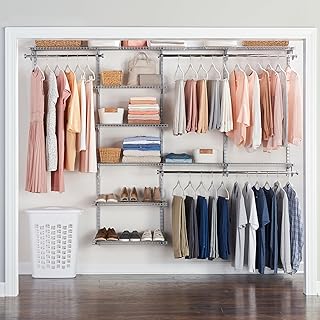
Rubbermaid Configurations Deluxe Custom Closet Kit 4-8 Ft.
Rubbermaid Configurations Deluxe Custom Closet Kit 4-8 Ft. Adjustable has been one of the most consistently praised picks in this category. 81 reviewers averaged 4.5/5.
4. Implement Smart Drawer Dividers For Small Items

If your closet has built-in drawers, or if you’re using a dresser inside the closet, adjustable dividers are mandatory. Without them, smaller items like socks, underwear, and belts turn into a tangled knot within three days of doing laundry. I used to just toss my socks into a drawer, and I’d spend five minutes every morning digging for a matching pair. You might also like: 12 Small Home Organization for Every Budget
I highly recommend the mDesign expandable drawer dividers. A 4-pack costs around $20.99. They have a strong tension spring inside and rubber pads on the ends, so you just compress them, slide them into the drawer, and let go. They grip the sides tightly without scratching the wood. For softer, smaller containment, fabric drawer organizers are excellent. The IKEA SKUBB series is my go-to. You can get a set of six different-sized boxes for $5.99. They fold flat when you aren’t using them, which is a nice bonus.
One trick I use to keep these drawers smelling fresh is tossing in a cotton ball with a few drops of essential oil. I usually pick up a small bottle of lavender or cedarwood oil from Sprouts for about $7.99. It keeps the closed drawers from getting that stale, trapped-air smell. Just make sure the oil doesn’t directly touch your delicate fabrics, or it will leave a grease stain. You might also like: 14 Aesthetic Closet Organization Ideas That Actually Work
5. Adopt File Folding For Efficient Shelf Storage

Stacking clothes on top of each other is a recipe for disaster in a small closet. When you want the t-shirt at the bottom of the pile, you have to lift the top five shirts, and inevitably, the whole stack topples over. Instead, you need to adopt the file-folding method. This involves folding garments into tight rectangles and standing them upright, like files in a cabinet. You might also like: 15 Stunning Organizing Kitchen Home Hacks Ideas You Haven’t Thought Of
I file-fold my t-shirts, workout leggings, and even my heavy denim jeans. When you file-fold jeans, you want the final rectangle to be roughly 6×8 inches. This allows them to stand up perfectly on a standard 12-inch deep closet shelf or inside a drawer. You can see the waistband and color of every single pair at a glance. It completely eliminates the friction of getting dressed in the morning.
I’ll admit, the physical act of folding takes a bit longer on laundry day. You have to smooth out the fabric, fold the sleeves in just right, and create that structural base. But the time you save during the week is worth it. Plus, file-folding allows you to fit nearly 30% more clothing into the same drawer space because you’re compressing the air out of the fabric.
6. Utilize Clear, Stackable Shoe Boxes

Shoes are notoriously difficult to store in small closets. They track in dirt, they smell, and they come in awkward, non-uniform shapes. Leaving them in a pile on the floor means they get crushed, dusty, and scuffed. The best solution I’ve found is using clear, stackable plastic shoe boxes.
I use the SONGMICS clear shoe boxes; a 12-pack runs between $36.99 and $39.99. They require a little bit of assembly—you have to snap the plastic tabs together—but once built, they are incredibly rigid. The crucial feature you need to look for is a magnetic drop-front door. This allows you to stack the boxes up to the ceiling and still pull out a pair of sneakers from the bottom row without unstacking everything above it. If you have larger feet, standard boxes won’t work. Kicks & Co makes XL clear plastic boxes that fit up to a US men’s size 13, costing $12.88 for a 2-pack.
A small negative: the clear acrylic can get scratched up and look cloudy after a year or two of heavy use, especially if you’re tossing boots with metal buckles inside. But the protection they offer your footwear is unmatched. I no longer have to dust the tops of my suede boots, and the closet doesn’t smell like old leather and damp rubber.

AWTATOS Cube Storage Organizer Storage 12 Cube Bookshelf
A dependable everyday pick — AWTATOS Cube Storage Organizer Storage 12 Cube Bookshelf DIY Plastic C pulls in 28 ratings at 4.5 stars. Not flashy, just solid.
7. Illuminate Dark Corners With Battery-Operated Lighting

Good lighting is a huge help, and for good reason. A small closet is usually a dark box. If you can’t see your clothes, you won’t wear them. Hardwiring a new light fixture is expensive and often impossible in rentals. Battery-operated lighting is the workaround.
I install battery-operated LED puck lights under the bottom of my shelves to illuminate the hanging rods below. GE Touch-Activated LED Puck Lights cost about $19.98 for a 3-pack and provide a clean, bright white light. If you want something cheaper, Brilliant Evolution Wireless LED Puck Lights start at $4.97 for a 2-pack. They usually come with double-sided adhesive tape for installation.
Here’s an honest warning: the adhesive tape that comes with these lights often fails, especially if your closet gets humid or hot during the summer. I’ve been woken up at 2 AM by the sharp crack of a plastic puck light falling off the ceiling and hitting the floor. I highly recommend using the small mounting screws that come in the package instead of relying on the sticky tape. It takes two extra minutes with a screwdriver, but they won’t fall on your head.
8. Label Everything For Sustainable Maintenance

Professional organizer Kim Longoria-Bruce states that labels help you maintain the space. She’s entirely right. When you’re the only one who knows that the gray fabric bin holds winter scarves, your family will inevitably throw random junk into it. Labeling creates a visual boundary that stops clutter from migrating.
I use a label maker for bins, shelf edges, and the inside lips of drawers. The NIIMBOT D11 label maker is fantastic. It costs around $23.99, connects to your phone via Bluetooth, and uses thermal paper, so you never have to buy ink. You can choose different fonts and borders right from the app. The Brother P-Touch PT70BM is another reliable, old-school option for about $25 if you don’t want to mess with a phone app.
One annoyance with the NIIMBOT is that the Bluetooth connection occasionally drops if your phone is low on battery, which is frustrating when you’re in the middle of a labeling spree. Also, standard label tape doesn’t stick well to fabric bins. If you’re labeling canvas or recycled fabric cubes, you’ll need to buy metal label clips that slide over the edge of the bin, and then stick your printed label onto the smooth metal surface.
9. Build Out Modular Closet Systems

The era of a single wooden shelf with a wooden rod is over. If you want to truly maximize a small space, you need a modular system that can adapt as your wardrobe changes. Systems like IKEA PAX or the Elfa system from The Container Store allow you to customize the layout down to the millimeter.
Modular systems feature heavy metal tracks that mount directly to the wall studs. From there, you hang brackets that support adjustable shelving, pull-out mesh drawers, and hanging rods. I installed an Elfa system in my primary closet, and the heavy metal components are incredibly durable. You can move a shelf up two inches in a matter of seconds without any tools.
The downside is the cost and the initial labor. A basic modular setup can quickly run over $300. You also have to be precise with your measurements and ensure you’re drilling into studs, or the entire system will rip out of the drywall under the weight of your winter coats. But the flexibility is unmatched. When I transitioned from an office job to working from home, I easily swapped a section of hanging rods for more pull-out drawers to hold my expanded collection of sweatpants.

Kmiectse Clear Storage Bins with Lids
Honestly, Kmiectse Clear Storage Bins with Lids – 4 Tier Plastic Bins with Wheel surprised me — sturdier than it looks in the photos, and over 2 buyers gave it 4.5 stars.
10. Rotate Seasonal Clothing In Clear Bins

You can’t keep heavy wool winter coats and flimsy summer sundresses in a small closet at the same time. You just don’t have the square footage. Rotating your seasonal clothing is non-negotiable. I store my off-season items on the very top shelf of my closet or under my bed in clear, lidded storage bins.
I use Sterilite 66-quart clear latching boxes. They cost about $11.98 at Target. The clear plastic is vital because you need to see what’s inside without pulling the heavy bin down and snapping off the lid. Never use opaque cardboard boxes; they attract pests like silverfish, and you’ll forget what’s inside them.
Before you pack anything away, you must wash and thoroughly dry every single garment. If you pack a sweater that has a tiny, invisible drop of oil from a salad dressing, that stain will oxidize and turn dark brown over the next six months. Furthermore, if clothes are even slightly damp from the dryer, they will grow mildew in a sealed plastic bin. I usually throw a few cedar block shavings (I reuse the brown paper bags from Whole Foods to hold the loose shavings) into the bins to repel moths and keep things smelling fresh.
11. Upgrade To Sustainable Materials For Your Closet Organization DIY

Eco-conscious design is taking over home organization. We’re moving away from buying dozens of brittle plastic bins that eventually crack and end up in a landfill. Replacing plastic with natural materials like bamboo, recycled fabric, water hyacinth, or seagrass adds a beautiful, warm texture to your closet.
I use recycled fabric storage cubes from 3 Sprouts for my bulky sweaters. They cost between $16.99 and $17.99 each and hold their shape remarkably well. They look much softer and more natural than rigid plastic. I also tried using woven seagrass baskets for a while because they look gorgeous on a shelf.
However, here is a major warning about natural woven materials: they are rough. The stiff fibers of a water hyacinth or seagrass basket will absolutely snag delicate fabrics. I ruined a $60 silk camisole because it caught on the rough interior of a woven bin. If you’re going to use natural woven baskets, you must line them with a smooth cotton cloth first, or only use them to store tough items like denim jeans or thick cotton sweatshirts.
12. Create Dedicated Accessory Zones And Mini-Declutters

Accessories are the silent killers of a clean closet. Belts, scarves, necklaces, and hats usually end up tossed on a shelf or shoved into a random drawer, creating a tangled mess. You need to give them a designated home. I utilize the dead space on the inside of my closet door.
I buy packs of Command wire hooks (about $4.29 for a multi-pack at Kroger) and stick them in a row on the inside of the door. I hang my necklaces and thin belts directly on these hooks. It keeps them separated and visible. For scarves, I use a specialized hanger with multiple rings that holds about 15 scarves in the space of one coat.
To keep all of this maintained, professional organizers recommend scheduling regular “mini-declutters.” Don’t wait for an annual spring cleaning purge. Dedicate 15 to 30 minutes on the first Sunday of every month to quickly scan your closet. Pull out the dry-cleaning plastic, re-fold the jeans that got sloppy, and remove anything you know you aren’t going to wear. If you want to take it a step further, digital wardrobe apps like Whering (which has a free tier with sustainability tracking) let you catalog your clothes on your phone. It sounds tedious, but it actually stops you from buying duplicate items when you’re out shopping. Took me years to figure out.
Tackling a small space doesn’t require a massive budget, just a methodical approach and a willingness to stop hoarding things you don’t wear. Start with the ruthless declutter, upgrade your hangers, and utilize your vertical space. If you implement even half of these strategies, your mornings will be significantly less stressful. Pin this guide so you have the exact product dimensions handy the next time you’re standing in the storage aisle, and let me know which step you’re tackling first.

SNSLXH 5 Pack Stackable Closet Storage Basket
SNSLXH 5 Pack Stackable Closet Storage Basket has been one of the most consistently praised picks in this category. 4 reviewers averaged 4.5/5.
Frequently Asked Questions
How do I start a closet organization DIY?
Begin by completely emptying your closet. Sort every item into keep, donate, and trash piles. Do not buy storage bins until you know exactly what inventory you are keeping, as containers often add unnecessary clutter.
What are the best hangers for small closets?
Slimline hangers are essential for saving space. Bamboo hangers offer durability for heavy coats without snapping, while velvet hangers prevent lightweight blouses from slipping. Standardizing your hangers instantly makes the space look cohesive.
How much space do I need for double-hang closet rods?
You generally need 40 to 42 inches of vertical clearance between the top and bottom rods. This provides enough room for standard adult shirts and folded pants to hang without dragging on the rod below.
How should I store shoes in a small closet?
Clear, stackable plastic shoe boxes with magnetic drop-front doors are ideal. They protect your footwear from dust and crushing while allowing you to access bottom pairs without unstacking the entire tower.
