What’s Inside
- Start with a Ruthless Declutter: The “Whatever Fits” Rule
- Invest in Slim, Non-Slip Hangers for Maximum Space
- Maximize Vertical Space with Adjustable Shelving and Double Rods
- Utilize the Back of the Door with Multi-Pocket Organizers
- Contain Small Accessories in Clear Bins on Upper Shelves
- Implement a “Boutique-Style” Shoe Wall with Graduated Shelving
- Install Motion-Activated LED Lighting
- Use Shelf Dividers to Maintain Order on Folded Items
- Brilliant Coat Closet Organization Ideas for Family Zones
- Utilize Command Hooks for Quick Access and Damage-Free Hanging
- Incorporate Pull-Out Drawers or Fabric Bins for Lower Storage
- The “Two-Foot Rule” for Shelf Overstuffing
- Store Out-of-Season Items Elsewhere (or High Up)
- Maintain a “Drop Zone” for Daily Essentials
- Surprising Tip: Wallpaper the Back Wall for Motivation
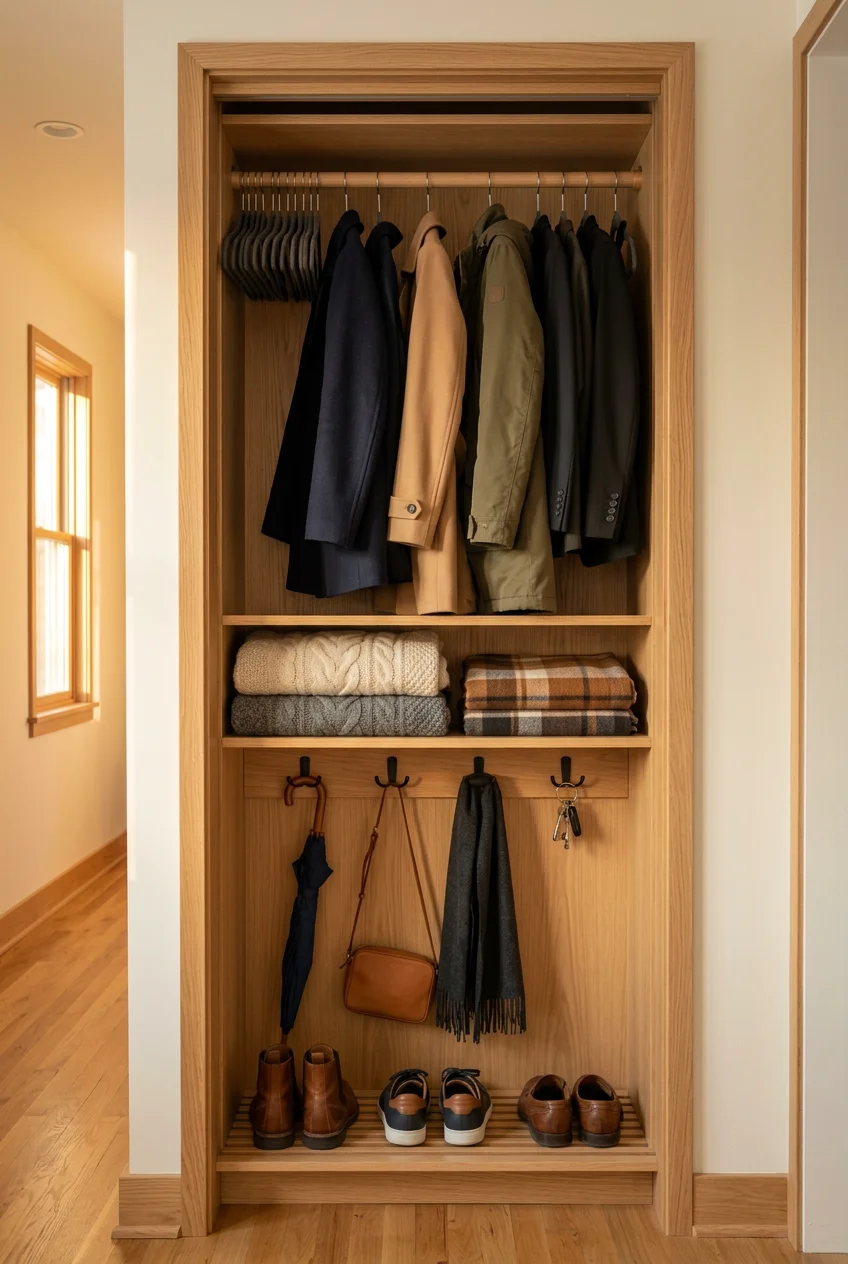
Last Tuesday, I stood in my hallway holding three soggy paper grocery bags from Trader Joe’s while staring at a literal wall of winter coats that had just avalanched out of my closet. I tried to shove a heavy wool trench back inside, but the door bounced off a rogue rain boot and smacked me in the shoulder. That specific bruise is exactly why I started researching coat closet organization ideas for small spaces. Most people think you just need a bigger house. You don’t. You need a better system. The truth is, searching for coat closet organization ideas won’t fix anything if you’re just buying more plastic bins to hide your mess. I spent two years cramming puffy jackets into a space the size of a phone booth before I finally realized my strategy was wrong. It smelled like damp dog and stale cedar in there. Let’s fix your space so you actually want to open that door. I’ve tested countless methods, wasted money on flimsy products, and finally figured out what works (learned that the hard way, trust me).
1. Start with a Ruthless Declutter: The “Whatever Fits” Rule

Professional organizer D’Nai Walker advises keeping only what fits comfortably in your space. I used to ignore this. I kept four identical black peacoats for five years because I was convinced I’d need backups. I didn’t. They just sat there collecting dust and making the closet smell like old, wet wool. Before you buy a single bin or basket, you have to pull every item out. Yes, even the broken umbrellas shoved in the back. Sort everything into keep, donate, trash, or relocate piles. If you skip this step, you’re just reorganizing your garbage. Overstuffing is why clothes get wrinkled and zippers get damaged. I learned this the hard way when I pulled out my favorite waterproof jacket last November and found a permanent, unfixable crease down the front because it was crushed against a bulky vacuum cleaner. It’s a common mistake. You have to be ruthless. If a coat is missing buttons, and you haven’t fixed it in six months, it goes in the trash bag. If your winter boots are pinching your toes, donate them. Your coat closet isn’t a time capsule. It’s an active, daily storage space. Once I applied Walker’s rule, I immediately had thirty percent more breathing room. The visual relief alone is worth the hour it takes to sort through the pile. You can’t organize clutter. You can only eliminate it.
2. Invest in Slim, Non-Slip Hangers for Maximum Space

Throw away those thick wooden hangers. They look nice in fancy hotels, but they steal inches of horizontal space you simply don’t have. Upgrading to uniform, slim, non-slip hangers is the fastest way to double your hanging capacity. I bought the Neat Method Everyday Hangers. They cost $38 for a 25-pack. They’re only 0.25 inches thick and feature a rubberized coating. This matters because heavy winter coats actually stay on them. I used to pick my slick puffer jackets off the floor three times a week before I switched. If you’re on a tighter budget, the Amazon Basics Slim Velvet Non-Slip Clothes Hangers are a solid alternative. You can usually grab a 30-pack for $16.99. They hold delicate items like silk scarves perfectly. There’s a tradeoff. Velvet hangers attract lint and pet hair like a magnet. I have to run a sticky lint roller over the shoulders of my black coats once a month. It’s annoying, but the space I save makes it worth the hassle. I bought my first set at Target last year, and the visual difference of having all matching black hangers instantly made the closet look customized. Stop mixing wire dry-cleaning hangers with bulky plastic ones. The mismatched heights cause the shoulders of your coats to bunch up and wrinkle.
3. Maximize Vertical Space with Adjustable Shelving and Double Rods

Look up. You’re probably wasting at least three feet of empty air above your coats. Installing adjustable shelving is a popular trend for flex closets, and it allows you to change the layout when winter ends. I spent a Saturday morning installing a simple double-hang rod system. You can buy a basic metal closet doubler at Walmart for $14.88. It hooks right onto your existing rod and drops a second bar about 35 inches lower. This lets you hang short jackets on the top rod and pants or skirts on the bottom. It doubles your capacity without requiring power tools. I tried a cheap tension rod first, but it collapsed under the weight of three denim jackets and chipped my baseboard. Don’t make that mistake. Buy the actual hanging rod doubler. The only negative is that floor-length coats won’t fit on a double rod system. You have to leave one section of your closet with a single high rod for long trenches and maxi dresses. I dedicated roughly 18 inches of rod space on the far left side just for my long winter coats. The rest is double-hung. This completely altered how I store my clothes. It feels like I built an addition onto my hallway for less than twenty bucks.
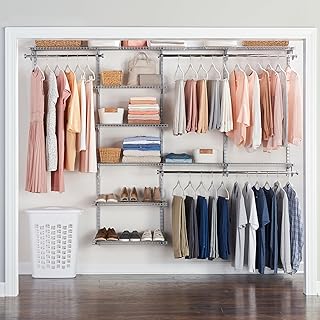
Rubbermaid Configurations Deluxe Custom Closet Kit 4-8 Ft.
Rubbermaid Configurations Deluxe Custom Closet Kit 4-8 Ft. Adjustable punches above its price — 81 buyers rated it 4.5 stars. I would buy it again.
4. Utilize the Back of the Door with Multi-Pocket Organizers

The back of your closet door is prime real estate that usually sits empty. Hanging an over-the-door organizer solves the nightmare of lost gloves and tangled scarves. I use the Homelux Theory Over The Door Organizer. It has a wide 2-column design with 6 multi-depth front pockets and 12 extra mesh side compartments. It holds up to 65 lbs of heavy gear. I keep umbrellas, dog leashes, and thick winter gloves in mine. If you want something cheaper, the KEETDY Over the Door Organizer has five deep mesh pockets and costs about $16 on Amazon. I actually bought one while standing in line at Sprouts, just scrolling on my phone because I was so frustrated with my messy floor. Here’s the honest truth about door organizers. If you stuff the pockets with oversized items like thick wool scarves, the door won’t shut. The pockets bulge out and hit the hanging coats. You have to keep the items relatively flat. I learned to roll my scarves tightly into 4-inch cylinders so they sit flush against the fabric. This keeps the door profile slim. It’s a small adjustment, but it stops the door from jamming against the doorframe every time you try to close it.
5. Contain Small Accessories in Clear Bins on Upper Shelves

Upper shelves are black holes. If you throw a pair of gloves up there, you won’t see them again until you move out. You need clear storage containers or deep baskets with handles. I rely heavily on the clear plastic bins from The Container Store. They cost $9.99 each for the medium size. Because they’re transparent, you can see exactly what’s inside without pulling a step stool out of the garage. I keep my winter beanies in one bin and my sunscreen and summer hats in another. Labeling is non-negotiable. I use a basic label maker to print bold, black text on white tape. It seems like overkill until you’re rushing to work in December and can’t find your ice scraper. A pro tip is to measure the depth of your top shelf before buying bins. My top shelf is exactly 11 inches deep. I bought 14-inch bins the first time, and the closet door wouldn’t close. I had to drive all the way back to the store to exchange them. Measure twice. If you hate the look of clear plastic, use woven baskets, but you must attach a rigid luggage tag to the handle with a clear label. Without a label, a basket is just a decorative trash can. You might also like: 15 Cozy Room Cleaning Tips Organizing Ideas to Steal Right Now
6. Implement a “Boutique-Style” Shoe Wall with Graduated Shelving

Throwing your shoes into a dark pile on the closet floor ruins the leather and makes finding a matching pair impossible. A major trend is creating a retail boutique experience inside your closet. This means your shoes need dedicated, visible storage. I installed a set of graduated shelves at the bottom of my closet. Professional organizer D’Nai Walker suggests using a shoe bag on the inside of the door for small accessories, but for actual footwear, you need a rigid rack. I bought a 3-tier bamboo shoe rack for $24.99. The shelves are angled slightly downward, so the toes of the shoes point toward you. It looks incredibly clean. The mistake most people make is trying to fit their entire shoe collection into the coat closet. You can’t. The coat closet is strictly for your everyday rotation. I keep exactly four pairs in there: my running shoes, my rain boots, my daily loafers, and my dog-walking slip-ons. Everything else lives in my bedroom closet. If I let more than four pairs accumulate, the space instantly feels cluttered again. I strictly enforce this rule. If a new pair comes in, an old pair goes back to the bedroom. It’s the only way to maintain that boutique aesthetic without the space turning into a dumping ground. You might also like: 16 Bedroom Closet Organization Ideas for Every Budget

Timate P3 Wall Mounted Closet Organizer System with 5
If you want something that just works, Timate P3 Wall Mounted Closet Organizer System with 5 Hanging Rods is a safe bet (7 reviews, 4.5 stars).
7. Install Motion-Activated LED Lighting

Most builder-grade coat closets don’t have a light fixture. You’re basically reaching into a dark cave every morning. Adding motion-activated LED lighting is a massive upgrade that takes five minutes. I bought a 4-pack of battery-operated LED puck lights at Costco for $22.99. They come with heavy-duty adhesive pads. I stuck two on the ceiling and one on each side wall behind the door frame. The second you open the door, the entire space lights up. It feels incredibly luxurious, like opening a high-end display case. Integrated smart tech is a huge trend for home organization. You don’t need an electrician. Just stick them up. The negative is that they run on AA batteries. If you open your closet constantly, you’ll be changing batteries every two months. I highly recommend buying a pack of rechargeable batteries to save money. I tried cheap strip lights from a discount bin once, and the adhesive melted in the summer heat, leaving a sticky residue all over my paint. Stick to reputable brands for the adhesive alone. Being able to actually see the difference between a navy blue jacket and a black jacket at 6:00 AM makes the battery maintenance completely worth it. You might also like: 13 Tiny Closet Organization Ideas That Actually Work
8. Use Shelf Dividers to Maintain Order on Folded Items

If you keep folded sweaters or large tote bags on your closet shelves, you know the frustration of a collapsing pile. You pull one sweater from the middle, and the entire stack tips over. Adjustable acrylic shelf dividers are the solution. I bought a 4-pack of clear acrylic dividers at Target for $14.99. They slide right onto any standard wooden shelf that’s up to 0.75 inches thick. They act like invisible bookends, creating neat, rigid compartments for your folded items. I use them to separate my heavy wool scarves from my canvas grocery bags. Before I had these, my top shelf was a chaotic mound of fabric. Now, it looks like a display table at a department store. A common mistake is buying dividers that are too short. You need dividers that are at least 8 inches tall to properly support a stack of heavy winter sweaters. I initially bought 5-inch wire dividers, and my thick cardigans just folded right over the top of them. The clear acrylic ones are sturdier and visually disappear into the background. Just make sure you measure the thickness of your shelf before buying. If your shelves are thicker than an inch, the standard slide-on dividers will crack the moment you try to force them on.
9. Brilliant Coat Closet Organization Ideas for Family Zones

If you share your home with anyone else, a free-for-all closet will fail within a week. You have to assign dedicated zones. Poor categorization is the fastest way to ruin a good organization system. I split my closet vertically. My husband gets the right side, and I get the left. We each have exactly 20 inches of rod space. If his jackets start creeping onto my side, I push them back. We also use different colored hangers to enforce the boundary. My hangers are black velvet; his are grey plastic. It sounds petty, but visual boundaries prevent arguments when you’re rushing to leave the house. We also categorize by item type. All the heavy winter gear goes on the far left, and the lightweight rain jackets stay on the right. Last October, before I implemented zones, I spent twenty minutes tearing apart the closet looking for my waterproof shell, only to find it buried under three of his oversized flannel shirts. That was the breaking point. Setting up strict zones forces everyone to take responsibility for their own mess. If his side gets cluttered, he has to fix it. It isolates the chaos and keeps the overall space functioning smoothly.

Yociyoga 4-Tier Stackable Closet Organizers and Storage
Yociyoga 4-Tier Stackable Closet Organizers and Storage Basket has been one of the most consistently praised picks in this category. 427 reviewers averaged 4.5/5.
10. Utilize Command Hooks for Quick Access and Damage-Free Hanging

You need temporary hanging spots for things you grab every single day. Command Hooks are the best renter-friendly, damage-free solution on the market. I use the 10 lb XL heavyweight hooks for my heavy canvas work tote. I actually bought a pack of them in the hardware aisle at Kroger for $4.49 while picking up milk. I stuck two of them on the blank side wall of the closet, right at eye level. One holds my tote bag, and the other holds the dog’s heavy retractable leash. It keeps them off the floor and instantly accessible. You can even create a DIY coat rack by placing two large hooks horizontally and resting a wooden dowel across them. I tried this for my baseball caps. Here’s the catch with Command Hooks. You have to clean the wall with rubbing alcohol first, and you must wait a full 24 hours before hanging anything heavy on them. I ignored the instructions once, stuck a hook on a dusty wall, and hung a wet winter coat on it immediately. It ripped a two-inch chunk of drywall paper right off the wall three hours later. Follow the package directions exactly. When applied correctly, they are incredibly reliable and add functional storage to blank walls.
11. Incorporate Pull-Out Drawers or Fabric Bins for Lower Storage

The floor space beneath your hanging coats is usually wasted. It just becomes a dusty area where stray shoes go to die. Adding a small drawer unit maximizes that full vertical height. I bought the Amazon Basics Fabric 3-Drawer Storage Organizer for $18. It measures 16.14 by 11.22 by 8.3 inches, and each drawer holds up to 8 kg. It fits perfectly under my shorter jackets. I use the top drawer for my shoe care kit, including a 4 oz tin of leather wax and a buffing brush. The middle drawer holds reusable shopping bags, and the bottom drawer stores heavy wool socks. Fabric drawers are great because they’re lightweight and won’t scratch your baseboards. The negative is that fabric drawers can warp if you overstuff them with heavy items like metal tools or heavy work boots. Keep the contents relatively light. Before I bought this unit, I just had a massive open basket on the floor. I had to dig through a tangled mess of bags and hats every time I needed something. Drawers force you to categorize. It keeps the dust off your items and gives the bottom of the closet a clean, finished look instead of looking like a storage unit.
12. The “Two-Foot Rule” for Shelf Overstuffing

Professional organizer Emily Kate Johnson has a strict warning against packing shelves too tightly. If you stuff every inch of a shelf, you can’t access the items in the back without pulling everything out. She recommends leaving roughly a two-foot rule of clear space on your main shelving unit. I apply a modified version of this to my coat closet. I intentionally leave at least 12 inches of empty, visible shelf space on my top shelf. It feels wrong at first, like you’re wasting space, but that empty gap is crucial. It gives you room to slide bins around and pull things down without knocking over the adjacent stack. I used to pack my top shelf wall-to-wall with spare blankets. Last winter, I tried to pull a fleece blanket from the center, and I ended up pulling a heavy metal flashlight down onto my forehead. Overstuffing is dangerous and inefficient. Leaving a buffer zone of empty space makes the closet feel breathable. It also gives you a temporary staging area. If I’m putting away groceries, I can rest my keys and sunglasses in that empty 12-inch gap for a minute. Empty space isn’t wasted space. It’s functional breathing room that makes the rest of the closet usable.

Ulif E10 Clothes Rack(With Stretchable Hanger
Ulif E10 Clothes Rack(With Stretchable Hanger Rod)Freestanding Clothin punches above its price — 958 buyers rated it 4.5 stars. I would buy it again.
13. Store Out-of-Season Items Elsewhere (or High Up)

Your coat closet should only hold the current season’s outerwear. Storing heavy snow boots next to lightweight summer rain jackets is a massive waste of premium space. Every April, I pull all my heavy wool coats, thick scarves, and insulated boots out of the hallway closet. I relocate them to under-bed storage boxes in the guest room. If you don’t have secondary storage, you have to pack them into vacuum-sealed bags and put them on the absolute highest shelf in your coat closet. I bought a 6-pack of vacuum bags for $15.99 at Walmart. They shrink a massive puffer jacket down to the thickness of a magazine. You must ensure your items are completely clean and dry before storing them. I made the mistake of packing away a slightly damp rain jacket two years ago. When I opened the bin in October, the jacket was covered in mildew spots, and I had to throw it away. Wash everything. Empty the pockets. Toss a cedar block or a lavender sachet into the bin to keep moths away. By removing out-of-season items, you instantly free up half your hanging space. It makes getting dressed in the morning so much faster because you aren’t pushing past coats you won’t wear for another six months.
14. Maintain a “Drop Zone” for Daily Essentials

Every home needs a dedicated drop zone for the things you have in your hands when you walk through the front door. Even if your coat closet is tiny, you can build a micro mudroom inside it. A major trend is closets that double as functional drop zones. I installed a small, 10-inch floating shelf on the right wall of my closet, just below eye level. I placed a ceramic tray on it that I found at Target for $8. This is my drop zone. The second I walk in, my keys, sunglasses, and wallet go into that tray. I used to just throw my keys onto the kitchen counter, which meant I spent ten minutes frantically searching for them every morning. I actually realized I needed this system after a trip to Whole Foods. I dropped my keys into my grocery cart, brought the bags inside, and lost the keys in the pantry for two days. A designated drop zone prevents that panic. If you don’t want to install a shelf, hang a small fabric organizer on the wall with Command strips. Just give those small daily items a permanent, predictable home right by the front door. It drastically reduces morning stress.
15. Surprising Tip: Wallpaper the Back Wall for Motivation

This sounds unnecessary, but it works. Wallpapering the back wall of your coat closet changes the entire psychology of the space. When a closet is just a dark, scuffed white box, you treat it like a dumping ground. When it looks beautiful, you subconsciously want to keep it tidy. I bought a roll of peel-and-stick botanical wallpaper for $34.99. It took me about an hour to measure, cut, and smooth it onto the back wall behind the hanging coats. The visual impact is incredible. Every time I open the door, I see this pop of dark green foliage. It makes the space feel intentional and custom. It provides extra motivation to hang my coats up properly instead of tossing them on the floor, because I actually want to see the pattern. The negative is that peel-and-stick wallpaper can be frustrating to line up perfectly. I definitely have a few air bubbles hidden behind my long trench coats. Don’t stress about making it flawless. You only see glimpses of it between the clothes anyway. Choose a bold print that reflects your personal style. It takes the space from a boring utility closet to a designed part of your home.
Organizing a small space isn’t about buying expensive custom cabinetry. It’s about being intentional with the inches you have. I’ve tried almost every system out there, and the combination of slim velvet hangers, strict decluttering, and a dedicated drop zone is what finally kept my hallway clean. Stop letting your outerwear control your entryway. Take an hour this weekend, pull everything out, and start fresh. If you found these coat closet organization ideas helpful, pin this article to your home organization board on Pinterest so you can reference it when you’re standing in the storage aisle trying to remember which hangers to buy. You’ve got this.

AWTATOS Cube Storage Organizer Storage 12 Cube Bookshelf
A dependable everyday pick — AWTATOS Cube Storage Organizer Storage 12 Cube Bookshelf DIY Plastic C pulls in 28 ratings at 4.5 stars. Not flashy, just solid.
Frequently Asked Questions
How do I organize a very small coat closet?
Start by decluttering mercilessly. Keep only the current season’s coats. Use slim velvet hangers to maximize horizontal space, and install an over-the-door organizer for small accessories like gloves and umbrellas to free up shelf space.
What should be stored in a coat closet?
Your coat closet should only hold your daily outerwear rotation. This includes your most frequently worn jackets, everyday shoes, umbrellas, and current season accessories. Store off-season gear and formal coats in a secondary location.
How can I maximize vertical space in my closet?
Install a double-hang rod system to instantly double your hanging capacity for shorter jackets. Add adjustable shelving above the rod, and use stackable clear bins to utilize the empty air near the ceiling.
Are velvet hangers really worth it for heavy coats?
Yes. Slim velvet hangers save a massive amount of horizontal space compared to wooden hangers. Their rubberized, non-slip texture prevents heavy wool coats and slick puffer jackets from sliding off and ending up on the floor.
