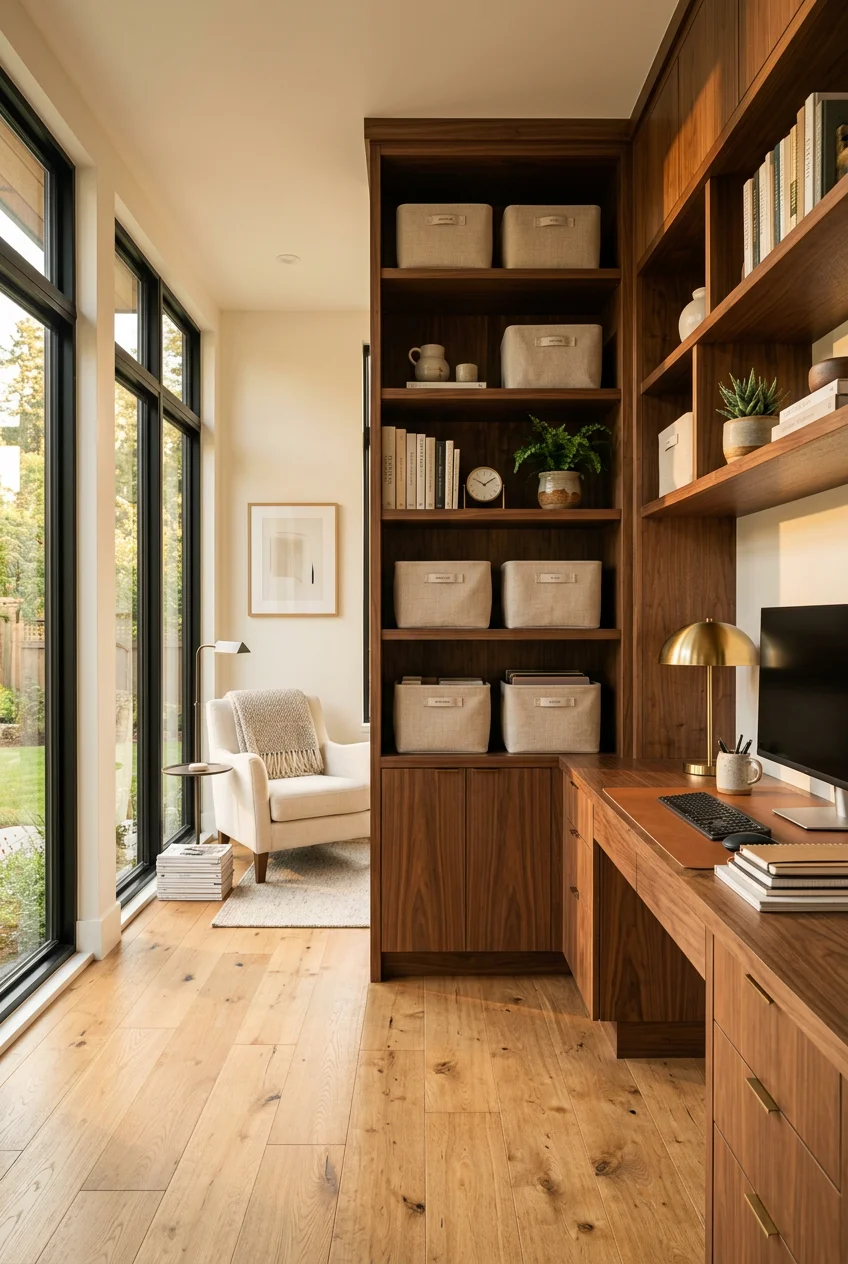
What’s Inside
- Expandable Bamboo Drawer Dividers for Kitchen Chaos
- Cord Clutter Control Basket That Actually Works
- Hot Water Heater Closet Drop Zone Conversion
- Discreet Bedroom Storage Bench
- Morning Routine Tray System
- Dollar Store Bins for Hidden Shelves
- Under-Bed Pull-Out Laundry Bins
- Strategic Hook Placement Everywhere
- Under-Sink Adjustable Dividers
- 1:1 Lid Match for Food Storage
- Water Bottle Limit System
- Top 3 Vases Only Rule
- Throw Blanket Cap System
- Natural Material Storage Bins
- DIY Ceramic Tile Serving Tray
- Vertical Tension Rod Dividers
- Lazy Susan for Deep Cabinets
- Magazine File Box Systems
- Shower Caddy Command Center
- Pegboard Utility Wall
I used to think a DIY home makeover meant painting walls or ripping up carpet. Then I realized the best transformations happen when you organize what you already have. These 20 projects changed how my house functions, and honestly, most took less than an hour.
Expandable Bamboo Drawer Dividers for Kitchen Chaos
I personally swear by Bamboozle expandable bamboo drawer dividers in my kitchen utensil drawer. They cost around $15-25 for a 2-pack and adjust to fit everything from small measuring spoons to 12-inch tongs.
Here’s what most people get wrong: they buy dividers but don’t label the sections. I use my Brother P-Touch label maker to mark “spatulas,” “whisks,” and “serving spoons.” Now my kids can actually put clean utensils back after unloading the dishwasher without playing guessing games.
The bamboo looks way better than plastic and doesn’t slide around when you open drawers. I adjusted mine to create six sections in a standard 18-inch drawer, and it’s held up for two years without warping. Totally Bamboo makes a similar version if Bamboozle is sold out. This simple DIY home makeover took me 10 minutes and saved me from digging through jumbled utensils every single day.
Cord Clutter Control Basket That Actually Works
The Yamazaki Home Tower Cord Organizer ($20-30) sits on my entryway console and changed my life. I coil excess charger cables inside and let 6-8 inch ends dangle out for easy grabbing.
Before this, I had a rat’s nest of phone chargers, iPad cables, and random USB cords creating visual chaos. This basket holds about five coiled cables comfortably, and the weighted base keeps it from tipping when you yank a cord out in a hurry.
Pro tip: label each cable end with washi tape showing what device it charges. My teenagers actually return cables now because they know exactly where the “Mom’s iPhone” charger lives. The metal construction looks sleek in high-traffic areas, and I’ve seen similar versions at Target for around $25. This beats drilling holes in furniture or buying expensive built-in charging stations.
Hot Water Heater Closet Drop Zone Conversion
I converted our awkward hot water heater closet into a functional drop zone using IKEA Trofast bins. Each bin measures 24×18 inches and costs about $25, and I mounted two at 36-inch height for my kids’ backpacks.
The key is leaving the bottom open for shoes and adding Command Hooks spaced 12 inches apart on the side wall for keys and reusable shopping bags. This contains the daily influx from school and work without taking up precious entryway floor space.
Honestly, this DIY home makeover idea works because everything has a specific landing spot. My daughter’s soccer bag goes in the left bin, my son’s school backpack in the right. I added a small tension rod at the top for hanging jackets that need to air out before laundry. The whole setup cost under $75 and took about an hour to install. Way better than tripping over backpacks in the hallway.

Criusia Over the Door Organizer
Honestly, Criusia Over the Door Organizer surprised me — sturdier than it looks in the photos, and over 200 buyers gave it 4.5 stars.
Discreet Bedroom Storage Bench
I bought the Wayfair Jasper Upholstered Storage Bench ($150-250, 48 inches wide) for my bedroom, and it’s the smartest furniture purchase I’ve made. The hidden compartment inside holds extra blankets, out-of-season clothes, and gift wrap supplies.
Professional organizer Di Ter Avest notes that concealed storage keeps bedrooms restful without the cost of custom built-ins. She’s right. My bedroom used to have visible plastic bins stacked in the corner, which made the space feel cluttered even when everything was organized.
This bench sits at the foot of my bed and doubles as a place to sit while putting on shoes. The lift-up lid has soft-close hinges, so it doesn’t slam. I store about 10 sweaters and four throw blankets inside during summer months. The upholstered top comes in tons of colors, and mine matches my duvet perfectly. This is the kind of storage that guests never even notice.
Morning Routine Tray System
I use a 14×10-inch acrylic tray from The Home Edit ($18) on my dresser for daily essentials. Keys, wallet, sunglasses, and my watch live here, and I never lose them anymore.
Arabella from Ankersen Drake says behavior-based systems make organization effortless, and she’s absolutely right. I designed this around my actual morning routine instead of some Pinterest-perfect setup. Every night, I empty my pockets into this tray, and every morning, I grab everything in one scoop.
The clear acrylic looks clean and shows me at a glance if something’s missing. I tried a decorative ceramic dish before, but items would slide around and fall off. This tray has 1-inch sides that contain everything perfectly. My husband now has his own tray on his nightstand, and we’ve stopped the “have you seen my keys?” arguments. Cost less than lunch out and solved a daily frustration.
Dollar Store Bins for Hidden Shelves
I fill my closet’s top shelf with dollar store bins in the largest size they carry (12x12x8 inches, under $2 each). These hold quick-toss categories like winter scarves, beach towels, and shoe care supplies.
Here’s the common mistake: people leave hidden shelves bare, thinking they’ll remember what’s up there. Then random stuff gets tossed up and forgotten. Clutterbug experts advise labeling bins to prevent mixing, and I use my label maker on the front edge of each bin.
I can fit six bins across my 6-foot closet shelf, and they’re light enough to pull down easily. The handles make grabbing them simple, even when I’m balancing on a step stool. Sure, prettier fabric bins exist, but for hidden storage, why spend $15 per bin when these work perfectly? I’ve replaced them once in three years when the handles cracked. This DIY home makeover cost me $12 total and organized 8 cubic feet of previously wasted space.

Lifewit 6 Pack Clothes Storage Bins with Lids
Honestly, Lifewit 6 Pack Clothes Storage Bins with Lids surprised me — sturdier than it looks in the photos, and over 1,072 buyers gave it 4.5 stars.
Under-Bed Pull-Out Laundry Bins

I stopped folding most laundry and started using Sterilite 66-quart clear totes under my kids’ beds. You can get a 6-pack for about $15, and the system is brilliant: pull out, basketball-toss clean clothes in, push back.
This works perfectly for kids who hate precise folding (basically all kids). Each child has two bins: one for tops, one for bottoms. Underwear and socks still go in dresser drawers because those are small enough to make sense there.
The clear plastic lets them see what’s inside without pulling bins all the way out. The low profile fits under beds with only 6 inches of clearance. I use the wheeled version in my own room for workout clothes and pajamas. My teenagers actually put away their own laundry now because there’s zero barrier to entry. No folding, no precision, just toss and done. This saved me probably three hours per week of folding and refolding.
Strategic Hook Placement Everywhere
I installed Command Hooks (holds 7.5 lbs, $5 for 6-pack) at 60-inch height wherever I naturally drop items. Three hooks inside my coat closet door, two in the bathroom for robes, four in the mudroom for bags.
This visual, limit-setting approach works way better for me than deep closets where stuff disappears. I’m a visual organizer, so if I can’t see it, it doesn’t exist. Hooks keep daily-use items visible and accessible.
Pro tip: install hooks at different heights for different family members. My 8-year-old’s coat hook is at 48 inches so he can actually reach it. The weight limit matters too. Cheap hooks fall off when you hang heavy winter coats, but Command Hooks have never failed me. I’ve moved them twice without damaging walls. This costs under $20 for a whole house’s worth and prevents the “chair as coat rack” situation in every bedroom.
Under-Sink Adjustable Dividers
Youcopia adjustable dividers ($20-30) organized my bathroom cabinet chaos. I created a 4-inch section for nail polishes and another for nail files, and nothing shifts around anymore.
What surprised me is how versatile these are. I also use them in my kitchen junk drawer for cords, in the pantry for granola bars (holds up to 20 packs standing upright), and in my daughter’s room for doll accessories. The dividers expand from 12 to 24 inches and lock in place.
The common mistake is buying fixed-size organizers that don’t adapt when your needs change. These adjust in seconds. Under my bathroom sink, I have five sections: hair tools, backup toiletries, first aid, cleaning supplies, and extra toilet paper. Everything stays put even when I’m frantically digging for bandaids. The white plastic looks clean and wipes down easily when something spills.

Durmmur 2 Pack Hat Racks for Baseball Caps
If you want something that just works, Durmmur 2 Pack Hat Racks for Baseball Caps is a safe bet (109 reviews, 4.5 stars).
1:1 Lid Match for Food Storage
I decluttered my food storage containers to a strict 1:1 lid match and tossed every orphan. This sounds obvious, but most people keep mismatched sets hoping lids will magically appear.
I pulled everything out, paired containers with lids immediately, and donated the complete sets I didn’t need to my local food bank. Now I have eight containers total: four small (2-cup), two medium (4-cup), and two large (8-cup). All the same brand so lids are interchangeable.
Pro tip: stack containers with lids on, not separately. This takes more cabinet space but saves so much time. I used to waste five minutes digging through a drawer of loose lids trying to find the right size. Now I grab a container and it’s ready to use. I went from 30+ mismatched pieces to 16 pieces total (containers plus lids), and my cabinet actually closes now. This DIY home makeover cost nothing and gave me back an entire shelf.
Water Bottle Limit System
I limited our family to one primary water bottle plus one backup per person. That’s eight bottles total for four people, down from the 23 we somehow accumulated.
I tossed anything smelly, missing parts, or never used. The ones with broken straws or cracked lids went straight to recycling. Now everyone has their designated bottle, and we actually wash them regularly because there’s no backup stash.
Here’s my related pro tip: buy uniform colors for everything possible. I switched to all black Bombas socks to minimize laundry mismatches when singles appear. Same concept applies to water bottles. We have all stainless steel Hydro Flasks now, and if someone grabs the “wrong” one, who cares? They’re identical. This reduced our dish load and freed up an entire kitchen cabinet shelf. Sometimes less really is more.
Top 3 Vases Only Rule
I kept only my top three vases and donated the rest. Most homes don’t host multiple bouquets at once, so why store 12 vases?
I have one tall cylinder vase for long-stem flowers, one medium round vase for grocery store bouquets, and one small bud vase for single stems or herbs. Everything else from past flower deliveries went to Goodwill. People make the pile-up mistake of keeping every vase “just in case.”
I store mine in a 12-inch deep basket on top of my kitchen cabinets for occasional use. They’re accessible but not taking up prime real estate. When someone sends flowers, I use one of my three vases and immediately recycle the cheap one that came with the arrangement. This freed up two shelves in my dining room hutch, which now hold serving platters I actually use. The mental clarity of not choosing between 12 vases every time is worth more than the physical space.

Over The Door Organizer with LifetimeWarranty
Over The Door Organizer with LifetimeWarranty has been one of the most consistently praised picks in this category. 521 reviewers averaged 4.5/5.
Throw Blanket Cap System
I capped throw blankets at one per sitting area plus one guest extra. For my family room sofa setup, that’s four blankets total: two on the couch, one on the armchair, one in the basket for when company comes.
Decluttering experts recommend selecting favorites and donating the “homeless” ones that migrate around the house. I had blankets draped over every surface, stuffed in closets, and piled on beds. Most were cheap fleece throws that pilled after one wash.
Now I keep only high-quality blankets I actually love: two chunky knit, one faux fur, and one lightweight cotton for summer. They’re pretty enough to leave out as decor. I folded each one specifically for display using the “thirds method” so they look intentional, not sloppy. This instantly made my living room look more pulled together, and I’m not constantly refolding blankets that slide off furniture.
Natural Material Storage Bins

I switched to natural materials like bamboo and water hyacinth bins over plastic for 2026. The Brightroom Water Hyacinth Basket (16×12 inches, $20-35) holds snacks in my pantry and towels in my bathroom.
Experts Kelly Tait and Kersh predict this eco-shift reduces environmental impact while organizing. I agree, but honestly, they also just look better. The woven texture adds warmth that plastic containers never achieve.
These baskets are surprisingly durable. I’ve had mine for 18 months, and they haven’t unraveled or lost shape despite daily use. They wipe clean with a damp cloth. The handles make them easy to pull off high shelves. I use three in my pantry for chips, granola bars, and baking supplies. They’re not airtight, so don’t use them for flour or sugar, but for packaged goods, they’re perfect. This DIY home makeover idea costs more upfront than dollar store plastic but looks expensive and lasts years longer.
DIY Ceramic Tile Serving Tray
I made a ceramic tile serving tray for under $10 using a 12×8-inch white subway tile, wooden handles from the dollar store ($2), and Gorilla Clear Glue. This took 10 minutes to assemble.
The surprising versatility is that it’s both functional and pretty enough for gifts. I use mine for breakfast in bed, corralling bathroom counter items, and serving appetizers when friends visit. The ceramic is heat-resistant, so hot mugs don’t leave rings.
Non-DIYers can absolutely do this. I’m not crafty, but gluing two handles onto a tile is foolproof. Let it dry overnight, and you’re done. I made three more as gifts and personalized them with different tile patterns: marble-look, geometric, and plain white. This is perfect for decluttering hobby supplies too. If you bought tile for a project and have extras, this uses them up instead of storing them for years. Cost less than a latte and looks like something from Anthropologie.

ULG 1 Pack Over Door Organizer with 5 Large and 10 Mesh
A dependable everyday pick — ULG 1 Pack Over Door Organizer with 5 Large and 10 Mesh Side Pockets pulls in 79 ratings at 4.5 stars. Not flashy, just solid.
Vertical Tension Rod Dividers
I installed tension rods vertically in my linen closet to create dividers for sheet sets. Each section is about 10 inches wide and holds one complete set: fitted sheet, flat sheet, and pillowcases bundled together.
This prevents the avalanche effect when you pull out one set and three others tumble down. I use spring-loaded tension rods that cost $8 each at Target, and they adjust from 18 to 30 inches. My closet needed four rods to create five sections.
Pro tip: store sheet sets inside one of their own pillowcases. Fold everything together, stuff it in the pillowcase, and fold the open end under. This keeps sets together and looks tidy on the shelf. I labeled the shelf edge with what size sheets live in each section: “Queen Guest,” “King Master,” “Twin Kids.” Now my husband can find sheets without my help, which is a miracle. This took 20 minutes and didn’t require any permanent installation.
Lazy Susan for Deep Cabinets
I put lazy Susans in every deep cabinet where items got lost in the back. The 12-inch diameter Copco turntables ($12 each) work in kitchen cabinets for spices, bathroom cabinets for medicines, and even my craft closet for paint bottles.
The common mistake is buying lazy Susans that are too large. Measure your cabinet depth first. Mine are 24 inches deep, so a 12-inch turntable leaves room to grab items without hitting the back wall. I use two per shelf, one in front and one in back, creating zones.
In my kitchen, the front turntable holds oils and vinegars I use weekly, and the back one has specialty items like truffle oil and fancy vinegars. I can spin the back one to reach things without moving the front. In my bathroom, medicines stay visible instead of expiring unseen in the back corner. This simple addition made me actually use products I forgot I owned. I found three bottles of ibuprofen that hadn’t expired yet.
Magazine File Box Systems
I use white magazine file boxes everywhere: kitchen for cutting boards and baking sheets, bathroom for hair tools, office for notebooks. The standard size is 4 inches wide, and I buy the $3 cardboard ones from IKEA.
These create vertical storage in cabinets where things normally stack horizontally. Instead of lifting five cutting boards to grab the one on bottom, I slide mine out like files. Same with baking sheets, which now stand upright in a lower cabinet instead of creating a precarious lean.
I covered mine with contact paper to make them water-resistant for bathroom use. The hair straightener, curling iron, and round brush each have their own slot. Everything cools down safely, and I can see what I own. In my office, each magazine file holds one project’s papers: “Taxes,” “Home Repairs,” “School Forms.” This beats the pile system I had before. Total cost for 12 boxes was $36, and they’ve lasted two years with no signs of wear.
Shower Caddy Command Center
I mounted a metal shower caddy on the inside of my bathroom cabinet door using Command Strips to hold hair ties, bobby pins, and small makeup items. The caddy is 10×12 inches and has three shelves.
This uses dead space and keeps tiny items from getting lost in drawers. I can see everything at a glance when I open the cabinet. The bottom shelf holds hair ties sorted by color in small containers. Middle shelf has bobby pins and clips. Top shelf has lip balms and travel-size products.
The key is using a caddy with solid shelves, not those wire ones where small items fall through. I found mine at HomeGoods for $8. The Command Strips hold strong even with the weight of products, and I’ve opened and closed that door hundreds of times without it falling. This took five minutes to install and solved my “junk drawer of hair accessories” problem. Everything has a specific spot now.
Pegboard Utility Wall
I installed a 2×4 foot pegboard in my garage using basic hardware from Home Depot (under $30 total). This holds tools, extension cords, and sports equipment off the floor.
The beauty of pegboard is that it’s completely customizable. I rearrange hooks seasonally: bike helmets in summer, snow shovels in winter. Everything hangs visibly, so I know what I have and can grab it quickly. No more digging through bins.
I painted mine navy blue before installing to match my garage walls, but you can leave it natural. The hooks cost about $1 each, and I needed 20 to start. I added a small shelf attachment for spray paint cans and a basket hook for work gloves. My husband was skeptical about this DIY home makeover, but now he’s the one who uses it most. Tools actually get returned because there’s an obvious empty spot showing where they belong. This freed up 12 square feet of floor space where stuff used to pile up.
These 20 projects prove that home makeovers don’t require contractor-level skills or huge budgets. I’ve done every single one, and my house functions better than it ever has. Start with the problem that bugs you most, whether that’s lost keys or overflowing cabinets. Pick one project this weekend and see how good it feels to actually fix something instead of just living with the frustration. Save this for when you’re ready to tackle the next one, because once you start, you won’t want to stop.
Frequently Asked Questions
What are the easiest DIY home makeover projects for beginners?
Start with expandable drawer dividers, Command Hooks, or dollar store bins for hidden shelves. These require no tools, cost under $25, and take less than 30 minutes. They create immediate visual improvement and make daily routines easier without any permanent changes to your home.
How much does a budget DIY home makeover cost?
Most projects cost $10-30 each. Bamboo dividers run $15-25, cord organizers $20-30, and pegboard setups under $30. You can makeover an entire room for $100-150 using strategic storage solutions. Focus on one problem area at a time rather than buying everything at once.
What storage materials are trending for 2026 home organization?
Natural materials like bamboo, water hyacinth, and wood are replacing plastic. Experts predict eco-friendly storage will dominate, with products like Brightroom Water Hyacinth Baskets ($20-35) becoming standard. These materials look better, last longer, and reduce environmental impact while organizing your space.
How do I organize without making my home look cluttered?
Use concealed storage like upholstered benches with hidden compartments, under-bed bins, and cabinet-mounted organizers. Keep surfaces clear by storing items inside furniture or behind doors. Choose uniform storage containers in neutral colors, and limit visible items to daily essentials only.