What’s Inside
- Implement a Toy Rotation System for Playroom Toy Storage
- Create Activity Zones with Specific Storage
- Utilize IKEA Trofast for Customizable Storage
- Embrace Montessori-Inspired Open Shelving
- Label Everything with Pictures for Young Children
- Maximize Vertical Space with Wall-Mounted Solutions
- Repurpose Furniture for Hidden Storage
- Invest in Multi-functional Storage Ottomans
- Choose Durable, Easy-to-Clean Bins
- Utilize Clear Bins for Visual Organization
- Store Small, Multi-Piece Toys in Divided Organizers
- Designate a Drop Spot for Quick Cleanup
- Prioritize Safety with Slow-Close Toy Chests
- Declutter Regularly Without the Kids
Last Tuesday night, I stepped barefoot on a rogue plastic stegosaurus in the dark and actually cried. If you’re dealing with a similar plastic explosion, mastering your playroom storage is the only way to save your sanity and the soles of your feet. I’m Hannah. For the last six years, I’ve been figuring out how to stop brightly colored plastic from taking over my house. I tried all those cute, aesthetic setups you see online. Most of them failed. The woven rope baskets I bought looked beautiful but smelled like dusty hay after two weeks. The giant wooden toy chests just became dark, sticky black holes for broken crayons and crushed graham crackers. It’s time to get honest about what actually works.
You don’t need a massive budget to fix this. You just need systems that make sense for tiny humans who love to dump things on the floor. I’m going to walk you through the exact bins, shelves, and labels I use in my own home, complete with the prices I paid and the embarrassing mistakes I made. Skip the flimsy cardboard organizers. They taste like wet cardboard to teething toddlers and fall apart in a month. Let’s look at the hard-wearing, kid-proof storage solutions that will finally give you your floor space back.
1. Implement a Toy Rotation System for Playroom Toy Storage
I used to leave every single toy out at once. It was a disaster. My kids would wander in, dump three bins of blocks, and walk away bored. Adopting a toy rotation system fixed this overnight. You keep only 8 to 10 well-chosen toys accessible. You store the rest out of sight in designated toy purgatory bins. This prevents overstimulation, encourages deeper focus, and makes old toys feel brand new when you reintroduce them every two to four weeks. I’ve found this strategy drastically increases their attention spans.
For my purgatory bins, I swear by the Greenmade 27-Gallon Storage Totes from Costco. They cost $10.99 each. They have strong, snap-on yellow lids and stack perfectly in the garage. Last month, I pulled out a dusty bin of wooden train tracks that had been in the garage since October. The kids shrieked like it was Christmas morning. The heavy black plastic keeps moisture and bugs out, though they have a strong factory smell at first. Just wipe them down with 2 tablespoons of white vinegar mixed in 16 oz of warm water before you load them up. Don’t skip the wipe-down. Trust me. Your plush toys will smell like a tire shop otherwise.
2. Create Activity Zones with Specific Storage

If you toss all the toys into one corner, you’re asking for chaos. Divide the playroom into distinct zones. An art station, a reading nook, and a building area make cleanup much easier. I set up a dedicated building zone specifically for tiny, painful plastic bricks and magnetic tiles. Keeping these items contained to one rug saves me from sweeping them up with the kitchen crumbs.
For the building zone, I use the Home4 Stackable Storage Container. It costs $24.99 on Amazon and comes with 60 adjustable compartments. It’s made of hard, clear plastic that clicks loudly when you snap the tiers together. I tried a cheaper knock-off first, and the plastic latches broke off in my hand within a week. Don’t cheap out on the latches. The Home4 container lets you sort small pieces by color, which is incredibly satisfying. My kids actually enjoy sorting their tiny figures into the little 2-inch squares. Having a specific zone and a specific box means I’m no longer finding plastic car tires inside my couch cushions.
3. Utilize IKEA Trofast for Customizable Storage

You can’t talk about playroom organization without mentioning the IKEA Trofast system. It’s a modular frame with plastic guide rails that accommodates three different-sized bins. A typical combination with a solid pine frame and six white plastic bins will cost you $126. The raw pine smells earthy straight out of the flat-pack box. The low height of these units promotes independence, letting your kids safely access and put away toys themselves.
I made a massive mistake when I first bought my Trofast unit. I bought only the extra-large, deep bins thinking they would hold more. Don’t do this. Deep bins just encourage kids to dump the entire container onto the floor to find the one blue dinosaur resting at the bottom. Stick to the shallow bins for small items like action figures and the medium bins for bulky items like wooden blocks. The plastic bins slide easily on the wooden rails with a satisfying swoosh. If the rails get sticky, just rub a plain white wax candle along the wooden groove. It works like magic.

Sterilite 6-Pack Latching Box
Sterilite 6-Pack Latching Box punches above its price — 14 buyers rated it 4.5 stars. I would buy it again.
4. Embrace Montessori-Inspired Open Shelving

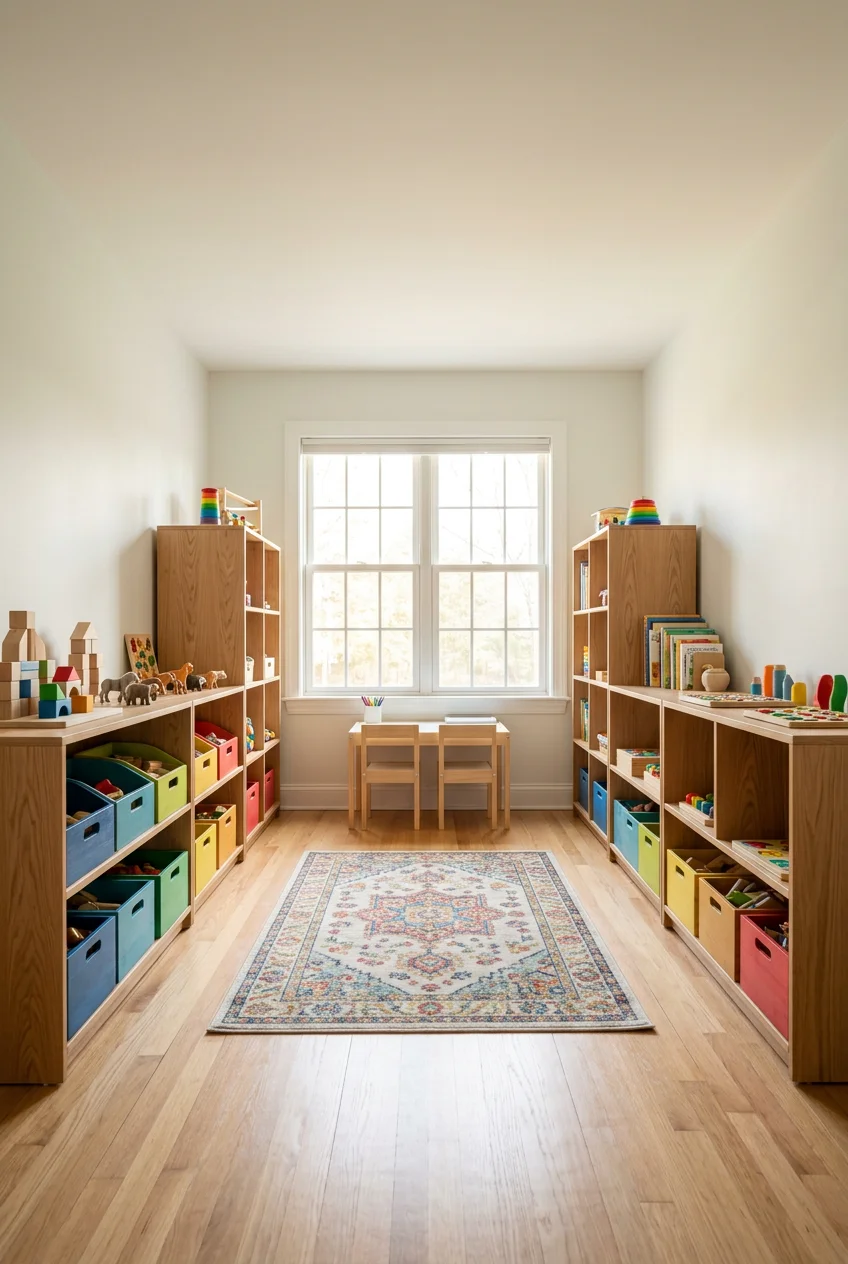
I used to rely on a giant, heavy wooden toy box my grandfather built. It looked gorgeous, but it was a nightmare for actual play. Toys went in, got crushed at the bottom, and were never seen again. Switching to low, open shelving changed everything. This is a core Montessori principle. It allows children to easily see and choose what they want, encouraging independence and making cleanup simple.
I bought two of the Room Essentials 3-Tier Wide Bookcases from Target for $20 each. They’re cheap particle board, but they work perfectly if you anchor them to the wall. Do not skip the wall anchors. The white laminate finish is smooth and easy to wipe down when it inevitably gets covered in sticky fingerprints. I arrange wooden puzzles and large vehicles directly on the shelves. Leaving empty space between the toys makes the room look less chaotic. When a shelf is crammed full, it visually overwhelms children, and they won’t play with any of it. Keep it sparse. Your brain and your kids will thank you. You might also like: 15 Brilliant Home Organization Ideas to Transform Your Space
5. Label Everything with Pictures for Young Children

A common mistake parents make is using only text labels. If your kid can’t read, a label that says “Dinosaurs” is useless. For toddlers and preschoolers, you must use picture labels to clearly indicate where toys belong. This promotes early literacy and empowers children to participate in cleanup by matching the physical toy to the picture. You might also like: 15 Stunning Home Storage Ideas to Transform Your Space
I use my Cricut Joy machine, which costs $149, to cut out simple vinyl silhouettes. I stick a black vinyl cutout of a car on the vehicle bin and a cutout of a block on the block bin. Last Friday afternoon, I was dragging my kids through Sprouts. We were in the produce section, and my toddler started matching the pictures on the fruit signs to the actual apples in the bins. It clicked for him because of our playroom setup. If you don’t have a Cricut, just take photos of the toys with your phone, print them at Walgreens for 39 cents a pop, and secure them to the bins with clear packing tape. It doesn’t have to be fancy. It just has to work. You might also like: 15 Creative Hacks Organizing Ideas You Need to See
6. Maximize Vertical Space with Wall-Mounted Solutions

If you have a small space, you can’t afford to waste floor real estate on bulky cabinets. You have to use your walls. Freeing up floor space by utilizing vertical storage is the smartest thing I’ve done for our tiny bonus room. Floating shelves are great for books, but pegboards are the absolute best for hanging art supplies, small toys, and dress-up accessories.
I installed the IKEA Skadis pegboard. It’s a white painted fiberboard that costs $22.99 for the 30×22 inch size. It feels sturdy and has a smooth, matte finish. I bought the little elastic cords and white metal hooks that go with it. I use it to hang up those annoyingly long toy doctor stethoscopes and plastic necklaces that always get tangled in bins. Warning: measuring for the wall brackets is a pain. I learned that the hard way. I measured wrong the first time and ended up with four extra holes in my drywall. Use a laser level. Once it’s up, it’s incredibly sturdy. I also use an over-the-door shoe organizer with clear plastic pockets for storing markers and glue sticks high out of reach.

Bathroom Organizers and Storage,4 Pack Bathroom Accessories
Bathroom Organizers and Storage punches above its price — 32 buyers rated it 4.5 stars. I would buy it again.
7. Repurpose Furniture for Hidden Storage

You don’t always have to buy furniture branded for kids. In fact, kid-branded furniture is usually overpriced and poorly made. I love repurposing existing furniture for hidden storage. An old dresser can easily be transformed into a toy storage unit by removing a few drawers and sliding in some fabric baskets. This is especially helpful if your playroom is part of your main living room and you don’t want it looking like a daycare center.
I bought a cheap Mainstays 6-Drawer Dresser from Walmart for $119. It comes in a heavy, flat box that smells strongly of wood glue and sawdust. I built the frame but left the top two drawers out completely. In those empty slots, I placed woven baskets for loose toys. I kept the bottom four drawers intact for storing board games and large puzzles. The metal drawer glides on this Walmart dresser aren’t the smoothest. They squeak a bit when pulled, but they hold a surprising amount of weight. Hiding the ugly, brightly colored cardboard game boxes inside a neutral dresser instantly makes the room feel calmer.
8. Invest in Multi-functional Storage Ottomans

If you’re dealing with a shared space, you need furniture that works double duty. Multi-functional storage ottomans and benches provide necessary seating for adults while concealing bulky toys. I’m a huge fan of hiding the mess in plain sight. Look for options with ample interior space to store larger items that don’t fit nicely on open shelves, like massive dress-up dresses or bulky foam blocks.
I bought the Threshold Boucle Storage Ottoman from Target for $85. The fabric has a nubby, textured feel that hides stains surprisingly well. The lid is heavily padded and lifts off completely, revealing a deep, black fabric-lined interior. I use this specific ottoman to shove all the oversized stuffed animals that my kids refuse to part with. Before I bought this, those giant plush dogs just sat in the corner collecting dust and dog hair. Now, they’re hidden away, and I have a comfortable place to sit while I watch my kids play. Just be aware that the hinges on cheaper ottomans can break if kids stand on the open lid, so I prefer the lift-off style lids to avoid broken hardware.
9. Choose Durable, Easy-to-Clean Bins

If you buy cheap, paper-thin bins, your kids will destroy them. I promise. You must select storage bins made from sturdy, easy-to-clean materials. Fabric bins are incredibly popular for cube organizers, but you have to buy the right ones. I’ve thrown away so many bins that lost their shape and slumped over like sad, deflated balloons.
My absolute favorites are the Threshold 13″ x 13″ Fabric Bins from Target. They cost $10 each and have thick, rigid cardboard inserts in the sides. The canvas fabric is thick and slightly rough to the touch. For larger, concealed storage, I use the Veronly Kids Toy Box Chest Storage. It costs $15.99 on Amazon, holds 21.9 gallons, and measures 24.5 x 13 x 16 inches. It has a velcro lid that makes a loud ripping sound when you open it, which is actually a great auditory cue so I know when my toddler is digging into toys he shouldn’t be. When these fabric bins get dirty, I clean them with a mixture of 1 tablespoon of Dawn dish soap in 16 oz of warm water. I scrub the stains with an old toothbrush and let them air dry outside.

WORKPRO 5-Tier Storage Shelf
WORKPRO 5-Tier Storage Shelf punches above its price — 153 buyers rated it 4.5 stars. I would buy it again.
10. Utilize Clear Bins for Visual Organization

While fabric bins look neat, they hide the contents completely. This means kids will pull out every single bin just to find one specific action figure. Clear storage bins fix this problem entirely. They allow children to easily see what’s inside, reducing the need to dump out the contents on your freshly vacuumed rug. This approach is particularly effective for organizing smaller categories of toys inside deeper cabinets.
I buy the Sterilite 6-Quart Clear Storage Boxes. They cost $1.14 each at Walmart. They are cheap, stackable, and the white plastic lids snap on securely. Last Sunday, I was doing a massive grocery haul at Kroger. I was exhausted, pushing a heavy cart, and I reached into my purse only to find a sticky, unwrapped lollipop and a stray Hot Wheels car. That car belonged in a specific clear bin at home. When I got back, I realized the clear bin system only works if you actually enforce putting things back. The beauty of the clear plastic is that I can scan the playroom in five seconds and know exactly which bin is missing its cars. No guessing required.
11. Store Small, Multi-Piece Toys in Divided Organizers

Tiny toys are the enemy of a clean house. Barbie shoes, Polly Pockets, and small craft supplies will scatter like dust if you don’t contain them properly. You can’t just throw these into a large bucket. They will get lost, and your kids will cry when they can’t find the exact pink high heel they need. You have to use organizers with small, adjustable compartments.
I mentioned the Home4 container earlier, but for really tiny items, I head to the craft store. I buy the 12-compartment plastic bead organizers from Michael’s. They cost $14.99 each. The plastic is thick and cloudy, and the little snap closures are incredibly tight. You have to press firmly to click them shut. I tried using cheap tackle boxes from the sporting goods store once, but the internal dividers slid up, and all the beads mixed together underneath. The sound of thousands of tiny beads mixing together is a nightmare. The Michael’s bead organizers have fixed dividers that run all the way flush to the bottom. I use these for tiny doll accessories and perler beads. It keeps the tiny pieces off the floor and away from my vacuum cleaner.
12. Designate a Drop Spot for Quick Cleanup

This is my favorite lazy-mom hack. You need to designate a drop spot for quick cleanups. At the end of the day, you don’t always have the energy to sort every single toy into its perfectly labeled bin. You need a buffer zone. Place a large floor basket in the middle of the room as a temporary drop spot. When it’s time for a frantic five-minute tidy-up before guests arrive, you just toss everything into this basket.
I use a massive, woven jute basket that I impulse-bought at Whole Foods for $39.99. It has a rough, scratchy texture and smells faintly of dried grass. It’s huge, about 20 inches wide. When my living room looks like a disaster zone, I grab the jute basket, walk around, and throw every loose toy inside. The room instantly looks clean. Then, on Saturday mornings when I have more energy, I dump the basket out and sort the items back into their proper homes. The drop spot prevents you from feeling overwhelmed by the mess. It gives you permission to just get the toys off the floor quickly without having to do a full organizational routine every single night.

SNSLXH 5 Pack Stackable Closet Storage Basket
Honestly, SNSLXH 5 Pack Stackable Closet Storage Basket surprised me — sturdier than it looks in the photos, and over 4 buyers gave it 4.5 stars.
13. Prioritize Safety with Slow-Close Toy Chests

If you choose to use a traditional toy chest, safety has to be your top priority. Heavy wooden lids are notorious for slamming down on little fingers. I learned that the hard way. When my oldest was two, he pinched his fingers in an antique wooden trunk I was using for blankets. The scream he let out still haunts me. You must ensure any hinged lid has a high-quality, slow-close safety hinge.
I eventually replaced that dangerous trunk with the Melissa & Doug Wooden Toy Chest. It costs $149.99 on Amazon. It holds 4.5 cubic feet of toys and comes in a smooth, painted white finish. The best part is the safety hinge. You can lift the lid, let go, and it stays perfectly suspended in the air. It won’t drop. It requires physical force to push it back down. The wood is heavy and sturdy, and it doubles as a bench seat. I keep our oversized, heavy wooden building blocks in here. It’s a classic piece of furniture, but the modern safety hardware makes it worth every single dollar. Don’t risk your kids’ fingers on cheap hinges.
14. Declutter Regularly Without the Kids

You can buy all the bins in the world, but if you have too much stuff, your playroom will always look messy. You have to declutter regularly. Here is my biggest pro tip: never, ever try to declutter with your children present. It is a massive mistake. If they see you throwing away a broken plastic toy from a fast-food meal they haven’t touched in six months, they will suddenly act like it’s their most prized possession.
I do my toy purges on Tuesday mornings when they are at preschool. I grab a box of Hefty 30-gallon black trash bags. They cost $15.99 for a box of 40. I use the black bags specifically so the kids can’t see what’s inside if they spot the bag in the garage. I sit on the playroom floor with a cup of coffee and a handful of dark chocolate peanut butter cups from Trader Joe’s (they cost $4.49 a tub and are my decluttering fuel—no exaggeration). I ruthlessly toss anything broken, missing pieces, or outgrown. I put the “maybe” toys into a purgatory bin. If no one asks for them in 30 days, I donate them to the local thrift store. Editing the collection is the only way to make your storage systems actually function.
Getting your playroom toy storage under control isn’t about creating a museum. It’s about creating a space where your kids can actually play without destroying your home. Start small. Grab a few clear bins, set up a drop spot basket, and ruthlessly bag up the junk while they’re sleeping. You’ve got this. If you found these tips helpful, please pin this article to your favorite home organization board so you can find these exact product links later!
Frequently Asked Questions
How do you organize a playroom with too many toys?
Start by decluttering broken or outgrown items without your kids present. Then, implement a toy rotation system using heavy-duty bins like Costco’s 27-gallon totes. Keep only 8-10 toys out on open shelving at a time to prevent visual overwhelm.
What is the best way to store small toy pieces?
Use clear, divided organizers with tight latches for tiny items like LEGOs or beads. I recommend the Home4 Stackable Storage Container or craft store bead boxes. This keeps tiny parts sorted by color and prevents them from mixing or spilling.
How can I encourage my toddler to clean up their toys?
Use open, low shelving like the IKEA Trofast system so they can easily reach the bins. Most importantly, label every bin with a clear picture of the toy, not just text, so they can easily match the item to its home.
What is a playroom drop spot?
A drop spot is a large, open floor basket placed in the room for quick cleanups. When you’re short on time, you toss all loose toys into the basket to clear the floor immediately, then sort them into their proper bins later.
