
What’s Inside
- Enforce the 20/80 Rule for Shared Closet Organization
- Ditch the 50/50 Split for Lifestyle Zoning
- Standardize with Slim-Line Velvet Hangers
- Double the Vertical Space with Adjustable Rods
- Control Folded Chaos with Acrylic Shelf Dividers
- Segment Drawers with Spring-Loaded Organizers
- Install Modular Flex Systems for Future Changes
- Stack Shoe Storage Vertically by Frequency
- Add Motion-Activated LED Smart Lighting
- Utilize Flush-Mount Hidden Storage Solutions
- Repurpose Over-The-Door Organizers for Accessories
- Stop Using the Closet as a General Storage Unit
Last October, I opened our bedroom closet to find my husband’s damp, heavy wool peacoat shoved violently against my favorite delicate silk blouses. The resulting wrinkled, slightly wet silk mess forced me to rethink our shared closet organization. If you’re currently staring at a similarly chaotic rod where two human lives are colliding in a tiny 6-foot space, you aren’t alone. I tried ignoring the problem for months. I just kept pushing his bulky sweaters to the left, hoping for the best. That strategy failed miserably when a massive pile of heavy denim jeans collapsed onto my leather work shoes. The sharp metal zipper of his jeans actually scratched the leather on my left boot. I realized then that treating a single closet like a dumping ground doesn’t work. We needed a logical approach. I grabbed a 25-foot Stanley measuring tape, a yellow legal pad, and a large iced coffee. Over three weeks, I tested dozens of configurations. I made plenty of expensive mistakes, like buying bulky wooden hangers that ate up 14 inches of rod space. But I also figured out what functions in real life. You don’t need a massive walk-in to make this work. You just need physical boundaries, the right hardware, and a bit of discipline. Whether you have a tiny reach-in or a walk-in, these strategies apply. Here’s how we fixed our space, step by step.
1. Enforce the 20/80 Rule for Shared Closet Organization

Before installing any hardware, you’ve got to face the hardest part. Both of you must ruthlessly declutter your inventory. According to the National Association of Professional Organizers, people typically wear 20% of their clothes 80% of the time. I learned that the hard way last Tuesday. I spent three hours trying to arrange my husband’s massive collection of college t-shirts in a hanging canvas organizer. I finally asked him when he last wore a faded blue one, and he admitted he hadn’t touched it since 2018. A massive mistake people make is trying to organize actual garbage. You can’t buy enough plastic bins to fix a hoarding problem.
Dedicate a full Saturday afternoon to this purge. Buy a box of 30-gallon Hefty strong trash bags. They cost $14.99 at Target for a box of 40. You need to sort everything into keep, donate, sell, and discard piles. Be brutal about what you actually wear. The scratchy texture of old, pilled wool sweaters isn’t worth the premium real estate in your bedroom. We packed up four giant reusable Whole Foods grocery totes full of clothes to donate to our local women’s shelter.
If you haven’t worn a piece in 12 months, it goes in the bag. You’ll instantly free up a quarter of your rod space just by removing the dead weight. The fresh, empty space makes the next steps possible. The only negative part is the sheer exhaustion. Sorting through years of accumulated fabric leaves a distinct, dusty smell in the air that triggers my allergies, so I recommend keeping a window open while you work.
2. Ditch the 50/50 Split for Lifestyle Zoning

Most couples draw an invisible line down the middle of the rod. I tried this 50/50 split for months before realizing it just causes resentment. Instead of an arbitrary split, allocate space based on each person’s wardrobe volume and daily lifestyle. My husband works in construction and wears heavy denim pants and flannel shirts. I work from home and wear thin cotton blouses and leggings. His clothing takes up twice as much volume as mine.
We took a 25-foot Stanley measuring tape and calculated our needs. He needed 40 inches of rod space for his bulky winter jackets. I needed only 20 inches for my dresses, but I required a taller vertical drop so the hems wouldn’t drag on the floorboards. We ripped out the single builder-grade wooden shelf and installed a modular IKEA Pax system. The basic white frame costs $110, and we customized the interior inserts differently for each side.
He got three wooden drawers for his jeans, while I opted for a wire basket for my workout gear. This personalized approach prevents space creep. When you have a hard boundary built for your exact inventory, your partner’s leather boots won’t migrate into your shoe zone. One honest mistake I made was miscalculating the depth. I didn’t account for the thick sleeves of his coats, which rubbed against the sliding doors. Always measure the shoulder width of your bulkiest items before committing to a frame.
3. Standardize with Slim-Line Velvet Hangers

If you take one piece of advice, let it be this. Replace every bulky plastic or wooden hanger with slim, non-slip velvet hangers. I bought a 50-pack of Amazon Basics velvet hangers for $16.49, and it altered how our clothes fit. Standard wooden hangers from Target are nearly an inch thick. When you have 100 shirts hanging, the wooden hangers consume 100 inches of rod space. The slim velvet versions are only 0.2 inches thick.
You can save 50% more rod space just by switching your hardware. I chose black hangers for my husband’s clothes and pale gray for mine. This color-coding creates an immediate visual boundary. If I see a black hanger creeping onto my side, I know who’s responsible. The velvet texture also grips slick fabrics. My silk camisoles used to slide off cheap plastic tubular hangers from Walmart and end up in a wrinkled pile on the floor.
Now, they stay put. The friction holds wide-neck sweaters securely without stretching the shoulders. The only negative is that wet clothes will cause the dye in cheap velvet hangers to bleed. I ruined a damp white cotton shirt last year because the black dye transferred directly onto the collar. Never hang damp items on velvet hangers. Dry them on a rack first.
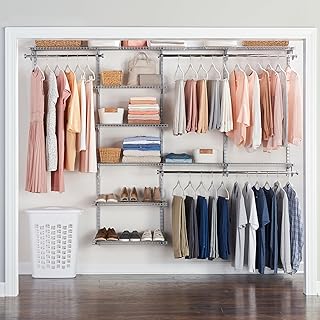
Rubbermaid Configurations Deluxe Custom Closet Kit 4-8 Ft.
Rubbermaid Configurations Deluxe Custom Closet Kit 4-8 Ft. Adjustable has been one of the most consistently praised picks in this category. 81 reviewers averaged 4.5/5.
4. Double the Vertical Space with Adjustable Rods

A massive failure in most closets is wasted vertical space. Builders usually install a single rod at 66 inches, leaving a three-foot void beneath your shirts. To maximize space, you must install a secondary rod. I bought The Container Store’s Elfa adjustable closet rod for $24.99. It hooks onto your existing top rod and hangs down, creating a second tier without requiring power tools or drywall anchors.
We set our bottom rod 42 inches from the floor. This provides clearance for my husband’s folded dress pants and my shorter button-down shirts. By doubling the hanging capacity, we freed up two wooden shelves that were previously crammed with denim. The metal mechanism clicks solidly when secured, and it holds up to 30 pounds without bowing. You might also like: 12 Small Home Organization for Every Budget
I have to warn you about a mistake I made initially. I hung the lower rod too low, and my husband’s size 12 leather work boots kept scraping against the hems of my linen shirts. Always measure the drop length of your longest shirt before locking the secondary rod into place. Also, be aware that the vertical hanging straps can slightly obstruct clothes behind them on the top rod, so keep your least-worn items in those spots. You might also like: 14 Office Organization Home Worth Trying
5. Control Folded Chaos with Acrylic Shelf Dividers

If you share a closet, you know the frustration of stacked clothing. You fold a tower of cashmere sweaters, and three days later, it looks like a landslide covering your partner’s ties. To prevent piles of jeans or handbags from toppling over, you need clear acrylic shelf dividers. I purchased a 6-pack from Angel Sar on Amazon for $24.99. These dividers are 12 inches tall and slide onto standard 3/4-inch wooden shelves. You might also like: 15 Clever DIY Easy Home Decor to Inspire Your Next Project
You don’t need screws or adhesive. The rigid plastic grips the wood, creating a solid wall between your items and your partner’s. The clear acrylic material is crucial because it doesn’t visually chop up the space or block the lighting. I use them to separate my workout leggings from my husband’s wool winter hats. The physical barrier forces you to pull items straight out rather than yanking them from the bottom.
One honest negative: if your shelves are thicker than one inch, the plastic tension clips will snap. I broke two trying to force them onto a thick custom shelf before realizing my error. The sharp cracking sound was frustrating. Make sure you take a tape measure and check the thickness of your shelves before you order.
6. Segment Drawers with Spring-Loaded Organizers

Throwing loose socks and underwear into a shared drawer is a recipe for daily arguments. When you’re rushing to get dressed at 6 AM, digging through your partner’s dark dress socks to find yours is irritating. For items like undergarments, ties, belts, and scarves, drawer organizers are mandatory. I rely on the OXO Good Grips expandable drawer dividers. A set of two costs $19.99.
These feature a strong spring-loaded mechanism and foam pads on the ends, so they wedge into the drawer without scratching the wood. They stand 4 inches tall, which perfectly sections off a standard dresser drawer. We used these to create four vertical columns in our main drawer. My husband gets the two left columns for his boxer briefs and black socks, while I take the two right columns.
The physical separation means our items can’t mix, even when the drawer is slammed shut. If you prefer bins, The Container Store offers a 5-drawer storage organizer tower for $49.99 that provides excellent separation. Just avoid the cheap fabric bins from dollar stores. I tried those first, and they lose their shape within a month. The sides collapse, turning the drawer into a messy disaster.

Kmiectse Clear Storage Bins with Lids
Kmiectse Clear Storage Bins with Lids – 4 Tier Plastic Bins with Wheel has been one of the most consistently praised picks in this category. 2 reviewers averaged 4.5/5.
7. Install Modular Flex Systems for Future Changes

If you’re planning a full remodel, look at the Flex Closet trend dominating home design for 2026. A static closet with fixed wooden shelves doesn’t work for a shared space because couples’ wardrobes fluctuate. One partner might start a new job and need 30 inches of hanging space for suits, while the other transitions to remote work and only needs folded storage. Modular systems adapt to these evolving needs.
We upgraded to the Organized Living freedomRail system. The starter kit cost about $350. The beauty of this system is the heavy-duty steel horizontal track that mounts to the top of the wall. Everything else—the vertical uprights, the wooden shelves, the metal rods—hooks into that track. You can rearrange the entire layout in ten minutes without a tool. I’ve adjusted my shelving heights four times this year to accommodate winter boots and beach bags.
It’s a long-term investment that grows with your wardrobe. The steel components are heavy, though. I dropped a metal bracket on my toe during installation, so wear proper shoes when assembling these. Also, finding the wall studs is critical. If you mount the main steel rail into plain drywall, the weight of two people’s clothing will rip the system out of the wall.
8. Stack Shoe Storage Vertically by Frequency

Shoe storage is the biggest point of contention in any shared closet project. You have to count each person’s inventory to determine storage. My husband owns four pairs of shoes. I own thirty-two. Trying to share a single rack was a disaster. His muddy hiking boots were crushing my suede pumps. For high-end closets, angled shoe shelves are a 2026 trend, creating a retail boutique experience.
Since we couldn’t afford a $5,000 build, I implemented vertical stacking. I bought a set of The Container Store’s large drop-front shoe boxes. They cost $11.99 each and measure 11 by 14 inches. These clear plastic boxes stack securely, allowing you to utilize vertical space up to the ceiling. We keep our daily sneakers and work shoes accessible at the bottom on a metal rack.
All of my seasonal heels and suede boots go into the clear boxes on the top shelf. The enclosed boxes protect the suede from dust, and the clear plastic lets me see exactly which pair I’m grabbing. The only downside is the smell. Enclosing leather shoes in airtight plastic traps odors. I have to place a small cedar block in each box to absorb moisture and prevent them from smelling like a locker room.
9. Add Motion-Activated LED Smart Lighting

You can’t organize what you can’t see. Most closets have a single, weak bulb in the center of the ceiling. This casts shadows, making it impossible to distinguish navy blue slacks from black ones at 5 AM. Integrating smart lighting is a major trend for 2026. Professional hardwired lighting can cost $200 to $800, which wasn’t in our budget.
Instead, I found a workaround. I purchased three GE motion-sensing LED light strips from Target for $34.99 each. These run on AA batteries and stick to the underside of the wooden shelves using adhesive tape. I chose the 6500K cool white temperature because it accurately renders the colors of our clothing. Now, when I open the door, the shelves illuminate. The motion sensor is highly sensitive, picking up movement from three feet away.
I have to mention one drawback. If I get up to use the bathroom at night and leave the closet door cracked, the sensor sometimes catches my movement and blasts my sleeping husband with light. Make sure you install them facing downward to minimize the glare. Also, replacing batteries every three months gets tedious, so invest in rechargeable AA batteries from Costco.
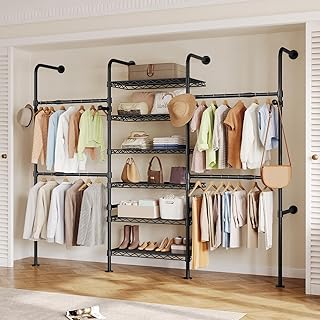
Closet Organizers and Storage
If you want something that just works, Closet Organizers and Storage is a safe bet (39 reviews, 4.5 stars).
10. Utilize Flush-Mount Hidden Storage Solutions

When two people share a small space, visual clutter accumulates fast. Ten belts, fifteen necklaces, and a dozen silk scarves hanging from hooks will make even the cleanest closet look like a thrift store. Discreet, hidden storage is a top trend for 2026. You want hardware that holds your accessories but slides out of sight. I installed a Rev-A-Shelf pull-out belt rack that mounts flush to our wooden cabinet panels.
I bought it at Home Depot for $42.99. It has a 14-inch depth and glides on a smooth ball-bearing track. My husband hangs his leather work belts on the hooks, and I use the back hooks for my long pendant necklaces. When we push the rack back in, it disappears against the wall. This keeps the shiny buckles and tangled chains out of sight while maintaining easy access.
Before I found this sliding rack, we used a cheap plastic ring hanger that required you to remove five belts just to get to one. The constant clinking of metal against the wall drove me crazy. The sliding rack requires a clearance of three inches, so check your spacing before drilling pilot holes. I accidentally mounted mine too close to the door hinge, and the rack couldn’t slide out fully.
11. Repurpose Over-The-Door Organizers for Accessories

If you have a traditional swinging door, you are sitting on a goldmine of unused vertical real estate. The back of the door is the perfect zone for bulky accessories. To maximize this space, install heavy-duty over-the-door organizers. I bought The Container Store’s 24-pocket mesh over-the-door shoe organizer for $19.99. Instead of shoes, I use the breathable mesh pockets to hold rolled winter scarves, wool socks, and small crossbody handbags.
The mesh material is crucial because it allows air to circulate, preventing that musty smell from developing on seasonal items. For my husband’s larger duffel bags and my structured leather totes, I utilize the main hanging rod. I bought a pack of heavy-duty 2-inch metal S-hooks from Walmart for $3.48. I hook one end over the closet rod and hang the bag’s strap on the bottom hook. This simple trick saves a massive amount of shelf space.
Just don’t hang heavy leather bags by their straps for more than a few months, or the weight will permanently stretch and damage the leather. I ruined a beautiful leather tote last spring by leaving it hanging full of heavy coins and receipts. Empty your bags before hanging them on S-hooks. The metal hooks can also scratch the paint on wooden rods, so wrap a small piece of electrical tape around the top hook if you want to protect the finish.
12. Stop Using the Closet as a General Storage Unit

A massive error couples make is treating their bedroom closet as a general storage unit for anything that doesn’t have a home. I used to keep our vacuum attachments, old magazines, and a bulk pack of paper towels from Costco shoved in the back corner. You can’t do this. Only store items that belong on your body in a clothing closet. Everything else must go.
Seasonal clothes should be rotated and moved to alternative storage when not in use. I bought four Sterilite 66-quart clear latching bins at Walmart for $12.98 each. In April, all of our winter coats, wool sweaters, and flannel sheets go into these bins and slide under our bed. This instantly frees up 30% of our active closet space. A surprising tip for maintaining this boundary is for both partners to adopt a capsule wardrobe. This involves curating a small collection of versatile, interchangeable pieces. I reduced my daily wardrobe to 35 items, which eliminated my morning decision fatigue.
For those with a higher budget, 2026 trends include smart closets with RFID tags for inventory tracking and AI-powered wardrobe analysis. Google Photos is even integrating AI to analyze your wardrobe and suggest outfits. While custom systems with these tech features can push costs to $3,000 to $15,000, simply removing the household junk from your closet costs nothing. I recommend spending this weekend pulling out everything that isn’t clothing. You’ll be shocked by how much space you have when you stop storing random household clutter next to your shoes. Save this guide and pin it for your next weekend project.

Timate P3 Wall Mounted Closet Organizer System with 5
A dependable everyday pick — Timate P3 Wall Mounted Closet Organizer System with 5 Hanging Rods pulls in 7 ratings at 4.5 stars. Not flashy, just solid.
Frequently Asked Questions
How do you divide a shared closet fairly?
Allocate space based on actual wardrobe volume and daily lifestyle needs rather than an arbitrary 50/50 split. If one person owns bulky work gear and the other has thin dresses, measure the physical footprint of the clothing and install custom zones that fit those specific dimensions.
What are the best hangers for shared closets?
Slim non-slip velvet hangers are the most efficient option. They prevent slick fabrics from falling onto the floor and save up to 50% more horizontal rod space compared to standard wooden or thick plastic tubular hangers.
How can I maximize space in a small shared closet?
Install a secondary adjustable hanging rod to double your vertical space for short items like shirts and folded pants. Add over-the-door mesh organizers for winter accessories and use clear under-bed bins to rotate out-of-season clothing.
How do you keep folded clothes neat on closet shelves?
Slide clear acrylic shelf dividers onto standard 3/4-inch wooden shelves. These rigid plastic barriers prevent heavy stacks of sweaters, jeans, or handbags from toppling over and mixing with your partner’s carefully folded items.
