What’s Inside
- Embrace Clear Stackable Bins for Ultimate Visibility
- Utilize Cube Organizers with Fabric Bins
- Install Hammocks for Space-Saving Stuffed Toy Storage
- Implement a Strict Toy Rotation System
- Label Everything with Pictures for Easy Cleanup
- Choose Multi-Bin Organizers for Child Accessibility
- Go Vertical with Wall-Mounted Floating Shelves
- Embrace Sustainable Stuffed Toy Storage
- Avoid the Dreaded Toy Box Black Hole
- Involve Children in the Decluttering Process
- Use Mesh Laundry Bags Inside Larger Bins
- Create a DIY Stuffed Animal Zoo Display
- Repurpose Over-the-Door Shoe Organizers
- Maximize Space with Under-Bed Rolling Storage
- Disguise Toys in Shared Spaces with Woven Baskets
- Stuffable Bean Bag Chair Covers
Picture this. It’s last Tuesday at 9 PM, and I’m walking into my daughter’s room holding a heavy basket of clean, warm laundry. I take one step in the dark, step squarely onto the hard plastic eyeball of a neon pink unicorn, and instantly twist my ankle. That was my breaking point with our complete lack of stuffed toy storage. My house looked like a carnival exploded. The plushies were everywhere. They smelled faintly of apple juice and dusty polyester. If you’re drowning in a sea of fluff, I get it. I tried tossing them all into a giant wicker basket for months before figuring out that just creates a bottomless pit of despair. You need actual systems. Organizing kids’ spaces doesn’t have to be a nightmare, but you can’t just wing it. Let’s fix this mess together.
1. Embrace Clear Stackable Bins for Ultimate Visibility

Let’s talk about the easiest fix first. I used to hate plastic bins, but I’m officially a convert. When you use opaque boxes, kids just dump everything out to find that one specific Paw Patrol dog. It’s infuriating. Now I use Target’s Brightroom 16qt Clear Storage Boxes. They cost exactly $4.00 each. They measure 16.75 inches long by 11.87 inches wide. I bought ten of them last month during a frantic Target run while sipping an iced coffee that tasted mostly like melted ice. Professional organizer Katy Winter is totally right about clear sweater boxes. Almost 90 percent of all toys will fit in them. You can stack them three high in a closet without them toppling over. Don’t buy the cheap dollar store ones. The lids crack if you look at them wrong. I learned that the hard way when I stepped on a flimsy lid and sent sharp plastic shards into my carpet. Stick to the Brightroom ones. They click shut firmly. You can see exactly what’s inside. The smooth plastic texture makes wiping off sticky fingerprints super easy. I’m talking about those mystery purple jelly smudges that seem to appear out of nowhere.
2. Utilize Cube Organizers with Fabric Bins

If you’ve got a dedicated playroom, you need a cube system. I resisted this for a long time because I thought it looked too much like a preschool classroom. I was wrong. The IKEA KALLAX is the gold standard for a reason. A standard 2×2 unit costs $34.99. It measures 30.37 inches by 30.37 inches. I bought the crisp white one, dragged the heavy flat-pack box up my stairs, and assembled it myself while cursing at the tiny hex key. The trick is pairing the KALLAX with the right inserts. Don’t buy the rigid plastic ones. They scrape the paint off the shelves and sound awful when you drag them. Instead, get the Amazon Basics Foldable Fabric Storage Cubes. You can get a 6-pack for $21.99. They measure exactly 10.5 inches by 10.5 inches by 11 inches. They slide in smoothly. The soft canvas texture feels nice, and they hold a surprising amount of medium-sized plushies. I keep the heavy wooden blocks in the bottom bins so the whole unit won’t tip over. The top bins are strictly for lightweight stuffed animals. This modular look keeps the room feeling calm instead of chaotic.
3. Install Hammocks for Space-Saving Stuffed Toy Storage

Wall space is your best friend when floor space is tight. I used to think toy hammocks were incredibly tacky. I pictured those cheap, neon nylon nets from the nineties that sagged sadly in the corner and collected dust. But the 2026 trend of cozy, textured decor totally changed my mind. Last month, I ordered a Lilly’s Love Macrame Stuffed Animal Storage Hammock off Amazon for $24.95. It measures 43 inches by 43 inches by 56 inches. Hanging it was a bit of a nightmare. I hit a metal pipe in my wall on the first try. Always use a stud finder. Once I actually got the heavy-duty metal hooks installed properly, I was amazed. It holds over 20 plush toys easily. The thick, woven cotton rope feels high-quality and smells slightly like natural twine. We even wove a $9.99 strand of warm-white LED fairy lights from Walmart through the netting. It creates this beautiful, soft glow at night. It keeps the bed clear of clutter so my kids can actually sleep under their blankets instead of under a mountain of polyester fur.

8 Pack Extra Large Heavy Duty Moving Bags
8 Pack Extra Large Heavy Duty Moving Bags punches above its price — 19 buyers rated it 4.5 stars. I would buy it again.
4. Implement a Strict Toy Rotation System

Most people get this wrong. I certainly did. I thought every toy my kids owned needed to be accessible at all times. The result was pure sensory overload. My kids wouldn’t even play with their toys. They’d just stare at the mess and whine that they were bored. Professional organizer Tonia Tomlin recommends rotating toys every few weeks. I finally tried this, and it actually works. I bought four 18-gallon opaque Sterilite storage totes from Home Depot for $9.98 each. The dark blue plastic hides the contents completely. Every Sunday night, after the kids are asleep, I take half the stuffed animals and pack them away in these bins. I shove the bins into the deep, dark corner of our guest room closet. When I pull them back out three weeks later, my kids act like it’s Christmas morning. They shriek with joy over a stuffed green dinosaur they literally ignored a month ago. The trick is making sure the rotation bins are completely opaque. If they can see the toys through the plastic, they’ll beg for them. Keep them hidden.
5. Label Everything with Pictures for Easy Cleanup

Labeling seems so obvious, but skipping this step is a massive mistake. I tried organizing without labels for six months. I’d sort everything perfectly into bins, and three days later, the Peppa Pig plushies were mixed with the sticky slime containers. It drove me insane. You can’t expect a four-year-old to read a label that says “Miscellaneous Plush.” You’ve got to use picture labels. I bought a pack of 96 Kassa Chalkboard Sticker Labels from Amazon for $12.95. They measure 3.5 inches by 2 inches. I used a $3.50 white Sharpie oil-based paint pen from Michaels to draw simple little icons on them. A crude drawing of a teddy bear goes on the plushie bin. A drawing of a car goes on the vehicle bin. The matte black vinyl texture of the stickers looks really clean against white plastic bins. When my kids outgrow a specific toy phase, I just wipe the sticker with a damp paper towel and rubbing alcohol, and I can draw a new picture. It empowers them to put their own junk away without whining. You might also like: 15 Gorgeous Organizing Bathroom Home Hacks Ideas Worth Trying This Year
6. Choose Multi-Bin Organizers for Child Accessibility

Sometimes you just need a piece of furniture designed specifically for the chaos of childhood. I bought the Delta Children Deluxe Multi-Bin Toy Organizer for my youngest child’s room. I found it at Walmart for $44.98. It’s got a sturdy wooden frame painted a crisp white, and it comes with nine fabric bins in varying sizes. It’s Greenguard Gold Certified, which gave me peace of mind because it didn’t have that awful chemical factory smell when I took it out of the box. The tiered design is brilliant. The bins sit at a slight angle, so kids can see exactly what’s inside without pulling the bin out. I keep the tiny Beanie Boos in the three small top bins. The medium bins hold the medium plushies. The large, heavy bins on the bottom hold the giant, awkward stuffed animals. Always put the heavy stuff on the bottom tier. I didn’t do that at first. I put a 5-pound weighted stuffed dog in a top bin, and the whole fabric bin sagged horribly and eventually warped the cardboard insert. Keep the heavy things low. You might also like: 20 Creative DIY Garage Organization Ideas That Changed Everything

4 Tier Storage Bins with Lids
A dependable everyday pick — 4 Tier Storage Bins with Lids pulls in 63 ratings at 4.5 stars. Not flashy, just solid.
7. Go Vertical with Wall-Mounted Floating Shelves

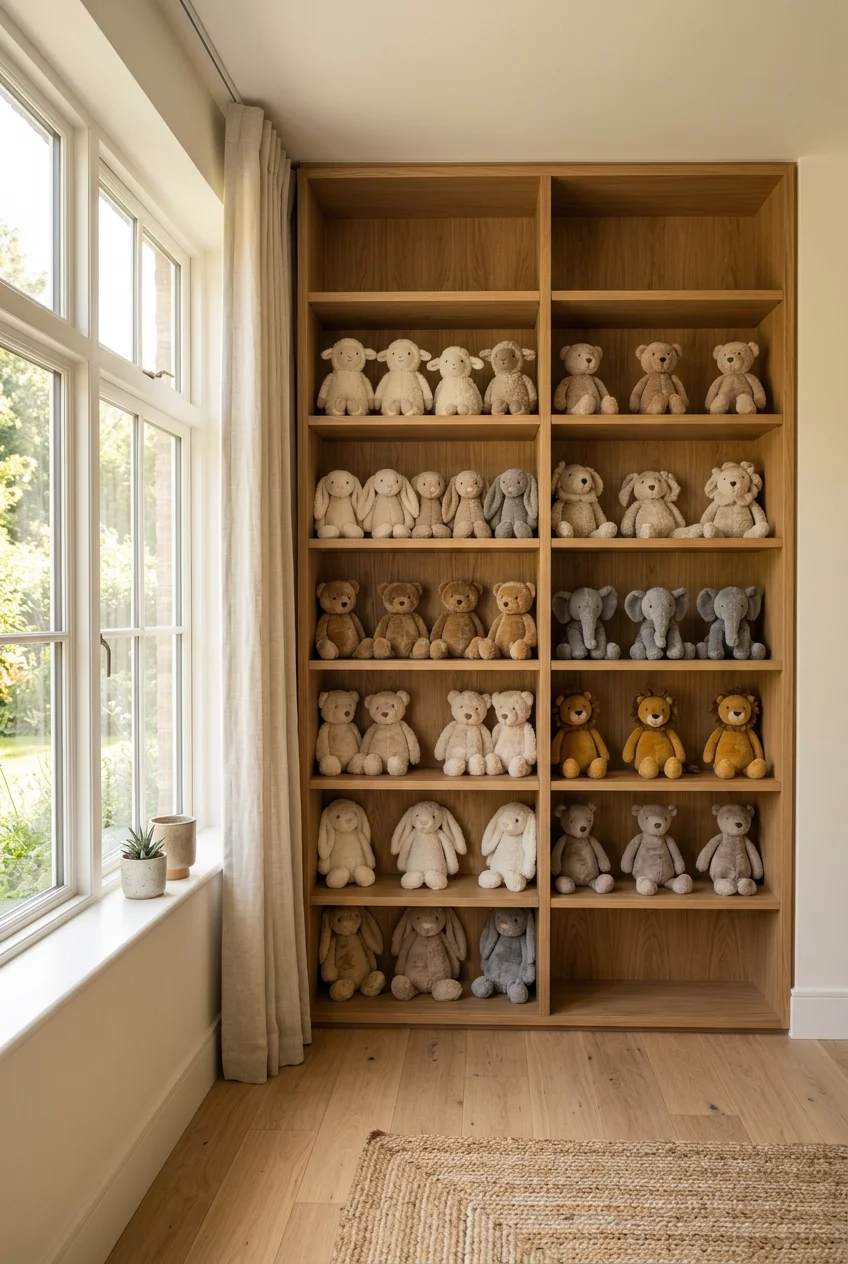
When you run out of floor space, you’ve got to look up. I live in an older house with tiny bedrooms. The floor space gets eaten up by a bed and a dresser instantly. I stole an idea I saw from Teddy Bear Art and installed floating shelves high up on the walls. I bought a set of three BAYKA Floating Shelves from Amazon for $23.99. They feature rustic pine wood boards measuring 16.5 inches long by 6 inches deep, with matte black metal brackets. These shelves are perfect for displaying those special, expensive plushies that your kids refuse to part with but rarely actually play with. You know the ones. The $35 souvenir stuffed dolphin from the aquarium trip. I lined them up neatly on the shelves. The raw wood texture of the shelves looks incredibly chic. But here’s my biggest warning. Don’t overcrowd the shelves. I tried cramming ten plushies onto one 16-inch shelf. It looked like a hoarder’s nest, and every time the door slammed, a stuffed animal would plummet to the floor. Keep it to three or four items per shelf. You might also like: 15 Stunning Organizing Kitchen Home Hacks Ideas You Haven’t Thought Of
8. Embrace Sustainable Stuffed Toy Storage

The 2026 interior design trends are leaning heavily into the “Cozy Culture” aesthetic. This means ditching the bright primary colors and harsh plastics for natural, sustainable materials. I’m fully on board with this. It makes a playroom feel like an actual part of your home instead of a plastic wasteland. Last Wednesday, I was browsing at Sprouts grabbing some overpriced organic apples when I realized I wanted my home organization to feel more natural, too. I started swapping out my ugly plastic tubs for organic cotton baskets. I found a gorgeous, thick-coiled cotton rope basket from the old Land of Nod collection (now Crate & Kids) on Poshmark for $28.00. It measures 18 inches wide by 14 inches high. The soft, unbleached cotton texture is beautiful. I also bought a set of three EKOBO bamboo storage jars for $35.00 to hold tiny doll accessories. They feel smooth and heavy, like polished stone. Upcycling an old wooden apple crate you find at a flea market works perfectly for this trend too. Just make sure you sand down the rough edges so your kids won’t get splinters.
9. Avoid the Dreaded Toy Box Black Hole

Let’s have a serious talk about the traditional wooden toy box. You know the one. It’s got a heavy hinged lid that threatens to crush tiny fingers. I hate them. I bought a beautiful, custom-painted wooden toy chest for $150 on Etsy when my first child was born. It was the biggest storage mistake I’ve ever made. It instantly became a black hole. Kids throw everything in there. The heavy wooden blocks sink to the bottom, crushing the delicate stuffed animals. The bottom of the box smells like stale crackers and despair. When your kid wants the toy at the very bottom, they literally have to shovel everything onto the floor to get it. Professional organizers completely agree with me on this. You’ve got to ditch the giant, single-cavity box. Instead, use smaller, categorized bins. I took that expensive wooden toy chest, removed the lid entirely with a screwdriver, and placed four smaller plastic bins inside it. Now, it acts as a frame to hold categorized containers. It completely stopped the chaotic dumping behavior.

SNSLXH 5 Pack Stackable Closet Storage Basket
A dependable everyday pick — SNSLXH 5 Pack Stackable Closet Storage Basket pulls in 4 ratings at 4.5 stars. Not flashy, just solid.
10. Involve Children in the Decluttering Process

You can buy all the expensive organizing products in the world, but if your kids aren’t on board, your house will be a wreck again in 48 hours. I used to wait until my kids were at school, and then I’d frantically throw away broken toys and donate stuffed animals I thought they didn’t care about. Big mistake. My daughter noticed her ratty, half-deflated stuffed cat was missing three weeks later and had an absolute meltdown in the middle of Kroger while I was trying to buy milk. Experts agree that you’ve got to involve them. It teaches them responsibility. Last weekend, I sat on the floor with my kids and a box of heavy-duty Hefty 30-gallon black trash bags ($14.99 at Target). We made three piles: keep, donate, and trash. I let them make the decisions. I was shocked. They willingly gave away toys I thought they loved. The key is giving them a physical boundary. I told my son, “You can keep whatever fits in this 14-inch basket. Once it’s full, we’ve got to donate the rest.” It worked like magic.
11. Use Mesh Laundry Bags Inside Larger Bins

This is a surprising tip that literally saved my sanity. Stuffed animals often come with tiny, annoying accessories. Build-A-Bear outfits, tiny plastic sunglasses, magnetic pacifiers. If you just throw these into a large bin with the plushies, they sink to the bottom and get lost forever. I was constantly stepping on tiny plastic shoes barefoot. I bought a 5-pack of Polecasa Mesh Laundry Bags from Amazon for $9.99. They measure 12 inches by 16 inches and feature a smooth rust-proof zipper. I use these bags to corral all the tiny accessories before throwing them into the larger toy bins. The white mesh material lets you see exactly what’s inside. I use one bag specifically for all the doll clothes. When my daughter wants to dress her bears, she just grabs the mesh bag. It keeps the sets together and prevents a jumbled mess. I even use a small 8-inch by 12-inch mesh bag for my son’s tiny plush keychains. It’s such a cheap fix, but it makes a massive difference in daily cleanup.
12. Create a DIY Stuffed Animal Zoo Display

If you’ve got a massive collection of medium-to-large plushies, you need a stuffed animal zoo. I kept seeing these on Pinterest and thought they looked way too complicated to build. I’m not a carpenter. But I finally caved and built one, and it’s brilliant. I went to Home Depot and bought four 1×2 pine boards (8 feet long) for about $3.50 each. I also bought a 20-pack of Kotap 24-inch bungee cords for $18.99. I built a simple tall rectangular frame. It measures 4 feet tall and 2 feet wide. I painted it with some leftover white semi-gloss trim paint I found in the garage. Then, I stretched the bungee cords vertically from the top board to the bottom board, spacing them about 4 inches apart. The flexible cords act like the bars of a “zoo cage.” Kids can just shove the stuffed animals through the stretchy cords. It holds an insane amount of fluff. The only negative is that the bungee cords can snap back and sting your fingers if you aren’t careful when installing them. Wear safety glasses.

Bathroom Organizers and Storage,4 Pack Bathroom Accessories
Bathroom Organizers and Storage has been one of the most consistently praised picks in this category. 32 reviewers averaged 4.5/5.
13. Repurpose Over-the-Door Shoe Organizers

Don’t sleep on over-the-door shoe organizers. They aren’t just for shoes. If your kid collects those tiny, palm-sized plushies like Squishville or Ty Teeny Tys, regular bins will swallow them whole. I tried putting them in a basket, but my kids would just dump the whole basket out to find the one pink axolotl they wanted. I went to Costco and bought a 2-pack of Whitmor Over-The-Door Shoe Organizers for $19.99. They measure 19 inches wide by 64 inches long and feature 24 clear vinyl pockets. I hung one on the back of my daughter’s closet door using the included metal hooks. The clear plastic pockets are the perfect size for tiny stuffed toys. The vinyl smells strongly of plastic when you first open it, so let it air out on your porch for a day. Now, my daughter treats it like a display case. She sorts them by color. It uses zero floor space, and the back of a closet door is usually completely wasted real estate anyway.
14. Maximize Space with Under-Bed Rolling Storage

The space under the bed is prime real estate that mostly just collects dust bunnies and stray socks. If your kids own a lot of large, flat stuffed animals or squishmallows, under-bed storage is the way to go. I used to just shove the plushies directly under the bed, but they’d get covered in dust and pet hair. It was gross. I bought two IRIS USA 50 Quart Clear Underbed Storage Bins with wheels from Amazon. They cost $29.99 for the set. They measure 39.75 inches long by 19.75 inches wide, and they’re only 6.5 inches tall. They slide perfectly under a standard twin bed. The little plastic wheels roll smoothly over my low-pile carpet. I love that the lids buckle securely on both ends. Just measure the clearance under your bed before you buy anything. I made the mistake of buying a 7-inch tall bin for a bed that only had 6 inches of clearance, and it got wedged so tightly I scraped the paint off the bed frame pulling it out.
15. Disguise Toys in Shared Spaces with Woven Baskets

If your house is anything like mine, the stuffed animals don’t stay in the bedrooms. They migrate to the living room like a slow, fuzzy invasion. I don’t want my living room looking like a daycare center. I want to drink my evening tea without staring at a neon blue Sonic the Hedgehog plushie. You need storage that disguises the toys completely. I rely heavily on massive woven baskets for the living room. I bought a gorgeous Threshold Water Hyacinth Round Basket from Target for $35.00. It measures 16 inches high and 18 inches in diameter. The thick woven seagrass has a wonderful, earthy smell and a really rich, natural texture. It looks like a high-end piece of decor sitting next to my sofa. But inside? It’s crammed full of stuffed animals. When guests come over, I just toss a stylish knit throw blanket (I bought mine at Whole Foods of all places, for $24.99) right over the top of the basket. It completely hides the toys. It’s my favorite lazy organizing hack.

Durmmur 2 Pack Hat Racks for Baseball Caps
Honestly, Durmmur 2 Pack Hat Racks for Baseball Caps surprised me — sturdier than it looks in the photos, and over 11 buyers gave it 4.5 stars.
16. Stuffable Bean Bag Chair Covers

This is my absolute favorite organization hack of all time. It serves a dual purpose, which is the holy grail of keeping a house clean. If your kids own dozens of soft, squishy plushies, don’t put them in bins. Put them inside a bean bag cover. I bought a Lukeight Stuffed Animal Storage Bean Bag Cover from Amazon for $26.99. It’s a 38-inch extra-large canvas bag with a heavy-duty zipper. Notice I said *cover*. It doesn’t come with the messy styrofoam beans. You use the stuffed animals as the stuffing. The thick cotton canvas feels incredibly durable. We shoved at least 60 medium and large plushies into this thing. Once it’s zipped up, it creates a massive, surprisingly comfortable floor lounger. My kids sit on it to read books or watch movies. One warning. Don’t put toys with hard plastic faces or electronic sound boxes in the bean bag. I accidentally left a talking Elmo near the surface, and every time my son sat down, the bag muffled a creepy “Ha ha! That tickles!” It was terrifying. Stick to purely soft plushies.
Organizing your kids’ toys doesn’t have to be a nightmare. I’ve spent years fighting the clutter, and I promise that setting up actual, functional systems changes everything. You don’t have to do all 16 of these ideas. Just pick two or three that make sense for your home and start there. I’d highly recommend starting with the stuffable bean bag cover or the clear Brightroom bins. They offer the fastest, most satisfying results. Don’t let the plushie mountain defeat you. Grab a coffee, buy some decent bins, and reclaim your floor space. If you found these tips helpful, definitely pin this article to your home organization boards on Pinterest so you can reference the exact measurements and prices later. I’m always tweaking my systems, but these are the foundational rules that keep my house from looking like a chaotic toy store. Let’s get organizing!
Frequently Asked Questions
How do you store stuffed animals so they don’t get dusty?
To keep plushies dust-free, I highly recommend using clear, stackable plastic bins with secure latching lids. Target’s Brightroom bins or under-bed rolling containers work perfectly. If you’re displaying them in a hammock, you’ll need to vacuum them lightly with a brush attachment every few weeks.
What is the best stuffed toy storage for a small bedroom?
When floor space is tight, you’ve got to use your walls and doors. Over-the-door clear shoe organizers are incredible for tiny plushies. For larger toys, hang a macrame corner hammock or install floating wood shelves high up near the ceiling to keep the floor totally clear.
How do I get my kids to put their stuffed toys away?
You have to make the system dead simple. Ditch the heavy toy boxes and use open bins or cube organizers. Label every single basket with a picture sticker, not just words. If they can see exactly where the teddy bear goes, they’re much more likely to do it themselves.
Can I store stuffed toys in the garage or attic?
I wouldn’t recommend it unless you’re using heavy-duty, airtight plastic totes. Garages and attics have extreme temperature swings and humidity that can cause mold inside the stuffing. Pests also love nesting in soft fabrics. Always keep cherished plushies inside the climate-controlled parts of your house.
