
What’s Inside
- Ditch the Fixed Wire Racks for Budget-Friendly Modular Systems
- Master Front Hall Closet Organization by Fixing Shelf Depth
- Stack Vertical Shoe Racks to Clear Floor Space
- Reclaim 16 Square Feet with Over-the-Door Storage
- Swap Plastic for Bamboo and Water Hyacinth Bins
- Install Clear Acrylic Dividers for Top-Shelf Structure
- Standardize with Slim Velvet Hangers to Double Capacity
- Assign Dedicated Jute Baskets for Each Family Member
- Stick Up Motion-Sensor LED Lights for Dark Corners
- Hack a Custom Look Without the $5,000 Price Tag
- Maintain Front Hall Closet Organization with the Outfit Method
- Mount Magnetic Strips for Keys and Dog Leashes
Last Tuesday, I stood in my entryway holding three heavy paper bags from Trader Joe’s while it poured freezing rain. I reached with my pinky to yank open the door, and a literal avalanche of winter coats, stale snow boots, and a rogue tennis racket spilled onto my wet boots. Effective front hall closet organization isn’t just about making your house look pretty for the internet. It’s about preventing that exact moment of frustration when you’re dripping wet, your arms are burning, and you just want to drop your groceries without fighting your own house. Most builder-grade closets are designed terribly. They give you one flimsy wire shelf, a single wooden rod, and a massive empty cavern of floor space where shoes go to die.
I lived with that useless setup for three years. I tried stuffing things into random fabric bins. I bought cheap plastic hooks that snapped under the weight of a damp wool coat. I did this wrong for months before figuring it out—it took me years, honestly. You don’t need to hire a luxury contractor to fix this space, but you do need a plan. The front closet is the hardest working three square feet in your home. It handles wet materials, heavy fabrics, awkward sporting goods, and daily traffic. If the systems aren’t rigid, the whole thing falls apart by Wednesday. Here are twelve specific, budget-friendly ways I overhauled my entryway storage, down to the exact measurements and prices.
1. Ditch the Fixed Wire Racks for Budget-Friendly Modular Systems

The biggest mistake you can make is relying on the single fixed shelf your house came with. Winter coats require different vertical clearance than spring rain jackets, and your needs change between December and July. I recommend a modular closet system. The Container Store’s Elfa classic system is my go-to. A basic setup starts around $500, which is cheaper than custom cabinetry but much more functional than static shelves.
I tried doing this the cheap way first. I bought a $29.99 fixed wire rack from Walmart, screwed it into the drywall with cheap anchors, and loaded it with five heavy winter coats. Two weeks later, I heard a massive crash in the middle of the night. The rack pulled out of the wall, taking chunks of drywall with it. Modular systems like Elfa or Preston use a steel top track that anchors into your wooden studs. Once that top track is secure, the vertical standards hang off it, and you can adjust the shelves in one-inch increments without drilling another hole.
This flexibility is crucial. In the winter, I move the bottom shelf up to 24 inches off the floor for tall, wet snow boots. In the summer, I drop that same shelf to 10 inches because we only store flat sandals and running shoes. You aren’t locked into one configuration. If you’re on a strict budget, you can buy just the top track, two vertical standards, and one adjustable shelf for under $100, then add more components as your budget allows. It’s a methodical way to build out your space over time.
2. Master Front Hall Closet Organization by Fixing Shelf Depth

Most people get this wrong. Builder-grade wooden shelves are often cut to 18 or 20 inches deep. This sounds great in theory because it feels like more storage. In reality, anything deeper than 14 inches above shoulder level turns into a black hole. Two years ago, I lost a thick wool scarf for an entire winter. I found it in April, crushed behind a stack of unused reusable grocery bags at the back of a 20-inch deep shelf.
For proper front hall closet organization, 12 to 14 inches is the sweet spot for shelf depth. This measurement allows a standard folded sweater or a row of hats to sit flush with the front edge, leaving zero dark space behind them. If you can see the back wall of the closet behind your items, you won’t lose them. I went to Lowe’s and had them cut standard white melamine boards to exactly 12 inches deep. The boards cost $16.48 each, and the cutting service was free.
If you have deep shelves and can’t replace them, use a physical barrier to stop items from sliding backward. I took a piece of scrap wood, cut it to the width of the closet, and screwed it into the top of the shelf, exactly 12 inches from the front edge. It acts as a bumper. When I push a basket or a stack of folded scarves back, they hit the wood strip and stop. It forces all the inventory to stay at the front of the shelf where the light hits it. It’s a minor structural change that eliminates lost items.
3. Stack Vertical Shoe Racks to Clear Floor Space

The floor of a front closet is a disaster zone. When you leave empty floor space beneath hanging coats, family members will kick their shoes into a chaotic pile. You end up digging through a mountain of footwear while trying to leave the house. You have to remove the option to pile things. I bought the Yamazaki Slim Shoe Rack for $65 at West Elm last October, and it changed how the floor functions.
This specific rack is only 8.7 inches deep. That measurement is critical because standard shoe racks are usually 12 to 14 inches deep, which interferes with the hems of long winter coats hanging above them. The Yamazaki rack hugs the back wall tightly. It holds six pairs of adult shoes vertically. By stacking the shoes upward rather than spreading them across the floor, I reclaimed enough horizontal space to store a bulk 30-pack of toilet paper from Costco on the left side of the closet.
For off-season or formal footwear you don’t wear daily, skip the open racks. I use the Cambridge Drop-Front Shoe Boxes from The Container Store. They cost $11.99 each. The drop-front door means you don’t have to unstack the boxes to get a pair of shoes out of the bottom bin. I stack four of these clear boxes on the top shelf for my formal heels and my husband’s dress shoes. They keep the dust off the suede, and the clear acrylic lets me instantly see which box holds the black pumps versus the navy ones. Skip the opaque plastic tubs. If you can’t see the shoes, you won’t wear them.
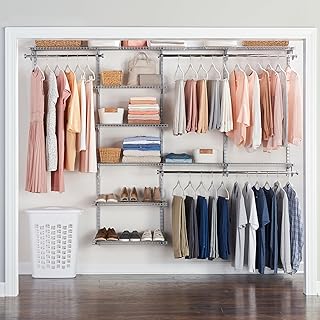
Rubbermaid Configurations Deluxe Custom Closet Kit 4-8 Ft.
Rubbermaid Configurations Deluxe Custom Closet Kit 4-8 Ft. Adjustable has been one of the most consistently praised picks in this category. 81 reviewers averaged 4.5/5.
4. Reclaim 16 Square Feet with Over-the-Door Storage

The back of a standard interior door measures roughly 16 square feet. Leaving it blank is a waste of usable real estate. However, you have to be careful about what you hang there. I made a mistake a few years ago—learned that the hard way. I bought a flimsy fabric shoe organizer from Amazon for $9.99. I stuffed it with heavy metal flashlights, wet umbrellas, and thick winter gloves. The fabric ripped within a month, and the cheap metal hooks scratched the paint right off the top of my door frame.
Skip the fabric pouches. They hold moisture, they smell like damp dog after a week of storing wet leashes, and they look messy. Instead, you need rigid, structured storage. I use the Elfa Utility Door and Wall Rack system. It costs around $140 for a full setup, including a central steel spine and several adjustable metal wire baskets. The entire system clamps onto the top and bottom of the door, so it won’t swing away from the wood and bang every time you open the closet. You might also like: 15 Utility Closet Organization Ideas Worth Trying
I use the deepest basket at the bottom for tall, awkward items like my travel umbrella and a can of waterproof shoe spray. The middle baskets hold our dog’s leash, harness, and a roll of waste bags. The top, shallowest basket holds sunglasses and a tube of SPF 30 lip balm. The rigid metal baskets allow wet items to air dry, preventing that stale, mildew smell. If $140 is too steep, Yamazaki makes a brilliant overdoor hanger with wooden hooks for $18.50. It’s minimal, it won’t scratch your paint, and it easily holds three heavy wet coats while they dry. You might also like: 20 Beautiful Aesthetic Home Makeover You Can Try Today
5. Swap Plastic for Bamboo and Water Hyacinth Bins

There is a shift happening in home organization toward natural materials, and it’s not just about aesthetics. Cheap plastic storage bins are terrible for entryway closets. If you live in a cold climate, the air right next to your front door drops significantly in temperature during the winter. I used to use clear plastic shoeboxes for my winter hats. In January, the plastic got freezing cold and brittle. I dropped one onto the hardwood floor, and it shattered into sharp, jagged pieces. You might also like: 12 Home Screen Organization Iphone for Every Budget
Natural materials handle temperature fluctuations better. I picked up four woven water hyacinth baskets from Target for $24.99 each. They measure 11 by 11 inches, perfectly fitting my 12-inch deep shelves. The thick woven texture hides dirt, and the natural fibers allow air to circulate around damp wool scarves, preventing them from smelling musty. I use one basket exclusively to hold all the crumpled reusable grocery bags from Whole Foods that used to spill everywhere.
For smaller items like keys, loose change, or dry-cleaning receipts, I use bamboo drawer organizers resting flat on the shelf. You can get a set of three bamboo trays for $15 at Walmart. The wood brings visual warmth to a space that is usually stark white and filled with nylon coats. Bamboo is also durable. When my wet boots splashed mud onto the bottom shelf, the bamboo tray wiped clean instantly with a damp cloth, whereas the rough plastic bins I used to own would permanently stain from the muddy water.
6. Install Clear Acrylic Dividers for Top-Shelf Structure

Top shelves are notoriously difficult to keep tidy. When you stack thick winter sweaters or bulky spare blankets, the piles lean to one side and topple over. You reach up to grab a black cardigan, pull it from the middle of the stack, and the entire pile collapses. Then you just shove the door closed and ignore the mess. You need rigid vertical boundaries to maintain order on flat shelves.
I use J&V Textiles clear acrylic shelf dividers. You can buy a pack of four on Amazon for $22.99. They are 8.25 inches high and 11.5 inches deep. They slide onto any standard 3/4-inch thick wooden shelf without any screws, tools, or hardware. The tension clamp holds them firmly in place. Because they are completely clear, they don’t block the overhead light or make the closet feel cramped.
I set the dividers exactly 10 inches apart. This creates distinct cubbies. I have one section for my husband’s heavy wool sweaters, one section for my cardigans, and one section for structured handbags. Last month, I came home with six heavy paper bags from Sprouts. I shoved them onto the top shelf temporarily. Because the acrylic dividers were there, the bags stayed upright instead of tipping over and spilling apples across the closet floor. The dividers force you to respect the physical boundaries of the space. You can’t lazily toss an item onto the shelf; you have to place it within the designated 10-inch slot.

Ulif E1 Heavy Duty Closet Garment Rack
If you want something that just works, Ulif E1 Heavy Duty Closet Garment Rack is a safe bet (14 reviews, 4.5 stars).
7. Standardize with Slim Velvet Hangers to Double Capacity

If you open your closet right now and see a chaotic mix of thick wooden hangers, cheap dry-cleaning wire hangers, and bulky plastic tube hangers, you’re wasting an enormous amount of space. I used to save the thick plastic hangers from retail stores thinking I was being frugal. I measured them last year. A standard plastic hanger takes up 1.5 inches of horizontal space on the closet rod. A slim velvet hanger takes up 0.2 inches.
By switching out the hangers, you can increase your hanging capacity by up to 50 percent. I bought a 50-pack of Brightroom black velvet hangers from Target for $22.49. The velvet flocking is crucial for an entryway closet. Nylon rain jackets and silky trench coats slip right off plastic hangers and end up in a wrinkled puddle on the floor. The velvet texture grips the slick fabrics tightly, holding them securely in place even when you brush past them.
There is one rule here: you can’t use velvet hangers for damp items. If you hang a soaking wet raincoat on a black velvet hanger, the dye from the velvet can transfer to the inner lining of your coat. For wet items, I keep exactly three slim chrome metal hangers pushed to the far right side of the rod. They cost about $10 for a 10-pack. They’re just as thin as the velvet ones, but they won’t transfer dye when exposed to water. The visual uniformity of having all black hangers makes the closet look professionally organized, even if it’s packed full.
8. Assign Dedicated Jute Baskets for Each Family Member

When you share a house with other people, communal storage bins fail quickly. If you throw everyone’s winter gear into one giant basket, you end up with a tangled knot of mismatched gloves and scarves. Last winter, my kids kept throwing their wet, snowy gloves onto the top shelf. The damp wool smell lingered for weeks, and we could never find a matching pair when we were rushing out the door for school.
You have to isolate the inventory. I bought four structured jute baskets from Lowe’s for $15.98 each. They measure 13 by 13 inches. I assigned one specific basket to each family member. I used heavy-duty black safety pins to attach a rigid metal label holder to the front of each jute basket, sliding a white card with a printed name into each slot. Jute is an incredibly tough, rough material. It withstands being yanked off the shelf daily by impatient teenagers.
This system eliminates the morning panic. If my son can’t find his left glove, I know with 100 percent certainty that it isn’t in my basket. He only has to dig through his own designated 13-inch space. When we got caught in a massive downpour running from Kroger to the car last month, we came home completely soaked. The kids knew exactly where to drop their wet hats. The open top of the jute baskets allows the items to dry out naturally, and the rough texture of the natural fiber hides the inevitable dirt and salt stains that come with winter weather.
9. Stick Up Motion-Sensor LED Lights for Dark Corners

Lighting is the most ignored aspect of closet organization. If you can’t see into the back corners of your shelves, those corners become dumping grounds for trash, old receipts, and broken umbrellas. Hardwired closet lighting costs between $200 and $800 to install professionally. I don’t have that kind of budget for a space where I mostly just store dog bags and winter coats.
Instead, I use battery-operated motion-sensor LED lights. I bought a 3-pack of GE magnetic light bars for $24.99. They run on standard AAA batteries and attach to the wall with a strong adhesive magnetic strip. I stuck one light to the ceiling of the closet, right above the hanging rod, and I stuck another one horizontally underneath the bottom shelf, pointing directly at the shoe rack on the floor.
The motion sensor is sensitive. The second I pull the closet door open, the lights snap on, flooding the space with bright white light. It makes a difference when you’re trying to distinguish between a navy blue jacket and a black jacket at 6:00 AM in the middle of December. The battery life is excellent because the lights automatically shut off 20 seconds after you close the door. I’ve only had to replace the batteries twice in the last year. It gives you the high-end look of custom lit cabinetry for less than thirty dollars.

AWTATOS Cube Storage Organizer Storage 12 Cube Bookshelf
AWTATOS Cube Storage Organizer Storage 12 Cube Bookshelf DIY Plastic C punches above its price — 28 buyers rated it 4.5 stars. I would buy it again.
10. Hack a Custom Look Without the $5,000 Price Tag

Professional custom closets from companies like Inspired Closets run anywhere between $2,500 and $10,000. They look incredible, with solid wood backing, soft-close drawers, and integrated shoe cubbies. I wanted that heavy, built-in look without the massive price tag. You can hack this aesthetic using standard flat-pack furniture if you know how to anchor it.
I bought a narrow, white Billy bookcase from IKEA for $45. It measures exactly 15.75 inches wide and 79 inches tall. I removed the existing wire shelf and hanging rod from my closet completely. I pushed the tall bookcase into the center of the closet and anchored it firmly to the back wall studs using heavy-duty L-brackets. This created a rigid, central tower of adjustable shelves right in the middle of the space.
Then, I went to Lowe’s and bought two wooden closet rods for $12 each. I installed one rod on the left side of the bookcase for long coats, and two tiered rods on the right side for shorter jackets and kids’ coats. I screwed the rod brackets directly into the side of the bookcase and the side walls of the closet. By using the $45 bookcase as the central anchor, I created a custom-looking, multi-zoned closet system for under $100. It looks substantial, it holds heavy weight, and it divides the space visually into specific functional zones.
11. Maintain Front Hall Closet Organization with the Outfit Method

The physical products you buy only solve half the problem. The behavioral systems you use dictate whether the closet stays clean. I used to spend ten minutes every morning hunting for matching winter accessories. I’d find the coat, then dig through a basket for the hat, then search the floor for the gloves. I started doing the outfit method after a stressful morning trying to get my daughter to a pediatrician appointment in the snow.
The outfit method is simple but effective for front hall closet organization. When you take a winter coat off, you don’t throw the accessories into a basket. You store the hat and the mittens directly inside the sleeves of the coat. I shove the left mitten and the knit hat into the left sleeve, and the right mitten into the right sleeve. If my kids are wearing snow pants, I fold the snow pants over the bottom bar of the hanger, then drape the heavy coat over the top.
This keeps entire functional sets permanently grouped together. When I grab my heavy parka off the rod, I know with absolute certainty that my thick waterproof gloves are already inside the sleeves waiting for me. It eliminates the need for massive accessory bins on the shelves, freeing up that space for bulky items like motorcycle helmets or large purses. It requires a few extra seconds of effort when you take the coat off, but it saves you minutes of angry searching when you’re rushing to leave the house.
12. Mount Magnetic Strips for Keys and Dog Leashes

Small, heavy items create the most visual clutter in an entryway. Keys, metal flashlights, and dog leash clips usually end up dumped in a messy ceramic bowl on a console table, or shoved onto the edge of a closet shelf where they get knocked off. I hate hearing the sound of a heavy set of keys hitting the hardwood floor. To solve this, I started utilizing the vertical wall space just inside the closet door frame.
I bought a 15-inch stainless steel magnetic knife strip from IKEA for $14.99. Instead of using it in the kitchen, I mounted it vertically on the inside wall of the front closet, right at eye level. The magnet is strong. I toss my heavy metal keychain at the wall, and it snaps perfectly into place with a satisfying click. It holds our car keys, a small metal flashlight for evening dog walks, and the heavy brass clip of the dog’s leather leash.
This keeps these small, dense items off the shelves and out of the baskets. It also acts as a visual reminder. I use a small magnetic clip to stick my paper grocery list from Sprouts directly to the strip, right next to my car keys. I can’t leave the house without grabbing my keys, which means I can’t accidentally leave the grocery list behind. It’s a tiny, $15 addition that improves the daily function of the space.
Organizing a front hall closet on a budget isn’t about buying matching plastic bins and making it look like a magazine spread. It’s about measuring your specific shelf depth, standardizing your hangers, and creating rigid boundaries that force the mess to stay contained. I’ve used this exact setup for two years now, and the door actually closes on the first try every time. If you found these specific measurements and product details helpful, pin this article for your next weekend project so you have the exact dimensions ready when you hit the hardware store.

Ulif E10 Clothes Rack(With Stretchable Hanger
Ulif E10 Clothes Rack(With Stretchable Hanger Rod)Freestanding Clothin has been one of the most consistently praised picks in this category. 951 reviewers averaged 4.5/5.
Frequently Asked Questions
What is the best shelf depth for a front hall closet?
The ideal shelf depth is 12 to 14 inches. Anything deeper than 14 inches creates a dark space where small items like gloves and scarves easily get pushed to the back and lost.
How can I store wet winter boots without ruining my closet floor?
Use a tiered vertical shoe rack made of rust-resistant metal or powder-coated steel, like the Yamazaki slim rack. Avoid wooden or fabric racks, which absorb moisture, warp, and hold onto musty odors.
Are custom closet systems worth the money for an entryway?
While luxury custom closets can cost over $5,000, you can achieve similar functionality on a budget using modular wall-mounted systems like Elfa, which start around $500 and allow you to adjust shelf heights seasonally.
How do I keep tall stacks of sweaters from falling over?
Install clear acrylic shelf dividers. They slide directly onto standard wooden shelves without tools, providing rigid vertical boundaries that keep stacks of bulky winter clothing upright and neatly separated.
