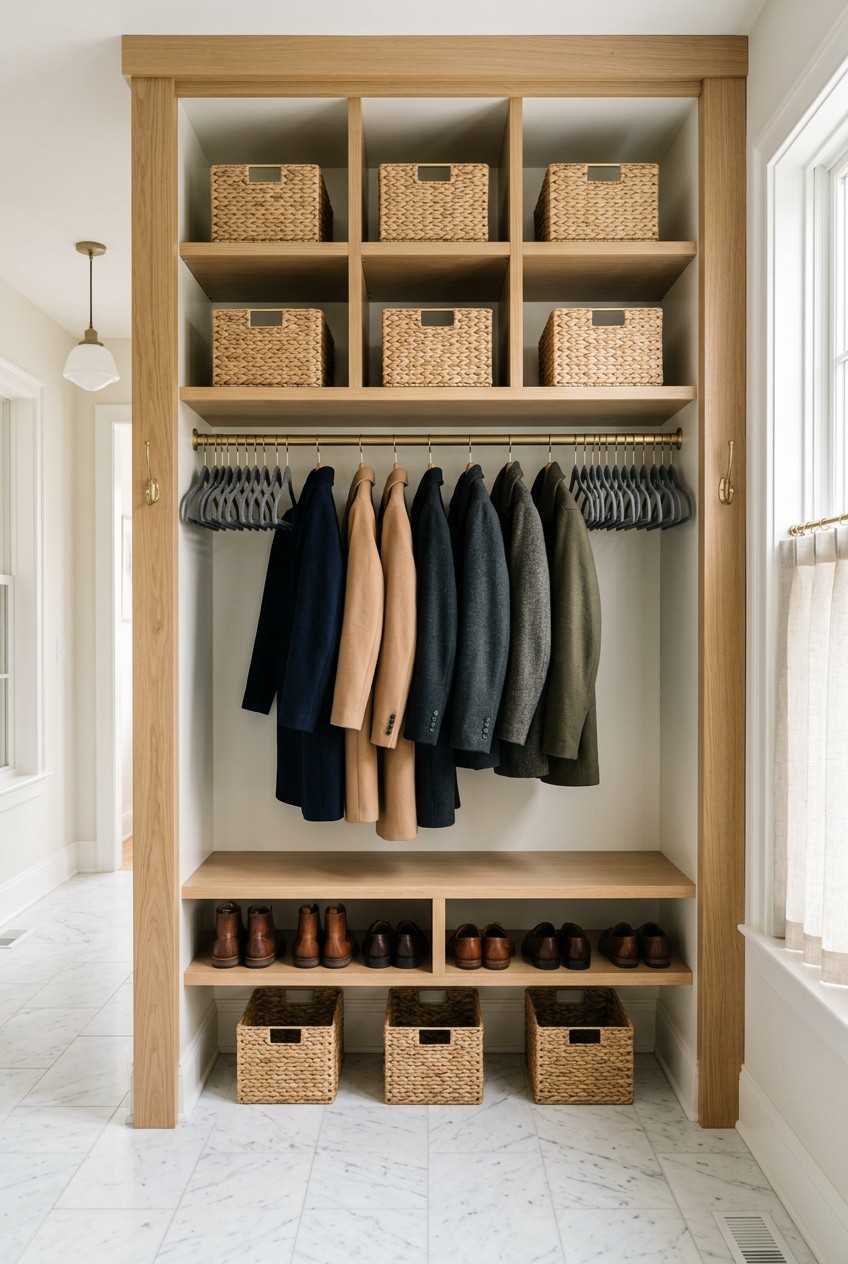
What’s Inside
- Declutter Ruthlessly and Seasonally for Optimal Space
- Maximize Vertical Space with Double Hanging Rods
- Invest in Quality, Uniform Slim Hangers
- Implement a “Shoes Above Coats” Strategy
- Utilize Over-the-Door Organizers for Accessories
- Employ Smart Bin and Basket Systems for Contained Clutter
- Embrace Specific Labeling for Effortless Retrieval
- Integrate a Mudroom Bench for Multi-functional Entryways
- Zip or Button Up Coats Before Hanging
- Store Off-Season Items in Climate-Controlled Conditions
- Prioritize Function Over Aesthetics for Daily Use
- Don’t Overlook Proper Lighting
- Designate a Spot for Empty Hangers
- Organize Items by “How You Wear Them on Your Body”
- Embrace Eco-Conscious Organizing with Durable Materials
Last November, I opened my hallway door and 14 scarves, three broken umbrellas, and a rogue snow boot immediately cascaded onto my feet. That humiliating avalanche was my breaking point. Let’s be real, effective coat closet organization isn’t just about making things look pretty. It’s about surviving the morning rush without losing your mind. I used to think I just needed a bigger house, but my storage systems were the real problem. I’d shove wet jackets next to dry-clean-only wool, kick my muddy boots into dark corners, and pray the door would close. I spent a frantic Saturday running to Target and completely overhauling my space. If you’re tired of fighting with tangled hangers and losing your favorite gloves in a dark abyss, you’re in the right place. I’m sharing the exact strategies, measurements, and specific products that finally brought peace to my entryway.
1. Declutter Ruthlessly and Seasonally for Optimal Space

I’m a huge believer in starting with a blank slate. You can’t organize clutter. I did this wrong for months before I figured it out. I’d just shuffle my heavy wool coats from the left side to the right and pretend I’d accomplished something. Pros at Composed Living always emphasize pulling every single item out first. Sort everything into keep, donate, and discard piles right on your living room floor. I’m embarrassed to admit I found three single gloves and a torn jacket from 2018 during my last purge. Once you’re staring at an empty space, you’ll realize how much room you actually have. The secret to coat closet organization is ruthless seasonal rotation. During the sweltering summer months, your heavy winter parkas shouldn’t be hogging prime real estate. I pack my bulky winter gear into heavy-duty vacuum-sealed bags or breathable canvas bins. I specifically use the Target Brightroom 66-quart clear bins. They cost exactly $15 each and stack perfectly under my guest bed. This simple swap frees up massive amounts of space for lightweight spring jackets and umbrellas. If you aren’t wearing it this season, it doesn’t belong behind that door. It’s a harsh rule, but it works.
2. Maximize Vertical Space with Double Hanging Rods

Most people look at their closet and only see the horizontal space. You’re ignoring the vertical potential. Standard coat depth is usually 22 to 24 inches. That leaves a massive, gaping void of unused air right below your hanging jackets. I used to just throw my reusable Trader Joe’s grocery bags into a messy pile on the floor of that empty space. It looked terrible and made finding anything impossible. Installing a second hanging rod completely fixes this. You can buy a simple ClosetMaid adjustable tension rod for $16.98 at Home Depot or Walmart. It takes roughly five minutes to install. You just twist it until it locks into the side walls. Suddenly, you’ve created two distinct tiers of storage. I hang my shorter denim jackets, raincoats, and cardigans on the top rod. Then I use the bottom rod for hanging pants, skirts, or longer scarves. It effectively doubles your hanging capacity without requiring any major renovations. If you’re tired of cramming your clothes together until they wrinkle, this is the best $17 you’ll ever spend. It’s a massive relief to actually see space between your hangers.
3. Invest in Quality, Uniform Slim Hangers

I can’t stress this enough. Throw away those flimsy wire hangers you get from the dry cleaner. They warp your clothes, they tangle, and they look like garbage. I swapped my entire chaotic collection for uniform slim hangers last Tuesday at Whole Foods, and the visual difference was shocking. I specifically buy the Utopia Home Velvet Hangers. You can grab a pack of 50 for about $24.99 on Amazon. The velvet texture grips the fabric, so your silky raincoats won’t constantly slip off and land in a crumpled heap on the floor. Plus, their ultra-slim profile means you can fit 30 percent more items on a single rod. But I need to share a crucial warning. Don’t use those thin velvet hangers for your 15-pound winter parkas. Organizer Jennifer Pearson rightly points out that heavy winter coats need substantial support. I learned this the hard way when a cheap plastic hanger snapped under the weight of my wool peacoat, leaving a sharp plastic shard sticking into the fabric. For the heavy stuff, I buy the IKEA Bumerang solid wood hangers. They cost $6.99 for an 8-pack and they won’t warp under pressure.
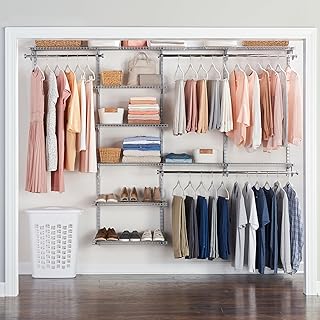
Rubbermaid Configurations Deluxe Custom Closet Kit 4-8 Ft.
Rubbermaid Configurations Deluxe Custom Closet Kit 4-8 Ft. Adjustable has been one of the most consistently praised picks in this category. 81 reviewers averaged 4.5/5.
4. Implement a “Shoes Above Coats” Strategy

This sounds backwards, but it works. Organizer Jennifer Pearson recommends perching your shoes on the shelves above your coats. I thought this was ridiculous until I actually measured my stuff. Shoes are typically shallow, averaging around 12 inches in length. Coats are deep, pushing 22 to 24 inches. When you put shoes on the floor beneath coats, they get completely swallowed by the dangling fabric. I used to kick my muddy boots into the bottom corner, and the wet dirt smell would just bake into the hems of my nice jackets. Now, I put my everyday sneakers and boots on the upper shelves at eye level. I use clear Container Store drop-front lucite shoe boxes that cost $11.99 each. Because they’re at eye level, I can instantly see what I need without digging through a dark, dusty floor pile. It keeps the dirty soles away from my clean clothes. If you’re dealing with a tiny entryway, moving your footwear up high completely clears the floor for a small bench or a heavy-duty boot tray for snowy days. It’s an incredibly logical swap once you try it. Trust me.
5. Utilize Over-the-Door Organizers for Accessories

The back of your closet door is prime real estate you’re probably ignoring. I used to just stick a single Command hook back there and call it a day. That was a huge mistake. You need an over-the-door shoe organizer. But the trick is that you aren’t going to put shoes in it. I bought the Whitmor 24-pair clear pocket rack for exactly $18.70. Instead of footwear, I fill those transparent pockets with all the tiny, frustrating accessories that usually get lost. One row holds my husband’s bulky winter gloves. Another row holds rolled-up beanies and scarves. The bottom pockets are dedicated to our dog’s gear. I shove muddy leashes, a roll of waste bags, and an extra collar down there. Before I did this, I’d constantly lose my keys under a mountain of knit hats on the top shelf. The clear plastic makes everything visible in one quick glance. Just make sure you measure the gap between your door and the frame before buying the metal hooks. If the hooks are too thick, your door won’t close properly. I had to return my first organizer because it scraped the paint off my door frame every time I shut it. You might also like: 20 Stunning Tool Storage Organizing Ideas for a Fresh New Look
6. Employ Smart Bin and Basket Systems for Contained Clutter

Loose items are the enemy of a tidy space. If you just stack loose hats and umbrellas on a shelf, they will inevitably fall over. I love the aesthetic of natural woven materials. I bought three beautiful, scratchy seagrass baskets from Target for $20 each. They smell earthy and bring warmth to the space. For the heavy-duty stuff, I rely on the Mainstays Fabric Storage Baskets from Walmart. They cost about $11.88 each and feature thick, reinforced handles. I use these deep bins on the very top shelves for items I don’t need every single day. One bin holds my thick wool scarves. Another holds extra reusable canvas grocery bags from Sprouts. When you use bins, you essentially create custom drawers on your flat shelves. You can just pull the whole basket down by the handle, grab what you need, and slide it back up. It completely stops the domino effect of pulling one sweater and ruining the entire stack. Just make sure the bins you buy actually fit the depth of your shelf. I once bought bins that hung two inches over the edge, and they looked awful. You might also like: 15 Clever Kitchen Small Space Ideas That Changed Everything

AMKUFO 6 Pack-Closet-Organizers-and-Storage
AMKUFO 6 Pack-Closet-Organizers-and-Storage has been one of the most consistently praised picks in this category. 52 reviewers averaged 4.5/5.
7. Embrace Specific Labeling for Effortless Retrieval

You might think you’ll remember what you put inside those opaque canvas bins. I promise you won’t. I spent an entire frantic morning last February tearing apart three different baskets looking for my favorite touchscreen gloves, only to find them hiding under a pile of dog sweaters. Specific labeling is crucial for maintaining the systems you build. I bought the NEAT Method Closet and Mudroom Label Set. It comes with 72 preprinted, repositionable labels that cover almost every category imaginable. If you want something more customized, you can order custom die-cut vinyl labels from Etsy shops starting around $4.50 for a small set. I slap these labels right on the front of my Walmart fabric bins. Now, my husband actually puts his winter gear back in the correct spot because the bin literally says Mike’s Gloves in bold black letters. It eliminates all the guesswork. If you’re using clear acrylic bins, you might not need labels for yourself, but they still help other family members understand your system. Don’t skip this step. It’s the glue that holds your entire organization strategy together. You might also like: 20 Creative DIY Garage Organization Ideas That Changed Everything
8. Integrate a Mudroom Bench for Multi-functional Entryways

If your coat closet is located right by your front door, you desperately need a place to sit down. Hopping on one foot while trying to yank off a wet snow boot is dangerous and annoying. I finally gave up and bought a mudroom bench. The ideal dimensions for an entryway bench are 17 to 18 inches in depth and 40 to 50 inches in width. This size comfortably seats two people without blocking the hallway traffic. I purchased the Vasagle industrial wood and metal bench for $65.99 on Amazon. It has a sturdy wooden top and two metal mesh shelves underneath. I bought specific wire baskets measuring 12 inches wide, 14 inches deep, and 8 inches high to slide perfectly onto those lower shelves. We drop our daily mail and keys in one basket, and our dirty work shoes in the other. It completely fixed our morning routine. Instead of leaning against the wall and scuffing the paint, we sit comfortably. If you have the floor space inside your actual closet, you can even tuck a small bench right under your hanging coats. Just measure carefully so your long coats don’t drape all over the seating area.
9. Zip or Button Up Coats Before Hanging

This is a tiny habit change that makes a surprisingly massive difference. Organizer Jennifer Pearson taught me to always zip or button up outerwear before putting it on a hanger. I used to just toss my jackets onto the rod with the zippers flapping open. They took up twice as much horizontal space because the sides flared out. Worse, the sharp metal zipper teeth would catch on delicate fabrics nearby. I actually ruined a $150 North Face puffer jacket because an unzipped zipper from a neighboring denim jacket snagged the thin nylon shell and ripped a massive hole in the sleeve. Feathers went everywhere. It was a nightmare. When you zip your coats all the way up to the collar, they hang in a perfectly streamlined, compact tube. They take up significantly less room on the rod. Plus, it forces the coat to sit perfectly centered on the hanger, so it won’t slide off one shoulder and fall to the floor. It takes exactly three extra seconds when you’re putting your coat away, but it protects your expensive garments and keeps the entire closet looking incredibly neat.

AWTATOS Cube Storage Organizer Storage 12 Cube Bookshelf
If you want something that just works, AWTATOS Cube Storage Organizer Storage 12 Cube Bookshelf DIY Plastic C is a safe bet (28 reviews, 4.5 stars).
10. Store Off-Season Items in Climate-Controlled Conditions

A huge mistake people make is violently shoving their expensive winter wool coats into cheap plastic garbage bags for summer storage. I did this once with a beautiful, expensive cashmere sweater. When I pulled it out in November, it was covered in mildew and smelled like a damp basement. Plastic completely traps moisture and destroys natural fibers. You must store your delicate off-season items in breathable canvas or linen storage bins. Before you pack anything away, wash or dry clean it. Moths are attracted to the invisible body oils and food particles left on worn clothes. I wrap my clean wool coats in acid-free tissue paper and place them in my canvas bins. Then, I toss in a handful of Household Essentials natural cedar blocks. You can get a 24-pack on Amazon for $9.99. They smell like a fresh pine forest and act as a natural moth repellent. I also throw in a few dried lavender sachets for good measure. Keep these bins in a climate-controlled area under your bed or on a high closet shelf. Never store your good coats in a hot, humid attic or a damp garage unless you want them ruined.
11. Prioritize Function Over Aesthetics for Daily Use

I love scrolling through perfectly color-coordinated closets on Instagram just as much as anyone else. But organizer Lauren constantly reminds her clients that function must always come before aesthetics. I learned this lesson the hard way. I once tried to organize my entryway by transferring all my loose items into identical, opaque white acrylic boxes. It looked stunning. It belonged in a magazine. But it was entirely dysfunctional. I couldn’t see what was inside, so I’d have to open four different boxes just to find my sunglasses. Eventually, I got lazy and just started leaving my stuff on the kitchen counter instead. Design your coat closet organization around how your household actually operates. Keep your most frequently accessed items right at eye level. My current-season jackets and my bulky Costco reusable grocery bags (which I bought in a 4-pack for $6.99) are front and center. The things I only need once a month, like my heavy snow boots, live on the highest shelf. It doesn’t look perfectly symmetrical anymore, but it actually works for my family’s chaotic mornings. If a system is too pretty to touch, it’s a bad system.
12. Don’t Overlook Proper Lighting

A dark closet is basically a black hole where your favorite clothes go to die. You can’t organize what you can’t see. Most builder-grade coat closets don’t even have a hardwired light fixture inside. For years, I used my phone flashlight to dig around in the corners looking for matching shoes. Interior designers strongly recommend installing proper lighting to illuminate your wardrobe. You absolutely want to avoid harsh fluorescent lights, which distort colors and make navy blue look exactly like black. Instead, use bright, neutral LED strips or puck lights. I bought a GE battery-operated LED motion sensor light for $14.99 at Target. I stuck it right to the ceiling inside the door frame using the included adhesive pad. Now, the second I open the door, the entire space floods with bright, clean light. It automatically shuts off after 30 seconds of no movement, so I never waste battery power. Being able to actually see the textures and colors of your coats makes choosing an outfit infinitely easier. Plus, bright lighting instantly exposes dust bunnies and dirt, forcing you to keep the floor clean.

Ulif E10 Clothes Rack(With Stretchable Hanger
Ulif E10 Clothes Rack(With Stretchable Hanger Rod)Freestanding Clothin punches above its price — 926 buyers rated it 4.5 stars. I would buy it again.
13. Designate a Spot for Empty Hangers

This is one of those incredibly simple tips that completely changes how your closet functions. You need a designated spot for your empty hangers. When you take a coat off a hanger, don’t just leave the empty hanger dangling randomly between your other clothes. It creates massive visual clutter and makes the rod look messy. Plus, when you come home with an armful of clean clothes, you have to hunt through the racks trying to find a spare hanger. I solved this by placing a simple Target Brightroom wire basket, which cost me $12, on the floor in the back corner of my closet. Every time I grab a jacket, I take the empty velvet hanger and drop it into that wire basket. When it’s time to hang up fresh laundry, I just grab the whole basket and bring it to my folding table. It completely streamlines the chore. Grouping the empty hangers together keeps your hanging clothes tightly packed and visually cohesive. It’s a tiny behavioral tweak, but I swear by it. It stops the frustrating sound of metal hangers scraping together while you search for an empty one.
14. Organize Items by “How You Wear Them on Your Body”

If you’re staring at your clothes and feeling overwhelmed, you need to change your sorting logic. Pros suggest arranging your closet based on how you intuitively dress your body. This means organizing items from top to bottom. If you installed those double hanging rods I mentioned earlier, this is where they truly shine. Hang your hats, scarves, and short jackets on the top rod. Hang your pants, heavy skirts, and longer coats on the bottom rod. I even group my accessories this way. Beanies go on the highest shelf, jackets in the middle, and shoes on the floor or bottom shelf. This subconscious organization mimics your actual body layout. When I’m rushing out the door for work at 7 AM, my brain doesn’t have to work hard to find an outfit. I literally just scan from top to bottom. I used to hang my long pants on the top rod, and the hems would constantly brush against the shoulders of the jackets hanging below them, transferring lint and wrinkles. Organizing by body zones eliminates that friction and makes getting dressed feel incredibly natural and fast.
15. Embrace Eco-Conscious Organizing with Durable Materials

A massive push right now is sustainable, eco-conscious organization. We have to stop buying cheap, brittle plastic bins that crack after six months and end up in a landfill. I’m completely guilty of this. I used to buy those flimsy plastic dollar-store containers, and they’d shatter the second I dropped them. Now, I strictly opt for organizers made from durable materials like bamboo, solid wood, or powder-coated metal. I recently invested in the Marie Kondo bamboo storage bins from The Container Store. They are definitely pricier at $29.99 each, but the quality is unbelievable. They are incredibly sturdy, they look gorgeous, and they are made from a highly renewable resource. You can also embrace this practice by simply reusing items you already own. I repurposed an old, heavy-duty Kroger canvas grocery tote to hold all my bulky winter sports gear. It hangs on a sturdy metal hook in the back of the closet. Choosing sustainable materials isn’t just better for the environment. These products actually last longer, hold more weight, and bring a beautiful, natural texture into your home. It’s an upgrade in every possible way.
Coat closet organization doesn’t have to be a miserable weekend chore. By making a few smart swaps, ditching the plastic, moving your shoes up high, and utilizing your vertical space, you can completely fix how your entryway functions. I’ve personally tested every single one of these methods, and I promise they will save your sanity on busy weekday mornings. If you’re tired of tripping over boots and fighting with tangled hangers, pick just three of these tips and start there. You’ll be amazed at the difference. I’d love to hear which strategy works best for your space. Make sure to pin this article to your favorite home organization board on Pinterest so you can reference these specific product measurements later!

SNSLXH 5 Pack Stackable Closet Storage Basket
SNSLXH 5 Pack Stackable Closet Storage Basket has been one of the most consistently praised picks in this category. 39 reviewers averaged 4.5/5.
Frequently Asked Questions
How do you organize a coat closet with too many coats?
Start by ruthlessly decluttering and pulling every item out. Store off-season coats in breathable canvas bins under your bed. Use uniform, slim velvet hangers to maximize horizontal space, and install a double hanging rod to double your capacity.
Where should shoes go in a coat closet?
Counterintuitively, store everyday shoes on upper shelves at eye level in clear lucite boxes. Since shoes are shallower than coats, placing them above prevents them from getting lost under dangling jackets and keeps dirty soles away from clean clothes.
What is the best way to store winter accessories like gloves and hats?
Utilize the back of your closet door. Hang a clear 24-pocket over-the-door shoe organizer. Instead of shoes, fill the transparent pockets with rolled-up beanies, scarves, and gloves so they are highly visible and easy to grab.
How can I stop coats from snagging on each other?
Always zip or button your coats completely before hanging them. This keeps the jacket compact, prevents the sides from flaring out, and stops sharp metal zipper teeth from catching and tearing delicate fabrics nearby.
