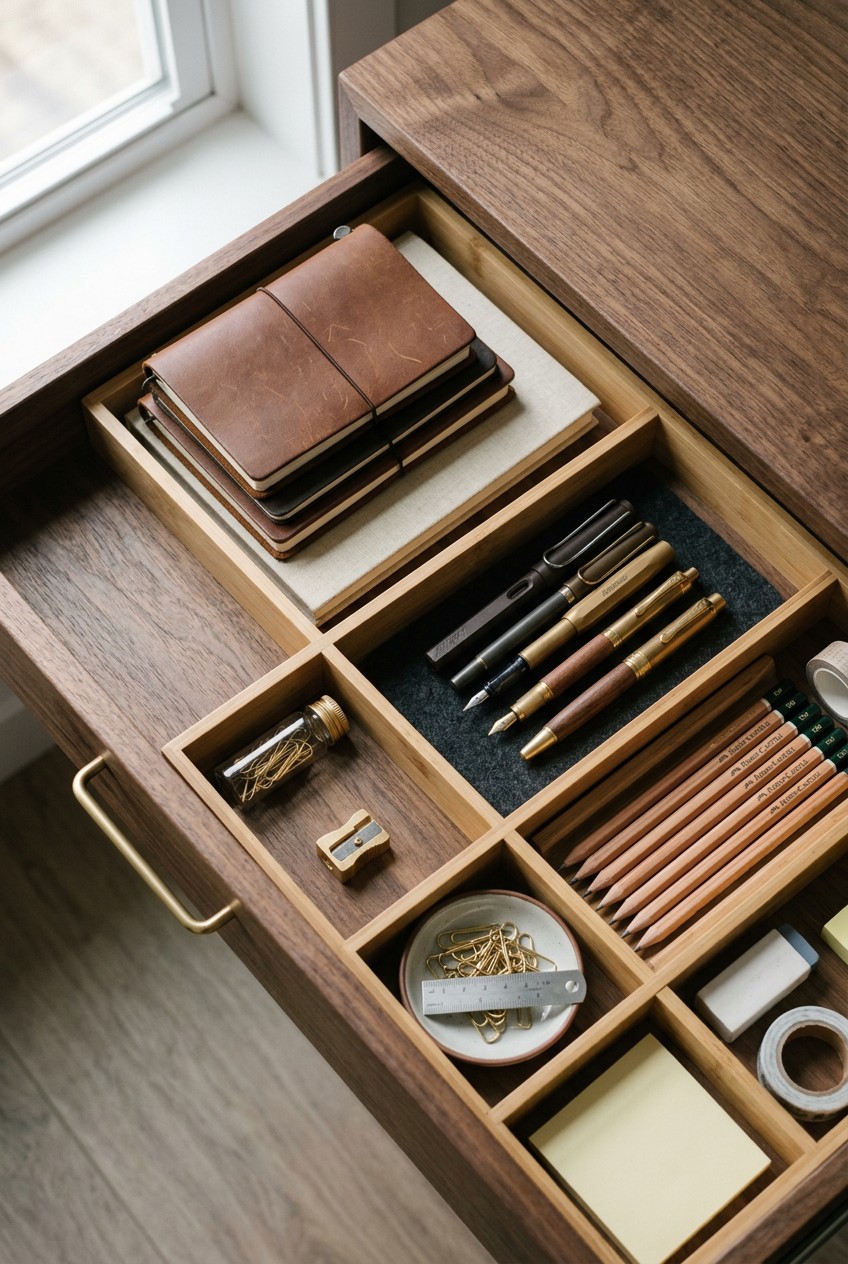
What’s Inside
- Start with a Full Drawer Purge and Reality Check
- Measure Precisely for Custom-Fit Organizers
- Categorize Before You Containerize
- Invest in Modular Drawer Dividers for Flexibility
- Prioritize the Top Drawer for Daily Essentials
- Tame Cable Clutter with Dedicated Solutions
- Utilize Vertical Space with Stackable Organizers
- Line Drawers for Aesthetics and Protection
- Combat Shifting Organizers with Adhesive Solutions
- Embrace Minimalism with a One In, One Out Policy
- Label for Quick Identification and Maintenance
- Repurpose Small Containers for Tiny Items
Last Tuesday at Whole Foods, I was digging through my oversized tote bag for a pen to sign a receipt. I realized with horror I’d dumped my entire home office into that bag the night before. My desk drawer system had failed me. It was a chaotic mess of crumpled sticky notes, tangled cords, and crunched granola bar wrappers. I’m not proud of it. I pulled out a fistful of crusty highlighters while the cashier stared. My top drawer had jammed shut earlier that week because a giant metal binder clip got wedged against the frame. I’d spent months yanking it until I finally ripped the whole track out. That’s when I knew things had to change.
You can’t ignore a messy workspace. It drains your energy. It ruins your focus. Every time you open a drawer and hear that scraping sound of loose rulers, your stress levels spike. I’ve been there. I’ve lived with the junk drawer guilt. Fixing it doesn’t require a contractor or thousands of dollars. It just takes a smart strategy and the right tools. We aren’t going to shuffle your garbage into prettier piles. We’re going to overhaul how you store your daily essentials. Let’s fix your workspace this weekend with these twelve methods. Grab a coffee. Roll up your sleeves. It’s time to reclaim your desk.
1. Start with a Full Drawer Purge and Reality Check

Before buying bins, you need to empty the drawer completely. I’m serious. Organizer D’Nai Walker emphasizes determining exactly what should live in the drawer, ensuring only appropriate items return. You can’t just shuffle garbage. Grab a heavy-duty trash bag. I swear by Glad 13-Gallon ForceFlex Trash Bags. They cost $14.99 for a box of 45 at Target. Open one up and dump the drawer upside down onto your floor.
I want you to hear fifty loose metal thumbtacks hitting the hardwood. I want you to smell the dusty scent of those promotional pens you took from a hotel three years ago. Throw them away. Discard broken items. Relocate things that don’t belong. If you find a kitchen spatula or toothpaste in your desk, move it right now.
Get rid of duplicates. I once found 14 dried-up yellow highlighters in my bottom drawer. I’d just push the dead ones to the back to make room for new ones. It’s a massive mistake. Once the drawer is empty, mix 1/2 cup of warm water with 1 tablespoon of Dawn dish soap. Wipe the bare wood clean with a rag. This initial decluttering is crucial for mental clarity. You won’t regret starting fresh.
2. Measure Precisely for Custom-Fit Organizers

Generic organizers lead to wasted space. If you guess, you’ll end up with gaps where dust and paperclips accumulate. Measure the inside width, length, and height accurately. I used to eyeball it at the store. I’d hold my hands apart, guessing the width. It never works. Grab a real measuring tool.
I recommend the Stanley 12-foot tape measure. It costs $6.98 at Walmart and fits perfectly in your hand. Measure the exact interior. For a custom fit, subtract 1/8 inch from the width and depth when ordering inserts. This math trick allows for easy placement. If you buy organizers that fit edge-to-edge, they’ll scrape the sides and get stuck when the wood swells in humid weather.
If you want to spend more, look into brands like Drawer Essentials. They offer custom-sized wood organizers that cost around $45.00. The bamboo texture feels incredible and looks professional. Don’t skip the measuring. Writing those three numbers on a sticky note will save you three trips to the store for returns.
3. Categorize Before You Containerize

Please avoid buying organizers before knowing what you actually need. I’m begging you. I tried this wrong for years. Last year, I bought a massive 20-piece clear acrylic bin set at Costco for $29.99. I thought it’d magically fix my life. It didn’t. I ended up with tiny squares and nowhere to put my bulky stapler.
Group like items first. Put all your writing utensils in one pile. Group markers, binder clips, and cables into separate heaps. This prevents junk drawer syndrome. Once you see the size of your “pen pile,” you’ll know exactly what size bin you need.
I use Post-it 3×3 inch sticky notes ($5.49 for a 4-pack at Target) to label each pile on my rug. I write “Cables” on one and “Paperclips” on another. It’s a visual process. You’re building a map of your future drawer layout. If you skip this, you’re just guessing. Categorizing forces you to confront how much junk you’ve accumulated.
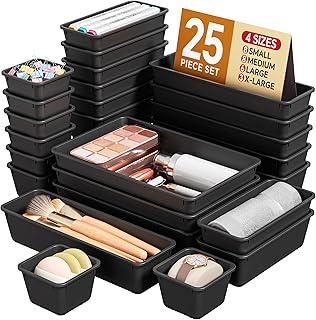
KEMETHY 25 PCS Plastic Drawer Organizers Set
KEMETHY 25 PCS Plastic Drawer Organizers Set has been one of the most consistently praised picks in this category. 310 reviewers averaged 4.5/5.
4. Invest in Modular Drawer Dividers for Flexibility

Trending for 2026 are modular systems that can be reconfigured. Your needs change. The giant ergonomic mouse you use today might be replaced by a slim trackpad next year. Your storage needs to adapt. Rigid, single-piece trays are awful because you can’t adjust the compartments. You might also like: 15 Inspiring Cozy Home Hacks That Changed Everything
I recommend modular systems. The Container Store offers the Everything Organizer or iDesign Linus Shallow Drawer Organizers. These range from $3.49 to $10.99. They are made of thick, clear plastic. They make a satisfying clicking sound when you line them up. For a cheaper option, IKEA’s KUGGIS inserts provide excellent compartmentalization for $3.99 each. The opaque white plastic hides ink stains beautifully. You might also like: 15 Gorgeous Organizing Bathroom Home Hacks Ideas Worth Trying This Year
Buy a few different sizes. Mix a long 9-inch bin for pencils with two small 3-inch squares for erasers. Because they are separate, you can play Tetris until you find the perfect layout. If you spill coffee in one section, you only have to wash one small bin instead of the entire tray. You might also like: 15 Inspiring Aesthetic DIY Home Decor You Can Try Today
5. Prioritize the Top Drawer for Daily Essentials

Reserve your top drawer for items you use daily. This is prime real estate. Don’t store old tax returns or backup staples in the drawer you open twenty times a day. Keep it limited to favorite pens, a notepad, and your phone charger. This boosts your daily efficiency.
I keep a 12-pack of Pilot G2 0.7mm black ink pens ($12.99 at Kroger) in my top drawer. I refuse to use anything else. The gel ink gliding on paper is the best feeling. I also keep an Anker 313 wireless charging pad ($15.99) at the front. A critical mistake is cramming too much into this drawer. As D’Nai Walker suggests, if a drawer is consistently stuffed, consider if you need a second organizer or alternative storage.
Leave some empty space. You should be able to reach in blindly and grab exactly what you need without knocking over a stack of sticky notes. If you have to dig, your top drawer is too full. Move the less important items down to drawer two.
6. Tame Cable Clutter with Dedicated Solutions

Tangled cables are a source of chaos. Throwing loose USB cords into a drawer is a guaranteed way to ruin your morning. Last month, I reached for an iPhone cable and pulled out a knotted clump of five different wires. It looked like a plastic tumbleweed. It knocked my coffee mug right off the desk.
Use VELCRO Brand ONE-WRAP Ties to secure individual cables. You can buy a kit for around $5.00 at any hardware store. The velcro grips tightly and won’t wear out like rubber bands. Wrap each cord before it goes into the drawer. For very small adapters, bead boxes are effective. I bought a 6-compartment bead box from Michaels for $3.99. It latches shut, keeping tiny adapters safe.
With the rise of smart devices, dedicate specific compartments for tech. Consider a small, multi-compartment mesh organizer like the Amazon Basics Desk Drawer Organizer. It costs around $16.79 and features steel mesh pockets perfect for USB drives, bulky charging blocks, and earbuds. The black metal looks sleek.

A-LuGei 【Military Grade】 Drawer Organizer
A dependable everyday pick — A-LuGei 【Military Grade】 Drawer Organizer pulls in 35 ratings at 4.5 stars. Not flashy, just solid.
7. Utilize Vertical Space with Stackable Organizers

If your drawers are deep, don’t let that vertical space go to waste. Most people get this wrong. They lay everything flat, leaving six inches of empty air above, while the bottom turns into a messy pile. You’re throwing away half your storage capacity.
Stackable organizers are the answer. I love the like-it Bricks Medium Bins from The Container Store. They range from $7.99 to $16.99. They have a plastic lip on the bottom that locks securely into the bin below. You get a satisfying click when you stack them. I use the bottom layer for things I rarely need, like extra staples or a backup mouse pad.
I also use the bottom bin to hide my snacks. I keep a stash of Trader Joe’s Dark Chocolate Peanut Butter Cups ($4.49 for a 16 oz tub) hidden under a top tray of highlighters. Nobody knows they’re there. The top bins slide smoothly, allowing you to layer items without creating a mountain of plastic. Just measure the height clearance before buying. If they sit too high, your drawer won’t close.
8. Line Drawers for Aesthetics and Protection

A pro tip is to line your drawers first. This protects the wood from ink leaks and adds style. I ruined my last desk because a cheap red pen exploded in the summer heat. The ink soaked into the unsealed wood grain. I scrubbed for hours, but the stain never came out.
Use contact paper or wide washi tape for a base. If you want heavy-duty protection, buy the Clear Plast-O-Mat Ribbed Shelf Liner from The Container Store. It’s priced from $10.99 to $31.99. The rubbery smell fades quickly, and the ribbed texture stops your bins from sliding.
For a cheaper alternative, I recommend the Duck Brand EasyLiner. You can grab a 20-foot roll for $6.88 at Walmart. Cut it to size using sharp scissors. Laying down a fresh liner feels like putting fresh sheets on a bed. It instantly makes a dark, dusty drawer look bright and intentional. Plus, when crumbs gather, you just pull the liner out and shake it over the trash.
9. Combat Shifting Organizers with Adhesive Solutions

A common frustration is inserts sliding around every time you open the desk. You arrange your bins perfectly, but the moment you pull the handle, everything slams to the back with a loud plastic crash. It ruins the layout you just spent an hour creating.
You must secure them. I tried double-sided tape, but it left a sticky residue that ruined the finish. Don’t do that. Use round Command small clear wire hooks ($11.49 for a pack at Target). Adhere them to the bottom of the drawer right against the back edge of your organizers to act as invisible bumpers.
Alternatively, apply Quakehold! Museum Gel to the bottom of each organizer for a non-slip grip. You can buy a 4 oz jar for $9.98 on Amazon. Pinch off a tiny ball of the gel, roll it, and stick it to the corners of your bins. Press the bin firmly down. The gel holds the plastic still, but it peels off cleanly whenever you want to rearrange. It’s basically magic.
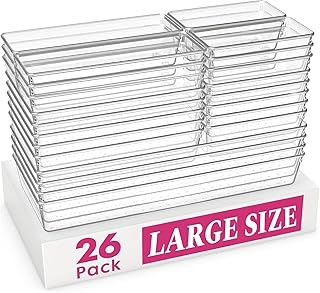
Criusia Large Drawer Organizer Bins 26 Pack | Complete 5
A dependable everyday pick — Criusia Large Drawer Organizer Bins 26 Pack | Complete 5 Size Clear Pl pulls in 24 ratings at 4.5 stars. Not flashy, just solid.
10. Embrace Minimalism with a One In, One Out Policy

To prevent future clutter, adopt a strict one in, one out rule. If you acquire something new, remove an old one immediately. This minimalist approach for 2026 helps maintain a clean workspace. I struggle with this because I love buying stationery.
Last month, I bought a bag of Organic Dried Mango ($5.99) at Sprouts. I stuffed the bag into my bottom drawer. A week later, sugary crumbs were everywhere, sticking to my mail. Now, I enforce the rule. If one snack bag goes in, the old one goes to the trash. If I buy a new notebook, an old, full one goes onto the bookshelf.
Instead of waiting for a major overhaul, dedicate 5 to 10 minutes weekly to tidy your drawers. This prevents buildup. I call these micro-tidies. Every Friday at 4:30 PM, I spend five minutes throwing away scrap paper and putting pens back into their slots. It keeps the system effective and ensures I start Monday morning with a clear head.
11. Label for Quick Identification and Maintenance

Even with clear organizers, physical labels save time and ensure items are returned to their correct homes. When you’re in a rush, your brain doesn’t want to think about where the staple remover goes. You’ll just toss it anywhere. Labels remove the guesswork.
I love the Brother P-touch PT-M95 Label Maker. You can grab one for $24.99 at Walmart. It’s lightweight, prints quickly, and the sound of the internal cutter slicing the tape never gets old. Peeling the backing off the 12mm tape and pressing it onto a bin feels rewarding. Use clear adhesive labels with bold black text for a clean look.
If you don’t want a machine, sticky notes cut into strips work perfectly. Labeling is crucial if you share a home office. My husband used to constantly steal my good scissors and put them back in the wrong place. Once I labeled a bin “Hannah’s Fabric Scissors,” he stopped messing up my system. The visual cue is powerful.
12. Repurpose Small Containers for Tiny Items

Don’t overlook household items for organizing. You don’t always need expensive acrylic sets. Tiny items like rubber bands and push pins need small, enclosed spaces. If you put fifty push pins into a 4-inch bin, they’ll scatter and stab your fingers when you reach in.
Mint tins or jewelry cases are inexpensive solutions for these micro-items. I use empty Altoids Peppermint tins. You can buy a 1.76 oz tin for $2.99 at Kroger. Once I eat the mints, I wash the tin and dry it. The metal hinge is durable. I fill one tin exclusively with silver paperclips.
The rattling sound of the metal clips hitting the tin is satisfying, and the peppermint smell makes the drawer smell fresh. You can also use small glass baby food jars or jewelry boxes. Repurposing saves money and keeps dangerous objects contained. Plus, the rectangular shape of a mint tin stacks beautifully in any drawer.
I’ve tried dozens of organizing methods, but combining these twelve strategies finally cured my messy desk. Don’t try to tackle your entire house this weekend. Just pick one drawer, grab a tape measure, and start sorting your pens. I promise you’ll feel a weight lift off your shoulders by Sunday night. If you found these tips helpful, please pin this article to your favorite home office Pinterest board so you can find the exact product names and measurements next time you hit the store!

Manalete Drawer Organizers Set of 15
Honestly, Manalete Drawer Organizers Set of 15 surprised me — sturdier than it looks in the photos, and over 945 buyers gave it 4.5 stars.
Frequently Asked Questions
How do I stop my desk drawer organizers from sliding around?
Use a small dab of clear museum gel under each corner of your plastic bins, or attach small Command wire hooks to the bottom of the drawer to act as invisible bumpers. This keeps everything perfectly locked in place.
What is the best way to handle desk drawer organization for deep drawers?
Utilize vertical space by investing in stackable acrylic bins. Store rarely used items or backup supplies in the bottom layer, and keep daily essentials in the top sliding trays so you don’t waste the vertical clearance.
How do I organize charging cables in my desk drawer?
Wrap each individual cord tightly using reusable velcro cable ties. For smaller adapters and earbuds, store them in a latching plastic bead box or a small multi-compartment mesh organizer to prevent messy tangles.
Should I line my desk drawers before organizing?
Yes, lining your drawers with ribbed plastic shelf liner or contact paper protects the wood from ink stains and scratches. The textured surface also helps prevent your plastic storage bins from shifting when you open the drawer.
