What’s Inside
- Ditch Plastic Covers for Breathable Alternatives
- Invest in Acid-Free Tissue Paper For Saree Organization In Closet
- Master the Art of Regular Refolding
- Opt for Padded or Specialized Saree Hangers
- Store Heavy Sarees Flat in Boxes
- Utilize Saree Storage Boxes with Clear Windows
- Implement Natural Pest Repellents
- Control Humidity with Desiccants
- Adopt the “File System” for Folded Sarees
- Pre-Clean Sarees Before Storage
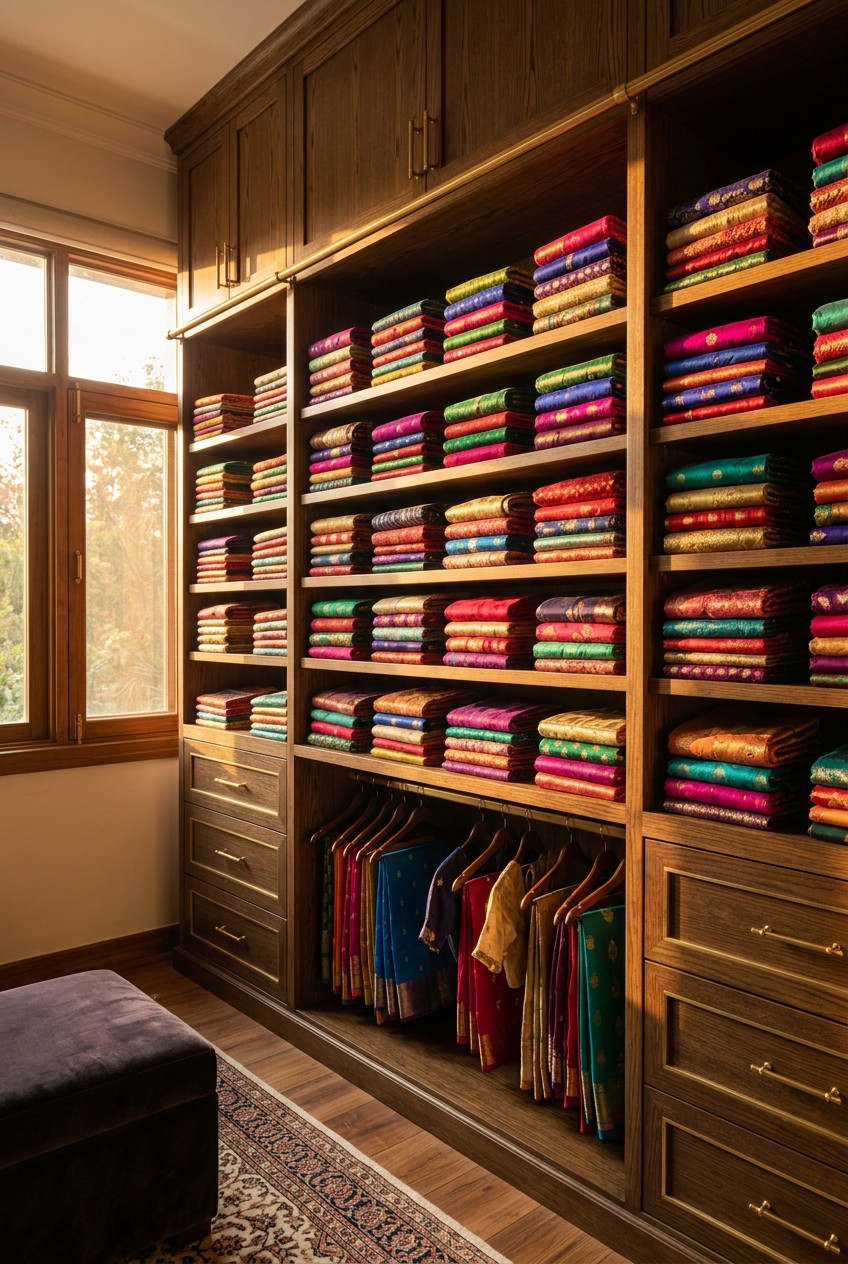
- Utilize Modular Closet Systems for Customization
- Store Blouses and Petticoats Separately and Systematically
- Protect Zari Work with Inward Folding
- Roll Delicate Silks for Long-Term Storage
- Avoid Direct Sunlight and Fluorescent Lights
Last October, I opened my bedroom doors to grab my mother-in-law’s vintage Kanjeevaram silk, only to find a massive yellowish moisture stain covering the entire pallu. That single disaster forced me to rethink my saree organization. You can’t just toss these delicate, expensive garments on a cheap wire hanger. I spent months doing this wrong. I ruined gorgeous fabrics with suffocating plastic bins and rusty metal clips before finally figuring out a system that works. If you’re tired of digging through messy piles of slippery silk or finding weird creases in your favorite georgette pieces, you’re in the right place. I’m going to walk you through the exact products, measurements, and folding methods I use to keep my collection pristine. Skip the cheap shortcuts. They perform poorly. Let’s fix your storage setup right now with practical, tested methods.
1. Ditch Plastic Covers for Breathable Alternatives

I used to buy those cheap plastic garment bags at Walmart for $5.99 a pack. I honestly thought I was protecting my clothes from dust. I was actually creating a humid, sweaty greenhouse that breeds mildew. Plastic traps moisture. When the temperature in your room changes, condensation forms right inside the bag. I learned this the hard way when a stunning pink chiffon saree developed tiny black mold spots I couldn’t wash out. You absolutely must ditch the plastic. Switch to breathable cotton or muslin bags instead. I personally swear by the handmade cotton saree covers from the SareeKala shop on Etsy. They cost exactly $18.50 for a set of three. These bags measure 16 by 14 inches and feature a sturdy, smooth-gliding metal zipper. The unbleached cotton feels soft and allows air to circulate while keeping dust out. When you open your doors, you won’t smell that toxic plastic odor anymore. It just smells like clean, dry laundry. This investment might feel steep, but it’s cheaper than replacing a ruined silk heirloom. Trust me on this one.
2. Invest in Acid-Free Tissue Paper For Saree Organization In Closet

Most people get this wrong. I certainly did. I used to grab leftover white tissue paper from birthday gifts and stuff it between the folds of my heavily embroidered pieces. Huge mistake. Standard tissue paper contains acids that’ll slowly eat away at delicate silk fibers and tarnish metallic threads over time. You need archival-quality materials. Textile conservators specifically recommend unbuffered acid-free tissue paper for animal-based fibers like silk and wool. I buy the Foster-Stephens unbuffered acid-free tissue paper sets. A pack of 24 sheets measuring 20 by 30 inches costs $22.50. The paper feels incredibly crisp and makes a sharp snapping sound when you unfold it. I take one sheet and place it flat across the zari work before folding the fabric. This creates a physical barrier that prevents color transfer and stops the heavy embroidery from snagging on the softer silk. I ruined a beautiful gold border three years ago because I skipped this step. The cheap paper I used actually stuck to the metallic threads in the summer heat. Spend the twenty bucks. It’s mandatory for proper saree organization.
3. Master the Art of Regular Refolding

This is a chore, but you can’t skip it. If you leave a heavy silk saree folded in the exact same position for years, the fibers at the crease will eventually snap. It sounds like a dry leaf cracking when it happens, and it’s heartbreaking. To prevent permanent creases and fabric stress, you must refold your pure silks every three to six months, intentionally changing the fold lines. I bought a cheap $14.99 desk planner at Target just to write down my refolding schedule. Every April and October, I pull out my heavy pieces, open them up, let them breathe for an hour, and then fold them slightly off-center from their original creases. If the original fold was exactly down the middle, I’ll shift the new fold by about two inches. This distributes the pressure across different vertical threads. Now, I make an afternoon of it. I put on a podcast, lay a clean white sheet on my bed, and gently rework every piece. It keeps the fabric supple and prevents those sharp, permanent white lines from forming on dark silks.
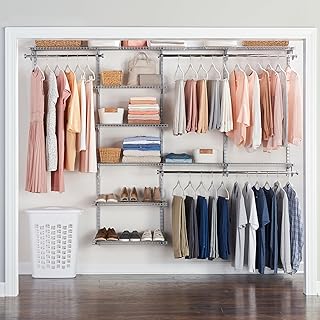
Rubbermaid Configurations Deluxe Custom Closet Kit 4-8 Ft.
If you want something that just works, Rubbermaid Configurations Deluxe Custom Closet Kit 4-8 Ft. Adjustable is a safe bet (81 reviews, 4.5 stars).
4. Opt for Padded or Specialized Saree Hangers

While heavy silks need flat storage, your lighter everyday pieces like chiffons, georgettes, and cottons can hang. But you can’t use thin velvet hangers, and you definitely can’t use wire. Wire hangers will leave aggressive rust stains and create weird, stretched-out shoulder nipples in the fabric. I bought a pack of Drape Divaa specialized saree hangers, and they fixed my slipping problem. They cost $24.99 for a five-pack. Each hanger is exactly 15.5 inches long and weighs 100 grams. They have a unique locking crossbar design covered in a smooth, non-slip foam padding. You drape the fabric over the padded bar, and it grips the slippery georgette without leaving a harsh crease. Before I found these, I’d open my doors to find half my lighter pieces pooled on the floor in a wrinkled mess. The foam padding feels squishy and prevents the fabric from sliding. Don’t waste your time with standard plastic hangers either. The smooth plastic offers zero grip, and you’ll spend your morning picking clothes off the floor.
5. Store Heavy Sarees Flat in Boxes

Gravity is the enemy of a heavy Kanjeevaram or Banarasi silk. If you hang a piece that has three pounds of intricate zari work woven into the pallu, the sheer weight of the embroidery will pull and stretch the delicate silk warp threads. Eventually, the fabric warps, and the drape is ruined. Heavy pieces must be stored flat. I learned this after buying a massive pack of clear plastic bins at Costco for $15.99. The plastic bins trapped moisture, but the flat storage concept was correct. I quickly swapped the plastic for breathable fabric boxes. When you store them flat, you remove all tension from the weave. I fold my heaviest 600-gram Banarasi silks into neat rectangles, interleave them with the acid-free tissue paper I mentioned earlier, and lay them flat at the bottom of a breathable box. I never stack more than three heavy pieces on top of each other. If you stack ten, the weight crushes the bottom piece and flattens the embroidery. Keep the stacks short and keep them horizontal. You might also like: 15 Clever Kitchen Small Space Ideas That Changed Everything
6. Utilize Saree Storage Boxes with Clear Windows

If you’re storing things flat, you run into a new problem. You can’t see what you own. I used to tear apart my entire shelf looking for one specific green cotton piece, leaving a messy avalanche of fabric in my wake. You need storage boxes with transparent front panels so you can identify the contents without opening the lid. I buy the PRIME foldable cloth organizers on Meesho. A pack of ten costs about $29.99. They measure 16 by 13 by 3 inches, which perfectly holds one heavily embroidered piece or two lighter cotton ones. The front features a thick, clear PVC window. The non-woven fabric sides allow for decent air circulation. For gifting or for my absolute most expensive bridal pieces, I use the Pitaraa Junction rigid cardboard window boxes. They measure 12 by 15 by 2.5 inches and cost $35.00 each. They have a magnetic closure that snaps shut with a satisfying click. Being able to scan my shelves visually saves me at least twenty minutes of frustrated digging every weekend. You might also like: 15 Stunning Organizing Kitchen Home Hacks Ideas You Haven’t Thought Of

AMKUFO 6 Pack-Closet-Organizers-and-Storage
AMKUFO 6 Pack-Closet-Organizers-and-Storage punches above its price — 52 buyers rated it 4.5 stars. I would buy it again.
7. Implement Natural Pest Repellents

Mothballs are awful. They smell like toxic chemicals, and that harsh, stinging scent clings to silk for months. I refuse to use them. Instead, I protect my collection using natural aromatic red cedar. I buy the Houndsbay 100% aromatic red cedar blocks. A set of four large blocks costs $14.99. I place one block in the corner of every storage box and a few on my open shelves. The wood has a slightly rough, sanded texture and smells incredibly warm, earthy, and clean. It’s a natural, chemical-free moth repellent that works. Here’s a trick most people don’t know. The cedar scent fades after about six months as the wood dries out. You don’t need to throw them away. I take a piece of fine-grit sandpaper and lightly buff the surface of the blocks. This exposes fresh wood oils and brings the strong scent back. Sometimes, I’ll also stop by Whole Foods and grab a tiny 1-ounce bottle of pure lavender essential oil for $9.99. I place two drops on a cotton ball and tuck it into the back corner of the shelf. Moths hate lavender just as much as cedar. You might also like: 20 Inspiring Organizing Storage Home Hacks Ideas for Any Style
8. Control Humidity with Desiccants

High humidity is a silent killer for natural fibers. If your storage space pushes past 50 percent humidity, you’re inviting musty odors, mold, and fiber degradation. My house tends to get sticky in August, and my closet used to smell like a damp basement. To fix this, you have to actively pull moisture out of the air. For small drawers and individual boxes, I use standard silica gel packets. But for the main hanging area, I rely on DampRid hanging moisture absorber bags. I grab these in the cleaning aisle at Kroger for exactly $7.48 per bag. They contain calcium chloride crystals that physically trap excess moisture. You just hang the bag on your rod, and over the course of a month, you’ll see the bottom pouch fill up with murky water. It’s gross but satisfying because all that water would have ended up in your clothes. Once the crystals dissolve and the bag is full of liquid, you just throw it in the trash and hang a new one. It completely eliminated the musty smell that used to cling to my cotton pieces.
9. Adopt the “File System” for Folded Sarees

If you’re storing lighter cottons or linens in deep drawers, stacking them on top of each other is a nightmare. When you pull the bottom one out, the whole stack collapses. I switched to the vertical file system, and it changed my daily routine. Instead of stacking them horizontally, you fold the garment into a tight, neat rectangle and stand it upright on its edge, just like a file folder in a cabinet. I fold the saree in half lengthwise, then in half again, and then fold it into thirds so it forms a rigid, self-supporting block measuring roughly 10 by 8 inches. When you open the drawer, you see the folded edge of every single piece at a glance. You can pluck one out from the middle, and the rest stay upright. I tried this wrong for months by not folding them tight enough, which just led to a slumped, messy drawer. You have to press the air out as you fold. The fabric should feel dense and compact. It maximizes your drawer space and keeps everything visually uniform.

VIPEK V5 Heavy Duty Clothes Rack
VIPEK V5 Heavy Duty Clothes Rack punches above its price — 56 buyers rated it 4.5 stars. I would buy it again.
10. Pre-Clean Sarees Before Storage

Never, ever put a saree away if you’ve worn it, even for just a few hours. I made this mistake after a summer wedding. I thought the silk looked clean, so I folded it up and put it in a box. Six months later, invisible sweat stains on the pleats had oxidized and turned into dark, permanent brown rings. Always ensure garments are 100 percent clean and dry before storing them. For expensive silks with heavy zari work, you must take them to a professional dry cleaner. For lighter synthetics or everyday cottons, I use the Dryel at-home dry cleaner kit. It costs $19.99 at most drugstores. You put the garment in the provided fabric protection bag with a moist cleaning cloth and tumble it in your dryer on medium heat for 15 minutes. It uses steam to release wrinkles and remove light odors. If I spot a tiny food stain on a cotton piece, I’ll run to Sprouts and grab their store-brand natural enzyme stain remover for $6.49. I treat the spot, gently hand wash the area, and let it air dry completely on a flat towel before it ever sees the inside of a storage box.
11. Utilize Modular Closet Systems for Customization

Standard builder-grade wire shelving is practically useless for a diverse wardrobe. You need varying heights for different storage methods. I ripped out my old wire racks and installed a modular system. I highly recommend the IKEA KALLAX and EKET series for this. A standard 4-cube KALLAX shelf costs $79.99, and the smaller EKET wall-mounted cabinets run about $45.00 each. The beauty of these systems is the customization. The KALLAX cubes measure exactly 13 by 13 by 15 inches, which fits the clear-window storage boxes I mentioned earlier. I use the deeper EKET drawers for my vertical file-folding system. Because it’s modular, you can build it up to the ceiling or keep it low to double as a dressing bench. The smooth, laminated particleboard finish won’t snag delicate silks like rough wooden shelves or wire racks will. I spent a Saturday afternoon assembling these pieces, and the difference is night and day. Having dedicated, perfectly sized cubbies for folded stacks prevents the towering, leaning piles of fabric that fall over.
12. Store Blouses and Petticoats Separately and Systematically

Don’t fold your matching blouse and petticoat inside the saree itself. I used to do this to keep sets together, but the hooks and eyelets on the blouse would constantly snag and pull the delicate threads of the main fabric. Plus, it creates a bulky, uneven lump that makes stacking impossible. You have to store them separately. I use the IKEA SKUBB drawer organizers to wrangle all these smaller pieces. A set of six different-sized fabric boxes costs just $5.99. I line them up inside my EKET drawers. For padded blouses, you have to be careful not to crush the cups. I fold the sleeves backward, then fold the blouse in half vertically so one cup rests gently inside the other. I stack them alternating directions in the SKUBB boxes to maintain their shape and maximize space. I roll my cotton petticoats into tight little cylinders and stand them upright in the smaller square boxes. It keeps the heavy metal hooks far away from my expensive silks while keeping everything neatly categorized by color.

AWTATOS Cube Storage Organizer Storage 12 Cube Bookshelf
AWTATOS Cube Storage Organizer Storage 12 Cube Bookshelf DIY Plastic C has been one of the most consistently praised picks in this category. 28 reviewers averaged 4.5/5.
13. Protect Zari Work with Inward Folding

When you’re dealing with intricate zari work, the metallic threads are incredibly fragile and abrasive. If you fold the garment with the heavy embroidery facing outward, it will rub against the walls of your storage box or snag on other fabrics. I’ve ruined the smooth finish of a plain silk border because the scratchy zari from an adjacent piece rubbed against it every time I opened the drawer. You must always ensure the zari faces inwards. When I’m folding a heavily embellished piece, I lay it flat and locate the heaviest concentration of embroidery. I fold the plain sections of the fabric over the zari first, essentially wrapping the rough metallic threads in the softer, plain silk. The outside of the folded rectangle should only show plain, unembellished fabric. Combine this inward-folding technique with the acid-free tissue paper barrier I discussed in section two, and your metallic threads will never snag, fray, or tarnish. It takes an extra thirty seconds of planning, but it saves hundreds of dollars in damage.
14. Roll Delicate Silks for Long-Term Storage

For absolute heirloom pieces, folding them at all is a risk. Museum conservators don’t fold ancient textiles. They roll them. If you have a highly delicate, vintage silk piece that you only wear once a decade, you should adopt this method. Rolling prevents any hard creases that can weaken the fabric over time. I buy Archival Methods acid-free textile storage tubes. A tube measuring 3 inches in diameter and 24 inches long costs $12.50. I spread the garment out flat on a clean table. I lay a continuous sheet of unbuffered acid-free tissue paper over the entire length. Then, I place the archival tube at one end and slowly, gently roll the fabric and paper together around the cylinder. You want it snug but not stretched tight. Once it’s completely rolled, I slide the entire cylinder into a long muslin bag and tie the ends with a cotton ribbon. I store these tubes flat on the very top shelf of my KALLAX unit. It takes up more linear space than folding, but it guarantees the fabric will survive for the next generation without a single stress tear.
15. Avoid Direct Sunlight and Fluorescent Lights

Light is a highly destructive force for natural dyes. Prolonged exposure to direct sunlight or even strong artificial fluorescent lights will cause vibrant colors to fade, bleach, and look patchy. I had a gorgeous deep emerald green silk that I kept on an open shelf near a window. After just one summer, the exposed folded edge faded to a sickly, pale mint green while the rest of the fabric stayed dark. The piece was ruined. You must store your collection in a cool, dark place. If your storage space has a window, you need to block it. I went to Target and bought a simple Eclipse blackout curtain panel for $24.99. I installed it over the small window in my dressing room, and it eliminated the UV exposure. Furthermore, I swapped out the harsh fluorescent overhead bulbs for soft, warm-white LED bulbs. LEDs emit significantly less heat and virtually no UV radiation compared to traditional bulbs. Keep the doors closed when you aren’t actively getting dressed. A dark environment preserves the rich, saturated dyes of your traditional wear for decades.
Honestly, implementing these changes took me a few weekends of dedicated work, but the peace of mind is incredible. You won’t have to panic about mold, rust, or torn fibers ever again. Start by swapping out those awful plastic bags and getting some acid-free tissue paper. Those two steps alone will save your most expensive pieces. If you found this breakdown helpful, I’d love it if you saved this guide or pinned it to your home organization boards so you can reference these exact measurements and brands later!

5 Tier Closet Hanging Organizer
5 Tier Closet Hanging Organizer has been one of the most consistently praised picks in this category. 1 reviewers averaged 4.5/5.
Frequently Asked Questions
How should I store heavy silk sarees?
Store heavy silk sarees flat in breathable cotton boxes to prevent the weight of the zari from stretching the fabric. Interleave the folds with unbuffered acid-free tissue paper and refold them every 3-6 months to prevent permanent creases.
Are plastic covers safe for saree organization in closet spaces?
No. Plastic covers trap moisture and cause condensation, leading to mold, mildew, and yellowing. Always use breathable cotton or muslin bags that allow air circulation while protecting the garments from dust.
What is the best way to fold everyday cotton sarees?
Use the vertical file system. Fold the saree tightly into a rigid rectangle and stand it upright on its edge inside a drawer. This maximizes space and lets you see every piece without toppling a stack.
How do I protect my sarees from moths naturally?
Skip harsh chemical mothballs. Use 100% aromatic red cedar blocks placed in your storage boxes. Sand the blocks lightly every few months to refresh their natural oils, and pair them with pure lavender essential oil.
