What’s Inside
- Start with a Strict Capsule Approach for Seasonal Items
- Maximize Vertical Space with Adjustable Shelving
- Standardize with Slim Velvet Hangers
- Clear Stackable Shoe Boxes for Footwear
- Install Motion-Activated LED Lighting
- Segment Shelves with Acrylic Dividers
- Use Modular Drawer Dividers for Small Items
- Utilize the Back of the Door with Command Hooks
- Create Specific Lifestyle Zones
- Avoid Overstuffing Your Hanging Rods
- Incorporate Hidden Storage Solutions
- Color-Code Your Categories
- Add Under-Shelf Baskets for Accessories
- Repurpose Wall-Mounted Magazine Holders
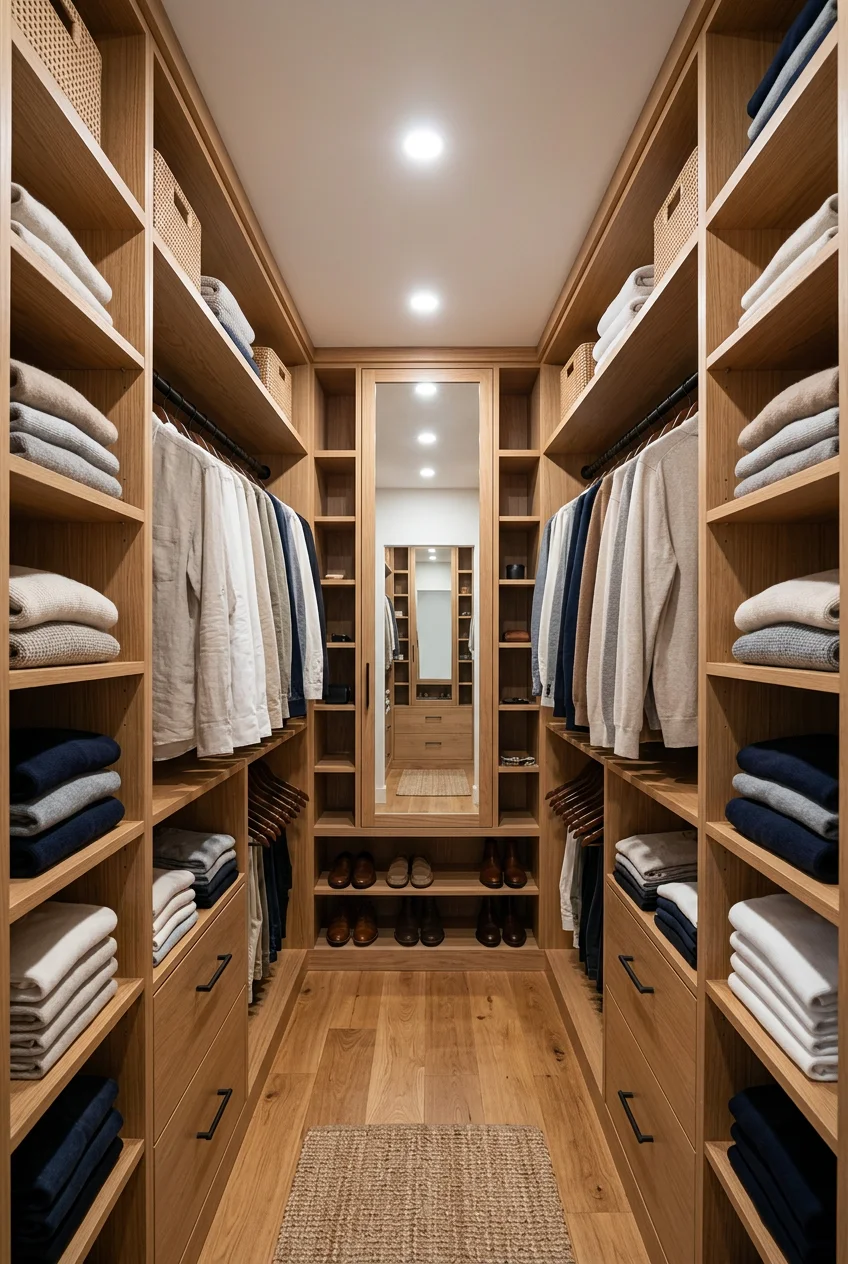
Last Tuesday, a heavy stack of denim collapsed directly onto my head while I was reaching for a sweater. It proved my storage situation was a total hazard. If you’re tired of dodging falling jeans, you need these small walk-in closet organization ideas to reclaim your sanity. I spent three years treating my 4×6 foot closet like a garbage disposal for fabric before I finally ripped everything out and started applying actual logic. The smell of stale cedar and trapped dust in that cramped space made me dread getting dressed every morning. I’d stand there in the dim light, shoving plastic hangers around, unable to find my black work trousers. Took me years to figure that one out.
That’s when I realized throwing more random bins at the problem wasn’t working. I needed a systematic approach based on measurements and functionality, not just pretty matching baskets. Let’s walk through the exact structural changes and specific products that actually make a tiny closet function like a large one.
1. Start with a Strict Capsule Approach for Seasonal Items

Professional organizers like Caroline Rector suggest paring down your active wardrobe to 30 to 37 versatile items per season. I tried this wrong for months before figuring it out. I’d just shove my thick winter coats to the back of the rod, where they crushed my delicate summer dresses and made the whole space feel claustrophobic. You can’t organize clutter. The first step for any of these small walk-in closet organization ideas is physical removal.
I now pack away anything I won’t wear in the next three months. I use the Sterilite 66 Qt. ClearView Latch Box. They run about $15 to $20 each at most hardware stores. The latches are stiff, which is annoying when your hands are cold, but they seal tightly enough to keep out the silverfish I occasionally spot in my attic. Last October, after a quick grocery run to Whole Foods for pumpkin puree, I spent a Saturday swapping my linen pants for heavy knits. Storing the off-season clothes in these clear bins under my guest bed freed up roughly forty percent of my hanging space. The visual relief of only seeing weather-appropriate clothing when I walk in at 6 AM is significant. Trust me on this.
2. Maximize Vertical Space with Adjustable Shelving

A common mistake is focusing on eye-level storage and ignoring the massive gap between the top shelf and the ceiling. I lived with a single, static hanging rod for five years, stacking shoeboxes precariously on the one shelf above it until they inevitably tipped over. To fix this, I installed the Elfa Classic system from The Container Store. A basic unit starts around $100 to $200, depending on your layout.
The installation process left my thumbs raw from pressing the brackets into the steel tracks, but the structural steel is sturdy. I added double-hang rods, which instantly doubled my hanging capacity for shorter items like blouses, skirts, and folded denim. By customizing the shelf heights in one-inch increments, I eliminated the dead air above my ankle boots and created exact slots for my folded bulky sweaters. Now, my clothes occupy the full 96 inches of vertical wall space. If you’re relying on the standard builder-grade wire shelf that came with your house, you’re wasting at least a third of your potential storage volume.
3. Standardize with Slim Velvet Hangers

Replacing mismatched hangers is the fastest way to reduce visual noise. I used to have a chaotic mix of thick wooden hangers, flimsy wire ones from the dry cleaner, and chunky plastic tubular ones I bought at Target in college. The plastic ones took up nearly an inch of rod space each. I switched entirely to Amazon Basics Slim Velvet Hangers. You can typically get a pack of 50 for $20 to $30.
The slim profile saves up to 50 percent of your hanging space. The black velvet texture physically grips the fabric, which means my wide-neck silk blouses stop slipping off and piling up on the dusty floor. There’s a tradeoff here. The velvet material acts like a magnet for pet hair and white lint, and damp clothes will occasionally transfer dye to the lighter-colored hangers. I avoid hanging anything even slightly damp on them now. Despite the lint issue, standardizing the hangers forces the shoulders of your garments to sit at the exact same height, creating a clean, uniform line that makes scanning for a specific shirt much faster.
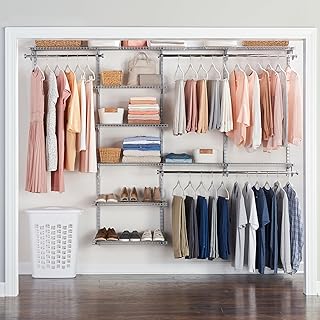
Rubbermaid Configurations Deluxe Custom Closet Kit 4-8 Ft.
If you want something that just works, Rubbermaid Configurations Deluxe Custom Closet Kit 4-8 Ft. Adjustable is a safe bet (81 reviews, 4.5 stars).
4. Clear Stackable Shoe Boxes for Footwear

Piling shoes on the floor is a guaranteed way to ruin your expensive leather and trip yourself in the dark. I used to kick my flats into a dark corner, resulting in crushed heels and scuffed toes. Now, I store all my active footwear in clear, stackable shoe boxes. I bought the 4-packs of durable PET material stackable boxes from Costco for about $30 to $40 per pack.
The hard plastic feels rigid, unlike those flimsy frosted boxes that collapse when you stack them more than three high. These easily hold up to a US Men’s Size 14, meaning my chunky winter boots fit without being smashed. The drop-front magnetic door is the specific feature that makes these functional. You don’t have to unstack the tower to get a pair of sneakers from the bottom row. I just pull the front flap open. The clear acrylic allows for instant visibility while protecting the suede from the ambient dust that circulates in small, enclosed spaces. I’ve used these for two years now, and the only negative is that the magnetic closures occasionally get misaligned if you build the tower too high on plush carpet. You might also like: 14 Office Organization Home Worth Trying
5. Install Motion-Activated LED Lighting

Good lighting is rarely prioritized in small closets, which usually feature a single, harsh overhead bulb that casts deep shadows on the bottom shelves. I bought the Feit Electric 13 in. Battery Operated LED Motion Sensor Closet Light for $20 to $30 after an embarrassing incident where I wore one navy blue sock and one black sock to a morning meeting. Learned that the hard way. You might also like: 16 Bedroom Closet Organization Ideas for Every Budget
These lights are battery-operated and rechargeable via USB, so you don’t need to hire an electrician to run hardwiring through your drywall. The motion sensor triggers the second I step through the door, flooding the hanging sections with bright, neutral 4000K light. You get about 3 to 4 hours of continuous runtime per charge. Because they only turn on for 20 seconds at a time, I only have to charge the lithium-ion battery every two months. I mounted them directly under the front lip of my shelves using the included magnetic strips. The adhesive on the magnetic strips is quite aggressive, so be careful if you’re sticking them to painted drywall, as it will peel the paint if you try to remove it later. You might also like: 12 Home Screen Organization Iphone for Every Budget
6. Segment Shelves with Acrylic Dividers

Without physical boundaries, stacks of folded jeans and sweaters inevitably merge into an unstable fabric mountain. I used to spend ten minutes every Sunday refolding the same stack of cashmere sweaters because pulling one from the middle caused the rest to slide off the shelf. I fixed this by installing clear acrylic shelf dividers. Brands like Modular Closets sell these for $10 to $30 each.
They’re typically 8 inches high and 12 inches deep, slipping directly over standard 3/4-inch wooden shelves. The clear acrylic practically disappears visually, keeping the space looking open while providing rigid support for soft items. You just slide them onto the shelf edge without any tools. I use them to separate my workout leggings from my denim, and to keep my soft leather handbags standing upright so they don’t crease. One detail to note: if your shelves are thicker than one inch, the tension clip at the bottom of the divider will snap. I broke two of them trying to force them onto a custom built-in shelf before I realized I needed to measure the wood thickness first.

AWTATOS Cube Storage Organizer Storage 12 Cube Bookshelf
A dependable everyday pick — AWTATOS Cube Storage Organizer Storage 12 Cube Bookshelf DIY Plastic C pulls in 28 ratings at 4.5 stars. Not flashy, just solid.
7. Use Modular Drawer Dividers for Small Items

Drawers without dividers quickly become a chaotic jumble of tangled bras, single socks, and belts. Rummaging through a dark drawer at 5:30 AM while trying not to wake my husband was a daily frustration. I implemented The Container Store Dresser Drawer Dividers, which cost between $23 and $32 per package.
They have a spring-loaded mechanism that creates constant tension, locking them firmly in place from front to back. For my delicate items, I use foldable fabric drawer organizers from Criusia. You can get a 12-pack for $15 to $25. The fabric boxes are segmented into small square compartments, perfect for rolling individual pairs of socks or storing rolled belts. The gray linen texture of the boxes looks clean, though the cardboard inserts that give them structure will warp if you accidentally spill water on them. By giving every small accessory a designated, walled-off square, I’ve completely eliminated the daily digging. When I pull the drawer open, everything is laid out in a single, visible layer.
8. Utilize the Back of the Door with Command Hooks

The back of the closet door is the most underutilized real estate in a small space. I used to leave it completely blank while my heavy terrycloth bathrobes took up a foot of hanging rod space inside. I started using heavy-duty Command Hooks, which run about $5 to $15 for a multi-pack at Walmart.
I bought the brushed nickel finish ones that hold up to 5 pounds. I spaced three of them across the top quarter of the door to hang my thick robes and my canvas tote bags. The adhesive strips hold securely as long as you prep the painted door surface with rubbing alcohol first. I skipped the alcohol prep on my first attempt, and a hook holding a heavy damp towel ripped off the door at 2 AM, sounding like a gunshot. You can also use two hooks and a small tension rod to create a DIY rack for hanging sunglasses or silk scarves. Keeping bulky, frequently grabbed items on the door frees up the internal shelving for items that actually need to be folded or boxed.
9. Create Specific Lifestyle Zones

Organizing by garment type is standard, but organizing by lifestyle zone is far more efficient for a daily routine. I used to have my black yoga pants mixed in with my black dress pants, which led to a lot of frantic texture-checking in the dark. Now, I designate specific physical zones within the closet.
The bottom left quadrant is exclusively for my work-from-home attire: soft knits, structured joggers, and cardigans. The top right is my workout zone. Last month, I used my heavy-duty canvas reusable bags from Trader Joe’s (the $3.99 ones with the reinforced handles) to physically sort these piles on the floor before putting them back in their new zones. Grouping items by the activity they’re meant for streamlines the process of getting dressed. If I’m going to the gym, I only look in the gym quadrant. The downside is that your closet won’t look like a perfectly color-coordinated rainbow from end to end, because the colors are broken up by category. But the functional speed you gain far outweighs the loss of that Pinterest-perfect aesthetic.

Ulif E10 Clothes Rack(With Stretchable Hanger
Ulif E10 Clothes Rack(With Stretchable Hanger Rod)Freestanding Clothin punches above its price — 951 buyers rated it 4.5 stars. I would buy it again.
10. Avoid Overstuffing Your Hanging Rods

Packing shelves and rods too tightly is a critical error that negates any organizational system you put in place. Professional organizer Emily Kate Johnson advises that an overstuffed closet remains chaotic regardless of how many expensive acrylic bins you buy. This is one of the most vital small walk-in closet organization ideas to remember.
I learned this the hard way after a trip to Sprouts. I had bought three new bulky winter sweaters from a boutique next door and tried to jam them onto a shelf that was already at capacity. The surrounding folded shirts crumpled, and I couldn’t pull a hanger from the rod beneath it without dragging three other shirts onto the floor. You need negative space to maneuver. I now follow the 80 percent rule: I never fill a rod or a shelf past 80 percent of its physical capacity. If I buy a new jacket, an old one gets donated. You should be able to easily slide the hangers back and forth. If you’re using those cheap, thick plastic Mainstays hangers from the grocery store, they’re eating up your negative space. Keeping that 20 percent of empty space allows the fabric to breathe, prevents severe wrinkling, and lets you actually see the individual garments.
11. Incorporate Hidden Storage Solutions

Visual clutter causes mental fatigue, even if the items are technically arranged in rows. A major component of these small walk-in closet organization ideas is hiding the ugly necessities. Dirty laundry hampers and random belts hanging from nails make a space feel messy.
I integrated hidden storage by placing an IKEA Smastad bench with a pull-out drawer at the back wall of my closet. It costs around $90 and fits perfectly under my lowest hanging rod. The smooth white exterior hides my messy canvas laundry bags completely. I also installed a sliding belt rack that mounts directly to the vertical wood panel of my shelving unit. It stays flush against the wall when not in use, hiding the tangled leather straps, and I just pull it out on its metal track when I need to select a belt. The drawer mechanism on the IKEA bench isn’t the smoothest, and it occasionally catches on the track if I overfill it with heavy denim, but getting the laundry out of my direct line of sight makes the tiny room feel twice as large.
12. Color-Code Your Categories

Once your clothes are sorted into lifestyle zones, color-coding within those zones creates a sense of visual calm. Professional organizer JP Taxman suggests this method to quickly identify specific pieces. I used to think color-coding was just for show, but it actually functions as a rapid visual index.
Inside my workwear zone, I arrange the hanging items from light to dark, following the ROYGBIV spectrum. White blouses on the left, moving through blues and grays, ending with black blazers on the right. I used a Brother P-Touch Label Maker, which costs about $35, to print small, discreet white labels for the edges of the shelves to designate the color zones for folded items. The label tape is durable but peels off cleanly if I need to rearrange. The one annoying part of this system is laundry day. Putting clothes away takes slightly longer because you can’t just shove a blue shirt into the first empty gap; you have to walk it over to the blue section. However, finding exactly what you need in under five seconds on a Tuesday morning makes that extra minute of sorting completely worthwhile.

Yociyoga 4-Tier Stackable Closet Organizers and Storage
Yociyoga 4-Tier Stackable Closet Organizers and Storage Basket has been one of the most consistently praised picks in this category. 418 reviewers averaged 4.5/5.
13. Add Under-Shelf Baskets for Accessories

The vertical gap between a folded stack of jeans and the shelf above it is wasted real estate. I noticed I had about six inches of empty air under my top shelf that was doing nothing. I bought a set of SimpleHouseware under-shelf wire baskets for $15 to $25 for a two-pack.
These clever metal baskets have two flat arms that slide directly over the top of an existing shelf, suspending a wire basket underneath it. I use them to hold my rolled silk scarves, winter beanies, and a small canvas bag of extra shoe laces. The white powder-coated steel feels durable, and it doesn’t bend even when I load it with heavy leather gloves. The negative aspect is that the metal arms that slide over the shelf do create a slight bump on the surface above. If you try to place a hard plastic bin directly on top of those arms, it will wobble slightly. I solve this by placing my soft, folded sweaters on the shelf above the basket arms, which absorbs the unevenness perfectly.
14. Repurpose Wall-Mounted Magazine Holders

For a lesser-known storage hack, look at office supplies. Storing rigid clutches and small evening bags on standard shelves usually results in them tipping over like dominos. I repurposed the IKEA Kvissle wall newspaper rack, which costs exactly $20. It’s a white, powder-coated steel vertical organizer meant for mail and magazines.
I mounted it on the narrow, six-inch strip of unused wall space right behind my closet door. I actually figured this out while unpacking groceries; I had set my heavy Kroger bags on the floor and noticed the narrow gap behind the open door. The angled metal slots of the Kvissle rack perfectly cradle my flat evening clutches, slim wallets, and even a few pairs of flat summer sandals. It keeps them separated, visible, and completely off the main shelves. The steel edges of the slots are slightly sharp, so I have to be careful when pulling out a delicate satin bag to avoid snagging the fabric. But for $20, it’s the most efficient use of dead wall space I’ve found for small, awkward accessories.
Organizing a tiny closet isn’t about buying matching velvet boxes; it’s about ruthlessly measuring your space and using structural solutions that fit your actual daily habits. I wasted years trying to make generic advice work before I finally implemented these exact strategies. The Elfa shelving and the clear shoe boxes alone completely altered how I get ready in the morning. If you’re staring at a chaotic pile of clothes right now, pick just one of these zones to tackle this weekend. I’d start with standardizing your hangers. It takes twenty minutes and the visual payoff is immediate. Pin this guide to your home organization board so you have the specific product dimensions and brand names handy when you’re ready to measure your own space.
Frequently Asked Questions
How do you maximize space in a small walk-in closet?
Install double-hang rods and adjustable shelving to use the full vertical height from floor to ceiling. Swap bulky plastic hangers for slim velvet ones to instantly regain up to 50 percent of your hanging rod space.
What should I store on the top shelf of my closet?
Use the top shelf for off-season clothing and rarely used items. Store these in clear, lidded plastic bins to protect them from dust and silverfish while keeping the contents easily visible from the ground.
How do you organize shoes in a tight closet?
Ditch the floor piles and use clear, stackable drop-front shoe boxes. They protect your footwear from dust, prevent scuffing, and allow you to stack shoes vertically all the way up a wall without the tower collapsing.
Are acrylic shelf dividers worth it?
Yes, they prevent tall stacks of folded sweaters and jeans from toppling over into a messy pile. They slide directly onto standard wood shelves without tools, keeping your folded categories rigidly separated and visually clean.
