
What’s Inside
- Use Heavy-Duty Ottomans for Hidden Toy Storage
- Maximize Space With Shallow Under-Bed Bins
- Integrate Deep Drawers Under Window Seats
- Modify Vintage Furniture For Concealed Play Items
- Upgrade Standard IKEA Systems With Custom Hardware
- Hang Clear Pocket Organizers Behind Closet Doors
- Use Tiered Rolling Carts For Art Supplies
- Organize Closed Cabinets With Clear Labeled Bins
- Rotate Excess Toys Into Garage Storage Bins
- Stuff Soft Toys Into Functional Bean Bag Chairs
- Stop Using Giant Open Toy Chests
- Contain Tiny Pieces With Drawstring Playmats
- Reassign Kitchen Cabinet Space For Daily Play
- Utilize Peg Rails And Woven Baskets On Walls
Last Tuesday, I dropped a $14 bottle of olive oil from Whole Foods directly onto my hardwood floor because I tripped over a rogue PAW Patrol vehicle hidden under a throw blanket. The oil splattered across the baseboards, and the plastic fire truck wheels dug a deep gouge into the wood. That was my breaking point. Figuring out practical hidden toy storage isn’t just about making your house look nice for guests. It’s about preserving your sanity and your flooring. I tried the giant open-basket method for months before figuring it out. Kids just dump them out. You need systems that actually conceal the plastic chaos while matching your adult furniture. Here are 14 hidden toy storage methods that actually work in real houses, with exact prices and measurements so you aren’t guessing.
1. Use Heavy-Duty Ottomans for Hidden Toy Storage

I bought the SONGMICS 43-inch folding ottoman for $69.99 on Amazon last October. It sits at the foot of our living room window. The faux leather texture is surprisingly thick, which matters when a toddler is dragging sharp metal toy trucks across it daily. It holds a massive 35 gallons of stuff. Right now, mine contains 42 Magna-Tiles, three baby dolls, a wooden train set, and a bulky plastic cash register. The crucial part here is the soft-close, child-safety hinges. I learned that the hard way. I previously bought a cheap $30 knockoff at Walmart. The flimsy lid slammed shut on my son’s fingers, resulting in an hour of crying and a bruised knuckle. Pediatric Health Associates strongly recommends soft-close hinges for any lidded toy storage, and I completely agree. The SONGMICS version stays open at a 45-degree angle until you physically push it down. It doubles as a coffee table when we have friends over for drinks. You just wipe the sticky peanut butter handprints off the top with a damp microfiber cloth. I’ve used this for two years now. The only negative is the bottom panel is slightly flimsy cardboard wrapped in fabric. Don’t let kids stand inside it or the bottom bows out completely.
2. Maximize Space With Shallow Under-Bed Bins

Most people buy under-bed bins that are too tall. I tried shoving standard 8-inch plastic bins under our guest bed for months before figuring it out. The plastic lids scrape the metal bed frame and get wedged stuck. You need specific dimensions. I switched to the Tim Mee Toy Underbed Storage Container. It measures exactly 30 inches long, 18 inches wide, and 5 inches deep. The 5-inch depth is the secret. It slides smoothly under almost any standard bed frame without catching on the wooden slats. I picked up three of these for $14.99 each during a random Tuesday Target run while buying laundry detergent. They hold all the seasonal items we don’t need daily, like summer water guns, bulky Halloween props, and extra bubble wands. For softer items like dress-up clothes, I use 90-liter fabric containers measuring 39 by 20 by 7 inches. The fabric sides have some give, which helps when you overstuff them with stiff superhero capes. The fabric ones cost me $18 for a two-pack. One honest negative about the plastic Tim Mee bins is the latches are incredibly stiff. My four-year-old can’t open them independently. I actually prefer this because it keeps him from dumping out the holiday toys in July. Just know you’ll have to pry them open yourself.
3. Integrate Deep Drawers Under Window Seats

Temporary plastic bins eventually crack or warp under heavy use. If you own your home, integrating built-in cabinetry is a permanent solution. We installed a custom window seat in our playroom last spring. The contractor built two massive deep drawers underneath, measuring 24 inches deep and 36 inches wide. The heavy-duty metal drawer slides cost $45 a pair at Home Depot, but they hold up to 100 pounds of weight. This handles heavy wooden puzzles, thick board games, and hardcover books without the bottom bowing. I painted the wood a dark charcoal gray to hide the inevitable black scuff marks from kids kicking the front panels with their shoes. This approach prioritizes long-term, integrated solutions over temporary fixes. A built-in window seat blends perfectly into the room architecture. The drawers pull out smoothly, revealing a massive hidden toy storage compartment. One mistake I made during the build was not requesting soft-close drawer tracks initially. The heavy drawers slammed hard enough to rattle the window glass. I paid an extra $120 to have the contractor swap the tracks out the next day. It’s expensive upfront. A custom bench can run $500 to $1,500 depending on the lumber prices. But the visual relief of having zero visible plastic bins in the room is worth the cost.

Lifewit 6 Pack Clothes Storage Bins with Lids
Honestly, Lifewit 6 Pack Clothes Storage Bins with Lids surprised me — sturdier than it looks in the photos, and over 1,078 buyers gave it 4.5 stars.
4. Modify Vintage Furniture For Concealed Play Items

You don’t always need to buy new plastic organizing systems. Repurposing old furniture adds character while hiding the mess. I found a solid oak mid-century credenza at a local thrift store for $85. It looked terrible, covered in white water rings and deep scratches. I sanded it down, stained it dark walnut, and added heavy-duty locking casters I bought for $22 at the hardware store. Inside, the deep shelves perfectly fit standard 11-inch storage cubes. When the sliding wooden doors are closed, it looks like a high-end dining room buffet. When you slide them open, it holds 40 pounds of wooden blocks and action figures. I also took an old wooden shipping crate I found near a Sprouts loading dock—I asked the store manager first. I sanded the rough edges, attached four $5 swivel wheels, and painted the lid with Rust-Oleum Chalkboard Paint ($11.98 for a 30-ounce can). Now it rolls into the corner of the living room. The kids draw on the top with chalk, and the inside holds all their bulky stuffed animals. The chalk dust does get everywhere. I vacuum around it twice a week, which is annoying. But the dual function of a drawing surface and a rolling toy box makes up for the dust. You might also like: 16 Walk In Closet Organization Ideas for Every Budget
5. Upgrade Standard IKEA Systems With Custom Hardware

The IKEA Kallax is everywhere for a reason, but it screams “playroom.” If you want it in your main living space, you have to modify it. Professional organizer Azure MacCannell highly recommends the IKEA Trofast system for LEGOs because of the sliding track bins, but the basic pine wood looks unfinished. I took a different route for our family room. I bought an IKEA Besta unit for $350. Out of the box, it looks like a basic white rectangle. I ordered custom brass legs and fluted cabinet doors from Prettypegs for an additional $180. The result is a piece of furniture that looks like a $1,200 West Elm media console. Behind those fluted doors, it’s pure chaos. We have three 10-inch deep bins holding Hot Wheels tracks, Barbie accessories, and loose puzzle pieces. The custom doors completely hide the bright plastic colors. One thing you need to know about the Besta hinges: they are a nightmare to align. I spent three hours turning the tiny adjustment screws with a screwdriver, sweating and cursing, before the doors sat flush. Take your time and watch a tutorial video on YouTube. The finished aesthetic is incredibly convincing. No one guesses it’s filled with plastic dinosaurs.
6. Hang Clear Pocket Organizers Behind Closet Doors

Floor space is precious. When you run out of it, look at the back of your doors. Standard over-the-door shoe organizers are highly effective for storing small, easily lost toys. I bought a SimpleHouseware 24-Pocket Organizer for $9.99 on Amazon. I hung it on the inside of the hallway coat closet. Each clear plastic pocket measures 5 by 7 inches. This is the exact right size for Barbie dolls, small Play-Doh tubs, or loose craft supplies like markers and glue sticks. Because the pockets are clear, my kids can see exactly where the blue marker is without dumping a whole box on the floor. It keeps tiny items visible and accessible without taking up a single square inch of floor space. I tried a cheaper fabric-pocket version first. That was a mistake. The opaque fabric meant kids couldn’t see what was inside, so they just shoved things into random pockets until the seams ripped out. You must buy the clear plastic version. The metal hooks that come with these organizers are sometimes too thick for tight door frames. I had to buy flat-profile hooks for $4 at Walmart so the closet door would actually close without scraping the paint off the door jamb. You might also like: 12 Small Home Organization for Every Budget
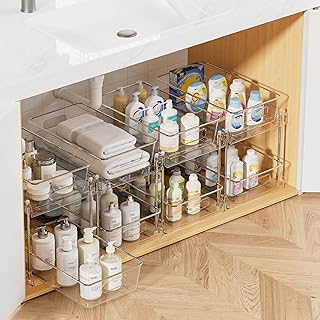
Vtopmart 4 Pack Bathroom Organizer
Vtopmart 4 Pack Bathroom Organizer has been one of the most consistently praised picks in this category. 65 reviewers averaged 4.5/5.
7. Use Tiered Rolling Carts For Art Supplies

Some toys need to move between rooms. Craft supplies and LEGOs are the worst offenders. I use a metal rolling storage cart from The Home Edit range, which I grabbed at Walmart for $39.98. It has three tiers, measuring 11.5 inches wide and 30 inches tall. The metal mesh bottoms stop small beads from falling through while letting dust sift out. I keep construction paper on the bottom tier, crayons and markers in small acrylic cups on the middle tier, and play dough on the top. When my daughter wants to color at the kitchen island, I just roll the cart out of the pantry. When she finishes, I roll it back behind the pantry door. It’s completely hidden from the main living area. The wheels on The Home Edit cart are surprisingly smooth on hardwood, but they struggle on our thick living room rug. If you have high-pile carpet, you’ll end up dragging it rather than rolling it. I tried keeping this cart permanently in the dining room, but it always looked messy because the tiers are open. It only works as hidden toy storage if you have a specific closet or pantry to roll it into when playtime ends.
8. Organize Closed Cabinets With Clear Labeled Bins

A common mistake is using opaque bins inside closed cabinets. I did this for a year in our TV console. I used dark gray fabric bins. My kids couldn’t remember what was in them, so they just pulled every single bin out onto the rug to find one specific toy. If the cabinet door is hiding the mess, the bins inside need to be transparent. I switched to the iDESIGN Linus Cube Bins with Handles. They cost $19.99 each at The Container Store. They are made of thick, shatter-resistant plastic. I also use the SAMLA boxes from IKEA, which are much cheaper at $3.99 for the 3-gallon size. I place these clear bins inside our solid wood cabinets. To make cleanup easier, I print picture labels using my phone and tape them to the front of the plastic bins. A picture of a train goes on the train bin. My three-year-old can independently put toys away because the visual cue is right there. The iDESIGN bins are expensive, and dropping them on tile will crack them. I lost a $20 bin last month because it slipped out of my hands. But the clarity of the plastic makes finding toys instantly easier.
9. Rotate Excess Toys Into Garage Storage Bins

You can’t organize your way out of simply having too much stuff. The most effective hidden toy storage strategy is removing 60 percent of the toys from the house entirely. I implement a strict toy rotation system. I keep only a small selection of toys accessible in the living room. The rest go into heavy-duty 18-gallon Rubbermaid Roughneck storage totes. I buy these for $14.98 at Home Depot. I store four of these dark green bins on metal shelves in my garage. Every four weeks, I bring one bin inside and swap out the living room toys. This renews my children’s interest in toys they haven’t seen in a month. It feels like Christmas morning to them, and it significantly reduces the visible clutter I have to look at daily. The Rubbermaid bins are crucial here because they seal tightly. I previously used cheap clear bins from Costco in the garage, and a family of spiders moved into the Lincoln Logs. The Roughneck bins keep moisture and bugs out completely. The rotation process takes me about 30 minutes on a Sunday afternoon. It requires discipline, but having half empty shelves in the playroom is a massive visual relief.

Amazon Basics 4-Shelf Steel Wire Storage Shelves for Garage
Amazon Basics 4-Shelf Steel Wire Storage Shelves for Garage punches above its price — 1,954 buyers rated it 4.5 stars. I would buy it again.
10. Stuff Soft Toys Into Functional Bean Bag Chairs

Stuffed animals are the bane of my existence. They are bulky, oddly shaped, and impossible to stack on a shelf. I refused to buy those hanging corner nets because they look like giant spider webs trapping dusty bears. Instead, I bought a stuffed animal storage bean bag cover from Lukeight on Amazon for $26.99. It measures 38 inches across when flat. You literally just unzip it and stuff all the plush toys inside. It holds about 70 small to medium stuffed animals. Once you zip it up, it forms a surprisingly comfortable bean bag chair. We keep it in the corner of the reading nook. It turns pure clutter into functional seating. The canvas material is thick, like heavy denim, so you don’t feel the hard plastic eyes of the toys poking through your back. I wash the cover in cold water every few months. One major flaw is the zipper. If you overstuff the bag, the zipper teeth will separate. I broke the zipper on our first bag by trying to force a giant carnival teddy bear inside. You have to leave about 10 percent of the space empty so the fabric can shift when someone sits on it. You might also like: 13 Craft Closet Organization Ideas You Need to See
11. Stop Using Giant Open Toy Chests

The traditional wooden toy chest is a terrible invention. It acts as a giant dumping pit. The toy your kid wants is always at the very bottom, requiring them to throw 30 other toys onto the floor to reach it. I tried this wrong for months before figuring it out. We had a beautiful $150 wooden chest from Pottery Barn Kids. It held everything, but my living room was destroyed every afternoon when they went digging for one specific dinosaur. You need smaller, categorized compartments. I sold the chest and bought an IKEA Kallax unit. Inside the square cubbies, I use 3 Sprouts Cube Storage Boxes. They cost $19.99 each and measure exactly 13 by 13 by 13 inches. The felt animal appliques on the front are cute, but more importantly, the bins are small enough to categorize effectively. One bin holds only play food. Another holds only magnetic tiles. The rigid cardboard sides keep the bins looking sharp on the shelf. The negative here is the cardboard core. If your toddler spills a sippy cup of water into a 3 Sprouts bin, the cardboard warps instantly and smells like mildew. Keep liquids far away from these fabric bins.
12. Contain Tiny Pieces With Drawstring Playmats

Stepping on a Lego barefoot is a universal parenting nightmare. Tiny toys spread across a rug are impossible to clean up quickly. I bought the SlideAway Toy Storage Organizer & Play Mat for $49.99. It looks like a standard storage basket, but it has a 52-inch sorting mat attached to the inside. You pour the LEGOs onto the mat, the kids play on the mat, and when they finish, you pull the heavy-duty handles. The mat slides all the pieces directly back into the basket in about four seconds. It’s incredibly fast. I keep this basket next to the sofa, and it just looks like a normal gray laundry hamper. I bought mine while grabbing groceries at Kroger, surprisingly enough, in their seasonal aisle. The canvas is thick and the stitching handles the weight of thousands of plastic bricks. The only issue is the lip of the playmat. It has a two-inch rim meant to keep pieces contained. My kids constantly sit on the rim, flattening it out, which allows tiny pieces to escape onto the floor anyway. You have to constantly remind them to sit outside the mat, not on the edge.

Sakugi Storage Shelves
Honestly, Sakugi Storage Shelves – 5-Tier Heavy Duty Garage Shelving Units with surprised me — sturdier than it looks in the photos, and over 34 buyers gave it 4.5 stars.
13. Reassign Kitchen Cabinet Space For Daily Play

Toys naturally migrate to wherever the parents are. For us, that means the kitchen and the dining room. Instead of fighting this migration, I leaned into it. Victoria Fearnley, a member of the Association of Professional Declutterers and Organizers (APDO), suggests dedicating specific, hidden spots in communal areas for toys. I emptied out a lower kitchen cabinet that used to hold my heavy baking sheets. I moved the baking sheets to the pantry and dedicated that 24-inch wide kitchen cabinet entirely to toys. I installed two sliding pull-out shelves from Rev-A-Shelf, which cost me $79.99 each at Lowe’s. Now, while I cook dinner, my kids pull out the bottom drawer to access their coloring books and puzzle boxes. When dinner is ready, they slide the drawer shut and close the cabinet door. The kitchen looks completely adult again. This keeps toys accessible for play but easily concealed. The tradeoff is sacrificing prime kitchen real estate. I had to donate a stack of plastic Tupperware I never used to make room. But having a clean kitchen floor while I chop vegetables is worth losing a little bit of storage space for pots and pans.
14. Utilize Peg Rails And Woven Baskets On Walls

When floor space is entirely gone, you must think vertically. Wall-mounted shelves keep items off the floor, making vacuuming easier. I installed a 48-inch wooden peg rail system across the back wall of our playroom. I bought the solid maple peg rail from a seller on Etsy for $45. I hung a series of woven seagrass baskets from the pegs using thick leather loops. The baskets cost $14.99 each from Target’s Threshold line. They measure 10 inches deep. I use these hanging baskets to hold lightweight items like foam blocks, doll clothes, and wooden train tracks. The natural texture of the seagrass adds warmth to the room, and the toys are completely hidden from eye level. It looks like a decorative wall feature rather than a storage system. The heavy items can’t go in these baskets. I tried putting a set of solid wooden blocks in one, and the weight pulled the basket handle right off the peg, crashing onto the baseboard. Keep the wall-mounted storage strictly for soft, light items. Ensure you use heavy-duty drywall anchors when installing the peg rail. Standard screws will rip straight out of the drywall when your kid inevitably pulls on a basket.
If you want these systems to actually work, you have to involve your kids in the process. Expert organizers emphasize that children maintain organized spaces better when they help create them. Ensure the bins are at their height. If they can’t reach the shelf, they won’t put the toy away. I learned this when I put the puzzle bin on the top shelf of the closet. I spent six months putting puzzles away myself before moving the bin to the floor. Start small. Pick one corner of your living room and implement a single hidden toy storage solution this weekend. The SONGMICS ottoman is my top recommendation if you just need a quick, affordable fix for a messy living room. Don’t forget to pin this article for later when you’re standing in the Target aisle trying to remember the exact dimensions of those under-bed bins. You’ve got this.
Frequently Asked Questions
How do you hide toys in a small living room?
Use multi-functional furniture like storage ottomans or hollow side tables. You can also reassign a lower kitchen cabinet or use tiered rolling carts that tuck away into a pantry or coat closet when playtime ends.
Are under-bed storage bins good for toys?
Yes, but you need bins with a low profile, typically 5 inches deep, so they slide easily under standard bed frames. Use them for seasonal items or bulky toys that aren’t played with every single day.
How do I stop my kid’s toy box from becoming a dumping ground?
Ditch the giant open toy chest. Instead, use modular shelving units like the IKEA Kallax filled with smaller, 13-inch categorized bins. This forces separation of toys and prevents kids from emptying everything to find one item.
What is a toy rotation system?
It’s a method where you keep 60 percent of toys in sealed bins in a garage or closet. Every few weeks, you swap them with the toys currently in the living room. It drastically reduces visible clutter and renews interest in old toys.
