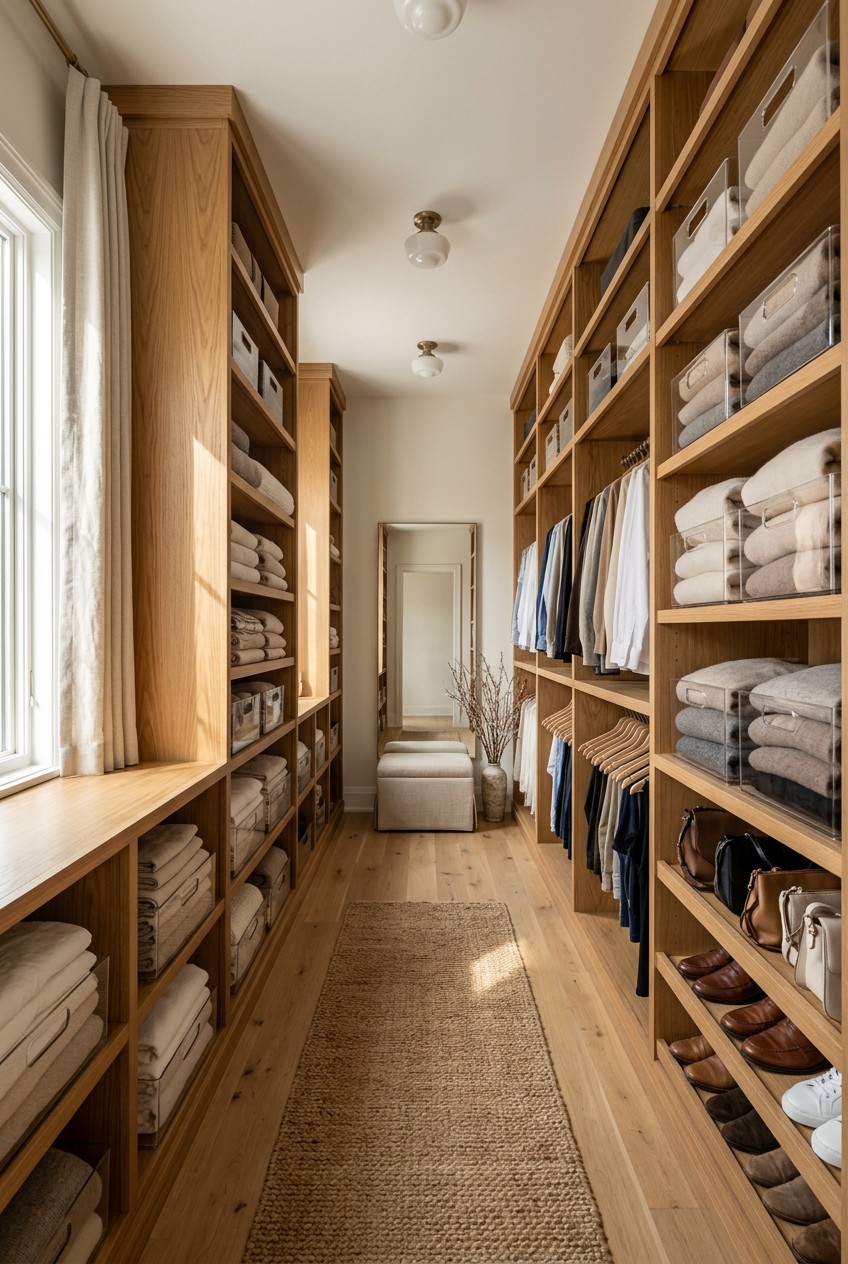
What’s Inside
- Always Declutter Before Buying Closet Organization Bins
- Embrace Clear, Stackable Closet Organization Bins for Visibility
- Prioritize Natural Materials for a Modern Look
- Utilize Modular Drawer Organizers for Tiny Accessories
- Invest in Soft Fabric Bins for Delicate Goods
- Maximize Vertical Space with Tiered Stackable Solutions
- Label Everything, Even Your Clear Bins
- Group Like Items Together to Avoid the Miscellaneous Trap
- Utilize IKEA SKUBB Boxes for Uniform Shoe Storage
- Avoid Round or Tapered Bins for Maximum Efficiency
- Don’t Overstuff Your Bins (Leave Breathing Room)
- Consider Discreet Storage for a Streamlined Aesthetic
- Repurpose and Thrift for Sustainable Solutions
- Use Heavy-Duty Bins for Seasonal Items Up High
- Integrate Modular Systems for Long-Term Adaptability
- Don’t Forget the Floor Space (Rolling Bins Are Key)
Picture this. It’s 7:45 AM last Tuesday. I’m standing in my bedroom in just my underwear, yanking a gray sweater from a mountain of clothes on my top shelf. The pile collapses, raining dusty sweaters and rogue wire hangers onto my head. That moment of frustration is why I finally got serious about finding the right closet bins. You can’t just shove things onto open shelves and pray they stay folded. I’ve tried this wrong for months. I’d buy random cute baskets, throw them in the closet, and wonder why it still looked like a disaster zone. The truth is, not all storage containers are created equal. Some are too flimsy, some waste space, and some are just plain ugly. I’m going to walk you through what works, what to avoid, and the exact products I use at home. Let’s get into the nitty-gritty of making your closet function.
1. Always Declutter Before Buying Closet Organization Bins

Before you even think about buying new storage, you must empty your space. I’m guilty of doing this backwards. A few years ago, I marched into Target, bought six of those $12.99 fabric cubes because they looked pretty, and brought them home. I tried to stuff my chaotic, oversized t-shirt collection into them. It’s a failure when you realize the bins don’t magically make your junk disappear. Professional organizer Emily Kate Johnson of Organized by Emily Kate warns that buying a basket won’t automatically organize your closet. In fact, it can add more clutter. She’s right. You must ruthlessly purge first.
Once you pare down your wardrobe, grab a metal tape measure. You need to measure the width, depth, and height of your shelves, drawers, and floor space. Write these numbers on your phone. I can’t stress this enough. If your shelf is 14 inches deep and you buy a 16-inch bin, it’s going to hang off the edge and look terrible. Polished Habitat highlights this as a massive mistake. I once wasted $45 on gorgeous acrylic bins from The Container Store that were exactly half an inch too tall for my shelves. The plastic scraped the paint off the ceiling of the cubby every time I pulled them out. Measure twice. Write it down. Only then should you start shopping.
2. Embrace Clear, Stackable Closet Organization Bins for Visibility

For items stored on shelves above your eye level, opaque boxes aren’t your best friend. If you can’t see what’s inside, you won’t wear it. You’ll forget about that silk scarf or those thick wool socks. I recommend switching to clear plastic containers for these areas. My favorite is the mDesign Closet Plastic Storage Organizer Bin with Open Dip Front. You can usually grab an 8-pack for about $45.99 online. The open front means you can reach in and grab a t-shirt without unstacking the whole tower.
I keep these for my workout gear. I can see the neon pink of my running shorts right through the plastic. The hard acrylic material feels sturdy, not like that cheap, bendy plastic that cracks if you drop it. For bulkier seasonal items like heavy winter coats, I swear by the Sterilite Ultra Latching Box 70 Qt. A 4-pack costs roughly $39.99. They feature thick, secure latches that snap shut with a loud click. I place these on the top shelf. Because they’re completely transparent, I don’t need to guess which box holds my ski pants and which one holds my ugly Christmas sweaters. Learned that the hard way.
3. Prioritize Natural Materials for a Modern Look

Basic plastic is great for utility, but sometimes you want your closet to look like a boutique. The 2026 design trend leans toward sustainable and biophilic design. People want organic materials like rattan, woodchip, seagrass, and bamboo to bring nature indoors. I agree with this shift. Staring at a wall of sterile plastic isn’t great. It feels like a hospital supply room.
To warm up my space, I used the StorageWorks Hand-Woven Large Storage Baskets. They come in a 2-pack for $32.99 and are made from natural water hyacinth. They measure exactly 15.25 inches long by 10.75 inches wide by 5 inches high. I keep these at eye level because they look gorgeous. The texture is earthy, and they smell faintly like dried sweetgrass. I use them to hold my jeans. I roll the denim tightly and stand the cylinders upright. The brown tones of the water hyacinth look incredible against the blue denim. A quick tip. Don’t put delicate fabrics like silk or thin knits in woven baskets. I’ve ruined a $60 silk camisole because it snagged on a stray piece of rattan. Keep the rough baskets for tough fabrics.

AMKUFO 6 Pack-Closet-Organizers-and-Storage
Honestly, AMKUFO 6 Pack-Closet-Organizers-and-Storage surprised me — sturdier than it looks in the photos, and over 52 buyers gave it 4.5 stars.
4. Utilize Modular Drawer Organizers for Tiny Accessories

Drawers are the black holes of the closet. You throw a pair of socks in there, and they disappear into a tangled mess of underwear and random receipts. To fix this, you need modular organizers. I’m obsessed with the iDesign Linus Shallow Drawer Organizers. They’re made from a heavy-duty, clear Resipreme plastic and cost about $14.99 for a set. I use the 6 by 6 by 2 inch squares. They feature little ribbed details on the bottom that keep things from sliding around.
I tried to go cheap on this once. I found some flimsy, thin plastic trays at a dollar store and thought I was smart. They slid all over the drawer, making a horrible scraping sound. I eventually threw them away. You need organizers with some weight, or at least rubber feet. OXO Good Grips also makes an incredible Large Expandable Kitchen Tool Drawer Organizer for $29.99. Yes, it’s for kitchens, but it works miracles in a wide closet drawer for sunglasses, watches, and rolled ties. It expands to fit your drawer. I was wandering through Walmart last month and noticed they carry similar modular, rubber-lined trays in their home section for about $9.99 a pop. They’re perfect for corralling tiny accessories.
5. Invest in Soft Fabric Bins for Delicate Goods

When it comes to delicate items, you need a soft touch. Workout clothes, swimwear, and cashmere sweaters don’t belong in rough wicker baskets or sharp plastic corners. Fabric storage cubes are the best solution here. I personally use the Amazon Basics Collapsible Fabric Storage Cubes. You can get a 6-pack for around $19.99. They measure 11 by 10.5 by 10.5 inches, fitting most standard closet cubbies.
I love these because they’re lightweight. I can pull a bin full of heavy sweaters down from a high shelf without straining my shoulders. Plus, they fold flat when not in use. Last winter, I was unpacking groceries after a run to Trader Joe’s. I was munching on their $3.49 peanut butter pretzels while putting away laundry. I realized my chunky knit sweaters were getting shoulder bumps from wire hangers. I took them all down, folded them, and stacked them into these soft gray fabric bins. It saved the shape of the garments. The fabric breathes, which keeps natural fibers like wool and cashmere from getting that musty smell over the summer. You might also like: 15 Creative Home Organizing Ideas You Haven’t Thought Of
6. Maximize Vertical Space with Tiered Stackable Solutions

Most closets have a massive amount of wasted air space between the top shelf and the ceiling. If you aren’t using that vertical real estate, you’re missing out. You need stackable storage containers to build upward. I recently discovered the CTSNSLH 4-Tier Stackable Plastic Storage Bins with Lids, which retail for about $49.99. When fully stacked, they reach approximately 32 inches high. They feature brilliant little front doors that swing open, so you don’t need to unstack the whole tower just to get sweatpants from the bottom bin. You might also like: 15 Inspiring Home Makeover Ideas You Haven’t Thought Of
For folded garments, the Snslxh Stackable Multifunctional and Foldable Closet Organizers are another fantastic option. Each basket measures 16.7 by 13.1 by 7.2 inches. They’re designed so the baskets pull out like drawers. I bought a massive pack of clear bins at Costco a few years ago that didn’t include this drawer feature. It was a nightmare. Every time I needed something from the bottom, I physically lifted three heavy boxes off the top. I eventually stopped wearing anything stored in the bottom box out of pure laziness. Invest in stackable bins that feature front access doors or sliding drawer tracks. It’s a lifesaver for your sanity. You might also like: 20 Lovely DIY Home Makeover That Make a Real Difference
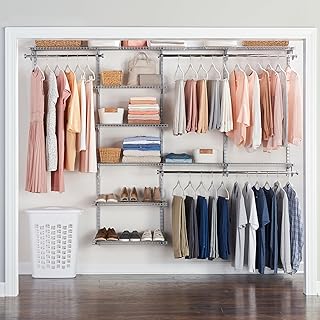
Rubbermaid Configurations Deluxe Custom Closet Kit 4-8 Ft.
Honestly, Rubbermaid Configurations Deluxe Custom Closet Kit 4-8 Ft. Adjustable surprised me — sturdier than it looks in the photos, and over 81 buyers gave it 4.5 stars.
7. Label Everything, Even Your Clear Bins

A major mistake people make is buying matching opaque bins, filling them, and then forgetting what’s inside. It defeats the purpose of organizing. If you need to dig through four identical white boxes to find your bathing suit, you’re wasting time. Professional organizer Trunz emphasizes that the simplest and most effective system is labeling. Defining where everything belongs makes it easy for anyone to find items and put them back.
I’m a fanatic about labeling. For opaque bins, clear labels aren’t optional. I use a Brother P-Touch label maker that costs around $34.99. I print crisp, black text on white tape. It looks uniform and clean. Even if you use clear bins, labels still help maintain a strict system. It stops you from lazily tossing a random belt into the bin designated for gym socks. If you aren’t ready to commit to a fancy label maker, don’t panic. Last month I grabbed a $5 roll of beige masking tape and a black Sharpie from Kroger while I was buying milk. I used it to make temporary labels for my seasonal bins. It works fine and gives off a cool, utilitarian vibe.
8. Group Like Items Together to Avoid the Miscellaneous Trap

Avoid the miscellaneous bin trap at all costs. We all own that one basket where we throw things that don’t belong anywhere else. A random scarf, a single glove, a spare button, a lint roller. Before you know it, that bin is overflowing with junk. You must group similar items by category before placing them in containers.
I was at Whole Foods last Tuesday buying an overpriced $6.99 green juice when I got a text from a client. She was having a meltdown because she couldn’t find her favorite leather belt for a work presentation. I asked where she kept her belts. She said they were mixed in with her purses, hats, and scarves across three different baskets. That’s a recipe for disaster. I told her to go home and dump all three baskets on her bed. Sort everything into strict piles. All belts together. All hats together. All scarves together. Then, assign one specific container to each category. I use the mDesign plastic bins for this. I keep one dedicated solely to my thick winter belts, and another just for my baseball caps. When you streamline your categories, your brain instantly knows where to look.
9. Utilize IKEA SKUBB Boxes for Uniform Shoe Storage

Shoes aren’t easy to store. They’re bulky, dirty, and never stack neatly. If you just line them up on the floor, they inevitably end up kicked into a chaotic pile. For an economical and highly uniform shoe storage solution, you can’t beat the IKEA SKUBB shoe boxes. A pack of four typically costs around $7.99, which is cheap compared to fancy acrylic shoe drops.
These boxes are made from a bright white polyester fabric with a mesh window on the front. They measure 8.75 by 13.5 by 6.25 inches. Because they’re all the same size, they create a clean, uniform look on your closet shelves. I’ll be honest, the mesh front isn’t perfectly clear. You can sort of see the color of the shoe, but it’s hard to make out the exact style in dim lighting. This is why labeling them is key. I write the brand and style on a piece of cardstock and slide it into the mesh panel. I used to keep my expensive suede boots in their original cardboard boxes. They looked terrible and mismatched. Switching to the white SKUBB boxes changed the visual aesthetic of my closet floor.

5 Tier Closet Hanging Organizer
5 Tier Closet Hanging Organizer punches above its price — 1 buyers rated it 4.5 stars. I would buy it again.
10. Avoid Round or Tapered Bins for Maximum Efficiency

This is a huge pet peeve of mine. Professional organizers advise against using round or tapered containers, especially on shelves. They might look cute in the store, but they’re a mathematical nightmare. A round basket placed on a square shelf creates dead, unusable space in all four corners. A tapered bin wastes precious inches between containers when you line them up side-by-side.
You always want to opt for square or rectangular bins with flat, straight sides. I learned this the hard way. I bought these adorable, slouchy round rope baskets for my top shelf. I could only fit three of them across. I swapped them out for the mDesign Plastic Deep Kitchen Food Storage Bins, which are perfectly rectangular and cost about $24.99 for a 4-pack. Because they feature straight 90-degree corners, I fit five of them in the same horizontal space. Users report that these straight-edged bins fill the space perfectly in cubby squares. Don’t sacrifice storage volume for a cute shape. Your closet is about function first. Straight lines are your best friend when trying to maximize every inch of a shelf.
11. Don’t Overstuff Your Bins (Leave Breathing Room)

It’s tempting to cram one more bulky sweater into a bin that’s already full. I’ve done it. You push down on the pile, zip the lid shut, and hope the seams hold. But overfilling your containers isn’t a good idea. It makes it impossible to find items without pulling everything out, and it can damage your clothing. Fabrics need room to breathe. If you pack wool or cotton too tightly, the fibers get crushed, leading to permanent wrinkles and a stale odor.
Plus, overstuffing will break your storage products. I once shoved 15 pairs of heavy denim jeans into a flimsy fabric cube. When I tried to pull it off the shelf by the handle, the fabric ripped right down the side, dumping jeans all over my feet. It’s a $15 mistake I won’t repeat. Trust me. You need to leave at least an inch or two of breathing room at the top of every container. If a bin is consistently overflowing, it’s a sign of a bigger problem. You either need to buy a second container, or you need to do another round of decluttering. If it doesn’t fit comfortably, it doesn’t belong.
12. Consider Discreet Storage for a Streamlined Aesthetic

The 2026 trend for closet design is moving toward a desire for discreet, hidden storage. People are tired of looking at visual clutter. Even if your items are neatly folded, a clear bin full of neon workout shirts and patterned leggings can look chaotic. The goal is to maintain a clean, streamlined aesthetic that feels calming when you open the door.
While open baskets are great for quick access, using lidded bins that blend with your closet’s interior is the best way to achieve this calm look. I love using solid, neutral-colored boxes with matching lids for the shelves right at eye line. It creates a solid wall of calm color rather than a busy patchwork of fabrics. Even Sprouts has a small home goods section now where I spotted these perfect little bamboo trays with solid lids for $14.99. I bought three to hold my messy collection of travel toiletries and extra shoelaces. Because the lids hide the mess, my shelf looks like a minimalist spa. If you’ve got open shelving, hiding the visually loud items behind solid materials like bamboo or matte white plastic will improve the entire feel of the room.

Ulif E10 Clothes Rack(With Stretchable Hanger
Honestly, Ulif E10 Clothes Rack(With Stretchable Hanger Rod)Freestanding Clothin surprised me — sturdier than it looks in the photos, and over 926 buyers gave it 4.5 stars.
13. Repurpose and Thrift for Sustainable Solutions

You don’t always need to spend a fortune on new matching sets. A surprising tip, and a massive 2026 trend, is to shop your own home or hit the thrift stores for unique, sustainable storage. The current design movement embraces joyous imperfection. This means mixing and matching vintage pieces with modern shelving for a curated look. It also eases the financial burden, because buying 20 large water hyacinth baskets at retail price will drain your bank account.
I’ve repurposed an old, beat-up vintage wooden chest I found at a flea market for $40. I cleaned it up, lined the inside with fresh cedar paper, and shoved it onto the floor of my walk-in closet. It holds all my heavy winter blankets and extra pillows. It looks chic and provides hidden storage. I also use a thick, coiled rope basket that used to sit in my living room holding firewood. Now, it sits in my closet holding all my rolled-up yoga mats. Don’t be afraid to think outside the traditional plastic box. An old decorative bowl can hold your watches. A vintage wire egg basket can hold your rolled socks. Get creative with what you already own before running to the store.
14. Use Heavy-Duty Bins for Seasonal Items Up High

Your prime closet real estate—the space between your knees and your shoulders—should be strictly reserved for items you wear weekly. Everything else needs to be relocated. You can’t keep winter coats at eye level in July. You should store infrequently used or out-of-season garments in heavy-duty bins on the highest shelves, tucked under the bed, or moved entirely to another storage area like an attic or garage.
I swap my closet out twice a year. In May, all my heavy wool coats, thick scarves, and snow boots go into massive, 27-gallon black plastic storage totes with bright yellow lids. You can get these at hardware stores for about $12.99 each. They’re practically indestructible. I haul them out to the garage and stack them on metal racks. This immediately frees up half of my closet space for my summer dresses and sandals. You must label these bins clearly. I use huge strips of white duct tape and a thick black marker. I write ‘WINTER COATS’ in giant letters. I’ve learned to do this after I spent an hour sweating in my dusty attic opening six identical black totes just to find one rain jacket. Keep the heavy stuff out of your daily sightline.
15. Integrate Modular Systems for Long-Term Adaptability

Your storage needs aren’t going to stay the same forever. You might buy a new collection of tall boots, or suddenly need space for maternity clothes. Modular and customizable systems are a dominant trend right now because they allow your storage to adapt to these changing needs without a full remodel. While individual containers are great, you need to consider how they integrate with adjustable shelving or pull-out drawers.
The gold standard for this is the IKEA PAX system. It’s entirely customizable. You buy the empty frame, and then you add shelves, glass drawers, and pull-out shoe trays exactly where you want them. The brilliant part is that the IKEA SKUBB series I mentioned earlier is designed to fit perfectly within these PAX dimensions. You don’t need to guess if a box will fit. It slides in with zero wasted space. I’ve installed a small PAX unit in my guest room for about $350. I used adjustable shelves so I could fit tall boots on the bottom and shallow jewelry trays on the top. If I ever need to change it, I just pop the shelf pegs out and move them up an inch. Your closet shouldn’t be static. It needs to flex and grow as your wardrobe changes.

AWTATOS Cube Storage Organizer Storage 12 Cube Bookshelf
Honestly, AWTATOS Cube Storage Organizer Storage 12 Cube Bookshelf DIY Plastic C surprised me — sturdier than it looks in the photos, and over 28 buyers gave it 4.5 stars.
16. Don’t Forget the Floor Space (Rolling Bins Are Key)

The floor of your closet isn’t just for kicked-off shoes. It’s often the most underutilized, messy area in the entire space. People tend to just kick their shoes off and let them pile up in a dark corner. To truly maximize your storage, you need to treat the floor with the same respect as your eye-level shelves. The best way to do this is with low-profile, rolling storage containers that can slide effortlessly out of the way.
I swear by the Sterilite 66 Qt Clear View Underbed Storage Box with wheels. They run about $22.99 each. Even though they’re marketed for under the bed, they’re the perfect height to slide under the hanging hems of your long dresses or winter coats on the closet floor. I use two of them side-by-side. One holds all my bulky travel backpacks and duffel bags, and the other holds my off-season shoes. I’m telling you, the tiny wheels on the bottom are a lifesaver. Instead of dragging a heavy plastic box across my hardwood floor and scratching the finish, I just hook my foot around the handle and roll it out smoothly. It keeps the floor looking clear and gives me an extra cubic foot of storage that would otherwise just be collecting dust bunnies and stray socks.
Getting your closet in order isn’t about buying the most expensive, Instagram-worthy acrylic boxes. It’s about finding the right tools for the exact dimensions of your space. I hope these specific tips save you from making the same frustrating, expensive mistakes I’ve made over the years. Take it one shelf at a time, measure everything twice, and don’t be afraid to mix high-end organic materials with cheap, functional plastic where it makes sense. If you found this breakdown helpful, please save it or pin it to your favorite home organization board so you can reference these exact product dimensions next time you’re shopping!
Frequently Asked Questions
What are the best materials for closet organization bins?
For visible shelves, natural materials like water hyacinth or bamboo look beautiful. For higher shelves, clear acrylic or heavy-duty plastic closet organization bins are best because you can quickly identify the contents without pulling the bins down.
How do I stop my closet organization bins from wasting space?
Always choose square or rectangular bins with flat, 90-degree sides. Round or tapered containers create dead space on your shelves. Measure your shelf depth and height precisely before buying to ensure a perfect, flush fit.
Should I use lids on my closet organization bins?
Lids are essential for long-term storage, like off-season winter coats or heavy blankets, to prevent dust buildup. For daily items like t-shirts or workout gear, open-front dip bins are much better for quick, easy access.
How do I organize small items in large closet bins?
Don’t just toss small accessories into a massive basket. Use modular drawer organizers or small plastic inserts inside your larger closet organization bins. This keeps belts, socks, and jewelry separated and prevents the dreaded miscellaneous junk pile.
