
What’s Inside
- Prioritize Decluttering First, Always
- Master the Category First, Then Color Rule
- Adopt the Light-to-Dark Gradient for Visual Flow
- Embrace the ROYGBIV Method for Vibrant Wardrobes
- Strategically Anchor with Neutrals for Balance
- Invest in Matching Slim-Profile Hangers
- Color-Code Hangers for a Surprising Hack
- Handle Patterned Items with Dominant Color Zones
- Utilize Modular Storage Systems
- Incorporate Clear Storage Bins for Accessories
- Color-Coordinate Shoes and Accessories
- Implement Monochromatic Sections for Sophisticated Styling
- Use Drawer Dividers for Small Items by Color
- Integrate Smart Lighting for True Color Recognition
- Maintain with Seasonal Rotation and Regular Editing
I spent 45 minutes last Tuesday morning sitting on my bedroom floor, surrounded by a mountain of tangled wire hangers, trying to find one specific navy blue blazer. That was the exact moment I realized my current system was a total disaster, and I finally committed to proper closet color organization. If you’re tired of buying duplicate black t-shirts because you can’t see what you own, you need a system that actually works. I tried color-coding my wardrobe three different times before I finally figured out the mechanics of it. It’s not just about making a pretty rainbow on a rod. It’s about building a highly functional map of your clothing so your brain can process your options in seconds. I used to think sorting by color was just for aesthetic Pinterest boards, but it’s actually a massive time-saver for your daily routine. Let’s break down exactly how to execute this right, using specific bins, lighting, and hangers that won’t break the bank. I’ve made all the rookie mistakes so you don’t have to. Trust me on this.
1. Prioritize Decluttering First, Always

Before you even touch a hanger, you’ve got to purge. I tried to color-code my closet in 2022 without decluttering first. It’s a massive mistake. I ended up perfectly organizing 14 stretched-out gray t-shirts I hadn’t worn since college. Learned that the hard way. Professional organizers like Amanda Titchenal constantly repeat this rule because it’s completely true. There is zero point in organizing items you don’t wear. I grabbed a box of Target up&up Heavy Duty 30-Gallon trash bags ($11.49 for 40 bags) and forced myself to touch every single garment. The smell of dusty, unworn fabric in the back corners was a harsh reality check. If I’d not worn it in the last year, it went straight into the donation bag. I hauled four heavy bags to my local thrift store next to the Kroger that very afternoon. You’re trying to reduce visual clutter so you only organize what you actually put on your body. When you keep clothes that don’t fit or feel itchy, they just take up valuable real estate in your color blocks. Be ruthless. If that itchy wool sweater from three Christmases ago is still hanging there, get rid of it. You won’t wear it just because it’s now hanging in a neat color-coordinated row. Get your inventory down to the essentials first, and the color coding will be significantly easier.
2. Master the Category First, Then Color Rule

The biggest mistake people make with closet color organization is skipping the category phase. I did this during my first attempt. I put all my blue jeans next to my blue silk blouses and my heavy blue winter coats. It looked like a giant, confusing blue blob. Expert Maria Baer calls this “stylish chaos,” and she’s completely right. You need to group items by type first. Put all your short-sleeve shirts together. Put all your long-sleeve shirts together. Put your pants in their own distinct zone. Only after you define these categories do you start color-coding within them. I installed a secondary Walmart Mainstays adjustable closet rod ($12.98) just to separate my tops from my bottoms. Once I got all my tank tops isolated on the top left, I arranged them by color. This means when I need a green tank top, I go to the tank top section and look for green. I don’t need to hunt through green dresses and green sweaters to find it. It sounds completely obvious, but skipping this step guarantees your system will fail within a week. You want functionality first, aesthetics second. If you mix sleeve lengths or fabric weights just to make the color gradient look uninterrupted, you’re going to ruin your morning routine.
3. Adopt the Light-to-Dark Gradient for Visual Flow

Once your categories are firmly set, the actual arrangement of the colors matters. Within each clothing category, always arrange your items from light to dark. I used to just throw colors together randomly, but the visual noise gave me a headache. I was drinking my $4.50 iced coffee from Whole Foods one morning, staring at my closet, and realized the harsh jumps from black to white to neon pink were making me anxious. Professional organizers rely on the light-to-dark gradient because it creates a calming visual effect. If you’re looking at your long-sleeve shirts, start with stark white on the far left. Move through your creams, light pastels, and brighter hues, and finish with your dark grays and blacks on the right. Your brain processes this gradient much faster than a randomized setup. I noticed that when I arrange things this way, I can spot a missing item instantly. If the cream section looks thin, I know those shirts are sitting in the laundry basket. The only negative here is that if you own five slightly different shades of gray, you might spend five minutes debating which one is technically darker. Don’t overthink it. Just get the general flow established so your eyes can scan the rack without jumping back and forth.
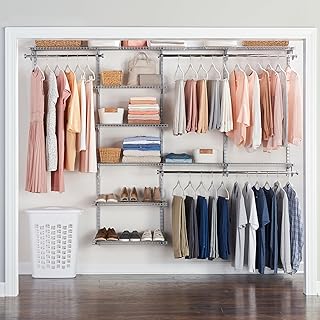
Rubbermaid Configurations Deluxe Custom Closet Kit 4-8 Ft.
If you want something that just works, Rubbermaid Configurations Deluxe Custom Closet Kit 4-8 Ft. Adjustable is a safe bet (81 reviews, 4.5 stars).
4. Embrace the ROYGBIV Method for Vibrant Wardrobes

If you actually wear a lot of color, you need a strict rule for the order. The standard ROYGBIV method (Red, Orange, Yellow, Green, Blue, Indigo, Violet) is the most logical way to handle a diverse wardrobe. I tried inventing my own color flow based on what I thought looked pretty, and I could never remember where I decided to put my teal shirts. Sticking to the basic rainbow eliminates decision fatigue. I own a stack of J.Crew Vintage Cotton V-neck t-shirts ($34.50 each) in almost every color they make. Hanging them in strict rainbow order creates a sharp, clear contrast between the color groups. You need to decide where to place your neutrals in this setup. I strongly suggest putting whites, blacks, grays, and browns at the beginning or the end of the spectrum, not mixed in. I keep my whites and creams on the far left, followed by the rainbow, and anchor the right side with browns, grays, and blacks. It keeps the vibrant colors from getting muddied. A quick warning: indigo and violet usually just blend into “purple” for most people’s wardrobes. Unless you own a massive collection of purple clothing, just group your dark blues and purples together at the end of the rainbow. You might also like: 16 DIY Closet Organization Ideas for Every Budget
5. Strategically Anchor with Neutrals for Balance

For 2026, closet design is moving away from the stark, primary-color rainbow and leaning into richer, moodier palettes with intentional layers. If your closet looks too much like a preschool classroom, you need to use neutral pieces as visual anchors. I started doing this last winter when my bright red sweaters were clashing horribly with my neon yellow tops. I took my basic Everlane Organic Cotton Crew tees ($30) in black, white, and gray, and used them as physical dividers between the loud color sections. Placing a black item between a bright red and a bright yellow section gives your eyes a place to rest. You can also use white and cream pieces to bridge different color families. It prevents the closet from appearing overwhelming. I keep my heavy beige cardigans right in the middle of my rack to break up the intense jewel tones. The downside to this method is that it technically breaks the strict category rule if you’re moving neutral basics around just to act as dividers. You’ve got to decide if you prioritize the visual break over having all your black shirts in one continuous block. For me, the visual relief is worth splitting up my black shirts into two separate anchoring zones. You might also like: 15 Utility Closet Organization Ideas Worth Trying
6. Invest in Matching Slim-Profile Hangers

You can execute the most perfect color gradient in the world, but if your clothes are hanging on a mix of thick plastic tubes and wire dry-cleaner hangers, it will look terrible. I fought this for years. I didn’t want to spend money on hangers. But professional organizer Jenna Haefelin is right: mismatched hangers create massive visual clutter and waste an unbelievable amount of space. I finally caved and bought two boxes of Amazon Basics Slim Velvet Hangers (pack of 50 for $22.99). The difference was immediate. The slim profile gave me back almost 50% more hanging capacity on my main rod. The velvet texture stops my wide-neck blouses from slipping off and landing on the floor, which used to drive me insane. The dark black velvet also creates a uniform background that makes the clothing colors pop. One negative I will point out: velvet hangers are terrible for damp clothing. I accidentally hung a slightly damp linen shirt on one, and the black dye from the hanger transferred onto the white fabric. Only use these for completely dry clothes. Throw away the wire hangers. Recycle the thick plastic ones. The uniform look is mandatory if you want your color system to actually look organized. You might also like: 15 Cozy DIY Closet Organization Ideas for Any Style

SNSLXH 5 Pack Stackable Closet Storage Basket
Honestly, SNSLXH 5 Pack Stackable Closet Storage Basket surprised me — sturdier than it looks in the photos, and over 4 buyers gave it 4.5 stars.
7. Color-Code Hangers for a Surprising Hack

Here is a trick most people don’t know about. You can use the hangers themselves as part of your color system. While I use black velvet for my everyday clothes, I use specific hanger colors to define formality levels. I bought a set of Target Brightroom Natural Wooden Hangers ($10 for a 5-pack) specifically for my heavy winter coats. I use white wooden hangers for my formal dresses and black velvet for my casual sweaters. This makes it incredibly easy to spot what you need at a glance. If I’m looking for a wedding guest dress, I just scan the rack for the white wooden hangers. I don’t even need to look at the garments themselves first. It cuts down my search time drastically. I tried using colored plastic hangers for this once (pink for tops, blue for pants) and it looked incredibly cheap and chaotic. Stick to neutral hanger colors like wood, white, gray, and black to indicate different zones. It keeps the closet looking mature while still giving you a functional map. Just remember to buy extra hangers in each specific color. There is nothing more frustrating than running out of white hangers and having to put a formal dress on a black velvet one, breaking your own rule.
8. Handle Patterned Items with Dominant Color Zones

Patterns will absolutely wreck your color system if you don’t establish a strict rule for them. I own a heavily patterned Anthropologie Somerset Maxi Dress ($168) that has pink, green, yellow, and black in it. For months, I just shoved it at the end of the rack because I didn’t know where it belonged. You’ve got two options for patterned items. The first is to squint at the garment and identify the most dominant background color, then place the item within that color section. If the dress reads mostly green from five feet away, it goes in the green section. The second option, which I actually prefer, is to create a dedicated section just for patterned clothing. I keep all my solids color-coded on the left, and all my florals, stripes, and plaids on the far right. This allows me to keep my solid color blocks perfectly pure. When I want to wear a pattern, I just go to the pattern zone. The mistake I made early on was trying to integrate striped shirts into my solid color blocks. A black-and-white striped shirt sitting between a solid black shirt and a solid white shirt just looks like a mistake. Group your patterns together.
9. Utilize Modular Storage Systems

Modular and customizable closet setups are dominating the design space in 2026. You need a system that adapts to your exact clothing volume, rather than forcing your clothes to fit a generic builder-grade wire rack. When I finally committed to serious closet color organization, I ripped out my wire shelves and installed an IKEA PAX system. The basic wardrobe frames run about $110 each, and you buy the specific drawers and shelves you need. This is crucial for color coding because you can adjust the shelving heights to accommodate different seasonal color blocks. I set up a specific short-hanging section just for my colorful summer blouses, and a taller section for my dark winter coats. The Container Store also offers the Elfa system, which is great, but slightly more expensive. The beauty of modular storage is that you can create physical boundaries for your colors. I use specific pull-out trays for my neutral folded jeans, and separate wire baskets for my brightly colored workout leggings. If your wardrobe grows and you suddenly own ten green sweaters instead of two, you just move a shelf down a few inches to make room. You aren’t permanently locked into one configuration.

Timate P3 Wall Mounted Closet Organizer System with 5
Timate P3 Wall Mounted Closet Organizer System with 5 Hanging Rods punches above its price — 7 buyers rated it 4.5 stars. I would buy it again.
10. Incorporate Clear Storage Bins for Accessories

You can’t hang everything. Smaller items like winter scarves, thick leather belts, and off-season bathing suits need containment. If you put them in opaque fabric bins, you completely lose the visual benefit of your color system. I used to use cute canvas cubes from Target, but I constantly forgot what was inside them. I switched to MUJI transparent Polypropylene Storage Drawers (specifically the L44xD55xH30cm size for $29.90 each). These are stackable, incredibly durable, and completely clear. Because they are transparent, I can fold my scarves by color and actually see the gradient through the plastic. It maintains the color organization without me having to open every single drawer to find my red wool scarf. I also use these for my off-season clothing. Right now, my bright neon summer tank tops are folded in a clear bin at the top of my closet. I can see exactly where they are, but they aren’t taking up prime hanging space on my main rod. The only negative with clear bins is that you’ve got to fold the items neatly. If you just shove your belts in there like a rat’s nest, everyone can see the mess. You’ve got to commit to folding.
11. Color-Coordinate Shoes and Accessories

Your clothing shouldn’t be the only thing following a color rule. Extending your color organization to shoes and accessories makes getting dressed significantly faster. I used to kick my shoes into a dark pile on the floor. Finding a matching pair of black heels in a rush was a nightmare. I bought a set of Kirkland Signature clear drop-front shoe boxes from Costco (an 8-pack runs about $34.99) and stacked them on the floor beneath my hanging clothes. I arranged my shoes by color inside the boxes. All the black boots are together, moving into brown loafers, then white sneakers, and finally colored heels. I do the exact same thing with my handbags. I display my structured leather bags on the top shelf, grouped by neutral tones. For my casual canvas totes and slouchy bags, I roll them up and put them into a large woven rattan basket. You don’t need to color-code the inside of a basket, but keeping the visible accessories aligned with your clothing gradient pulls the whole closet together. It visually connects the top shelf to the floor. Just don’t store leather bags touching each other in a humid climate, or the dye can transfer between colors.
12. Implement Monochromatic Sections for Sophisticated Styling

If you gravitate towards one specific color, you should dedicate a significant portion of your closet to a monochromatic section. I wear a massive amount of navy blue. Half my wardrobe is blue. Instead of just having a giant blue block in my rainbow, I broke it out into its own dedicated zone. This monochromatic organization makes coordinated dressing completely effortless. I’ve got a three-foot section of rod that is just navy. It holds my dark Levi’s 501 Original Jeans ($98), my navy blazers, and my navy silk dresses. Seeing all the different textures and fabrics within a single hue reveals exactly how versatile that color is. It also prevents you from buying duplicates. When all your black clothes are grouped together in one massive section, you realize very quickly that you don’t need to buy a seventh black turtleneck. You can see exactly what you own. The trick to making a monochromatic section work is paying attention to fabric weight. Since the color is all the same, organize the section by sleeve length or material thickness. Put the heavy navy wool coats on the left and the sheer navy blouses on the right. It gives the block structure.

Kmiectse Clear Storage Bins with Lids
Kmiectse Clear Storage Bins with Lids – 4 Tier Plastic Bins with Wheel has been one of the most consistently praised picks in this category. 2 reviewers averaged 4.5/5.
13. Use Drawer Dividers for Small Items by Color

Your drawers need color rules just as much as your hanging rods. Throwing all your socks into a drawer is a recipe for frustration. I used to dig through a tangled ball of cotton every morning trying to find two matching black ankle socks. I finally bought the Amazon Basics 2-pack drawer organizer dividers ($13.49). They are made of a gray non-woven fabric and pop right into standard dresser drawers. I separate my socks strictly by color. White athletic socks go in one compartment, black dress socks in another, and colorful novelty socks in a third. I do the exact same thing for my activewear. My sports bras are folded and filed upright by color. When I open the drawer, I see a perfect gradient from white to black. Filing your clothes upright (the KonMari folding method) is mandatory if you want to see the colors. If you stack your underwear flat on top of each other, you can only see the top pair, which defeats the entire purpose of color-coding the drawer. The fabric dividers are cheap and they keep the rolled items from unrolling and mixing together when you open and close the drawer aggressively.
14. Integrate Smart Lighting for True Color Recognition

You can’t color-code your closet if you can’t actually see the colors. Motion-activated lighting is a top closet trend in 2026 for a very practical reason. Most reach-in closets have terrible, shadowy lighting. I spent months thinking a dark navy shirt was black because my ceiling light was so dim. I kept hanging it in the black section, and it drove me crazy every time I wore it in the daylight. I fixed this by installing Govee LED Strip Lights (a 16.4-foot roll costs $22.99). I ran the adhesive strip along the inside frame of the closet door and under the top shelf. The bright white light illuminates the clothing perfectly. Good lighting is absolutely crucial for accurate color recognition. When you’re trying to distinguish between a dark charcoal gray sweater and a faded black sweater, you need proper illumination. I highly recommend getting lights with an adjustable color temperature. Set them to a cool daylight white (around 5000K) rather than a warm yellow light. Yellow light distorts the colors of your clothing, making blues look green and whites look dingy. The adhesive on these light strips can peel paint if you rip them off too fast, so apply them carefully to the trim.
15. Maintain with Seasonal Rotation and Regular Editing

Even the most perfectly executed color system will degrade if you don’t maintain it. You can’t just organize your closet once and expect it to stay flawless forever. Seasonal rotation is mandatory. In early May, I pull all my heavy winter coats, thick wool sweaters, and dark corduroy pants out of the main color rotation. I pack them into Sterilite 66-quart latching storage boxes ($11.98 at Walmart). To keep them smelling fresh, I drop in a few cedar balls infused with lavender essential oil I grab from Sprouts ($7.99 for a small bottle). I label the outside of the bin with heavy tape: “Winter Sweaters – Darks.” Moving the off-season items out of your closet frees up prime real estate for the clothes you’re actually wearing right now. It also makes your color blocks smaller and easier to manage. You need to regularly review your color sections. Every three months, I scan my racks. If I see a green shirt that has been sitting in the exact same spot since the last season, I pull it out and donate it. Clutter builds up silently. If you force a new shirt into a tightly packed color block without removing an old one, the hangers will bunch up, the clothes will wrinkle, and the entire system will collapse.
Implementing this system takes a solid afternoon of work, but the daily time it saves is immeasurable. No exaggeration. Getting dressed shouldn’t feel like a treasure hunt in a dark cave. Start by pulling everything out, purging the items you hate, and sorting by category before you even think about the rainbow. I promise, once you get your hangers matching and your colors flowing from light to dark, your mornings will be significantly less stressful. Pin this guide for your next free weekend, and let me know which step makes the biggest difference in your space.
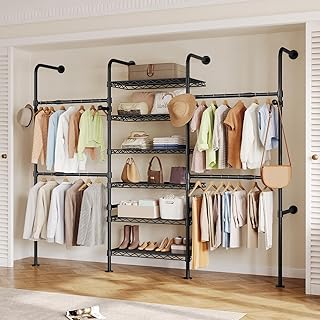
Closet Organizers and Storage
Honestly, Closet Organizers and Storage surprised me — sturdier than it looks in the photos, and over 39 buyers gave it 4.5 stars.
Frequently Asked Questions
How do I maintain closet color organization?
You’ve got to commit to seasonal rotations and regular decluttering. Store off-season items in clear bins to free up space. When you buy a new item, immediately hang it in its designated color zone rather than shoving it at the end of the rack.
Does the ROYGBIV method work for small closets?
Yes, it’s highly effective for small spaces because it creates instant visual boundaries. If you’re working with limited hanging space, sort by category first, then apply the rainbow gradient to each small section to keep the visual clutter down.
What should I do with patterned clothing?
You can either group all patterned items in their own dedicated section at the end of your closet, or identify the dominant background color of the garment and place it within that specific solid color block.
Are velvet hangers really necessary for color coding?
They aren’t strictly mandatory, but switching to uniform slim hangers drastically improves the visual flow. The matching profile removes background noise, allowing your eye to focus entirely on the color gradient of the clothing.
