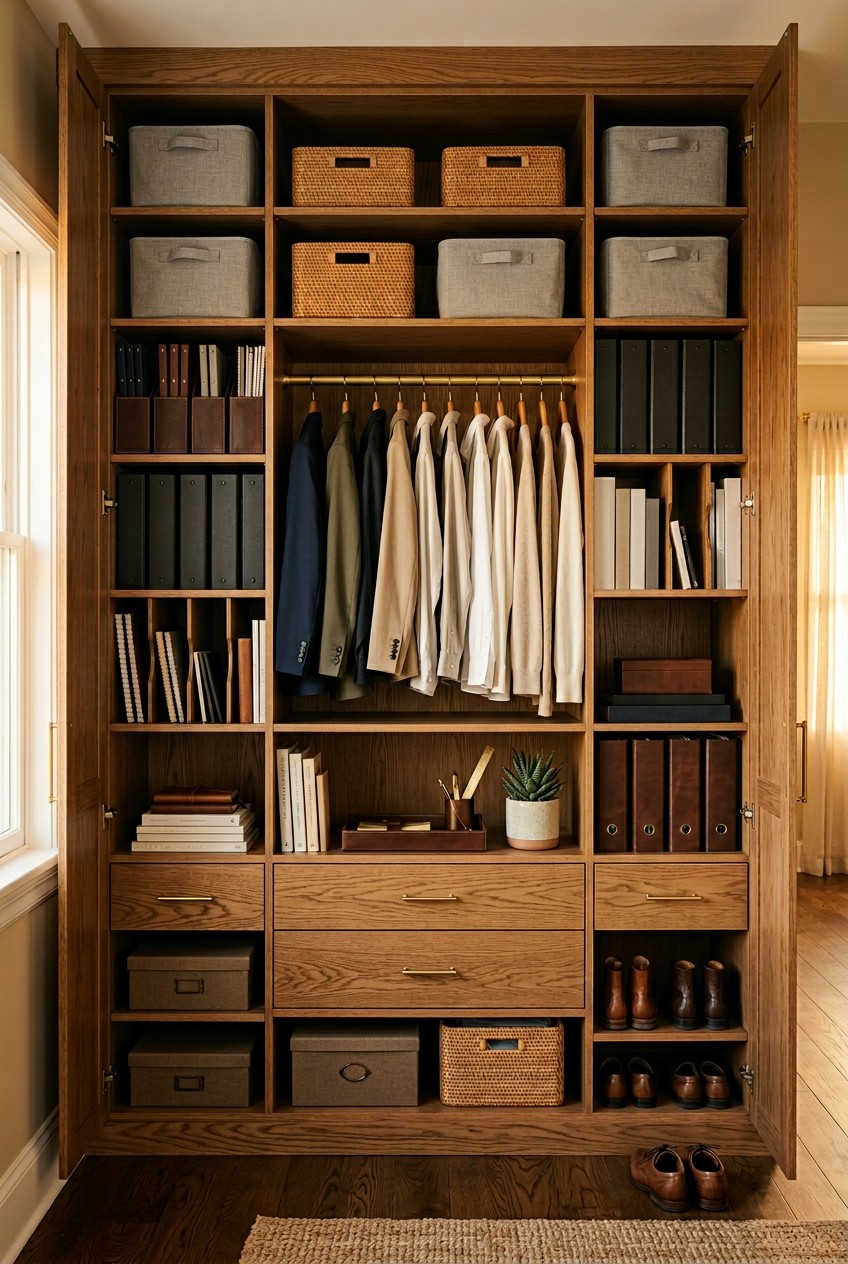
What’s Inside
- Start with a Brutal Purge and Strict Categorization
- Maximize Vertical Space with Modular Systems
- Implement Smart Drawer Organization for Tiny Supplies
- Embrace Clear, Labeled Storage Bins for Office Closet Organization
- Utilize the Back of the Door for Hidden Storage
- Invest in a Quality Label Maker
- Conquer Cable Clutter with Dedicated Solutions
- Incorporate Vertical File Storage for Paperwork
- Create Distinct Zones within Your Office Closet Organization
- Consider Custom or Semi-Custom Closet Systems for Long-Term Value
- Integrate Biophilic Design Elements to Soften the Space
- Use Shelf Dividers to Maintain Perfect Order
- Adopt the KonMari Vertical Folding Method for Soft Goods
Last Tuesday, I opened the door to grab a simple black pen and was immediately hit by a physical avalanche of old tax returns, tangled charging cords, and empty cardboard boxes. If you’re struggling with office closet organization, I completely understand the frustration. My workspace used to smell like stale coffee and dusty paper, and every time I needed a paperclip, I’d end up wasting twenty minutes digging through a dark, chaotic mess. Proper office closet organization isn’t just about making things look pretty on social media. It’s about saving your sanity during a busy workday.
I tried doing this wrong for months before figuring it out. I’d buy random cheap bins, shove them onto sagging shelves, and hope for the best. It always failed. You can’t just buy a few plastic tubs and expect a miracle. You need a solid strategy, specific products that actually fit your space, and a willingness to get a little ruthless with your clutter. Drawing on advice from professional organizers, some brilliant new trends for 2026, and my own embarrassing trial-and-error moments, I’ve put together a massive guide to fix your storage nightmare. Let’s get into the exact steps, products, and honest mistakes you need to know about.
1. Start with a Brutal Purge and Strict Categorization

Before you even think about buying new bins, you have to empty the entire closet. I mean every single item. Drag it all out onto your office floor. Professional organizer Nancy Meck, founder of Meck Organizing, explicitly warns against buying storage products before you know exactly what you’re keeping. If you skip this step, you’re just organizing garbage. I learned that the hard way last year when I spent forty dollars on beautiful acrylic trays, only to realize I was using them to store dried-out highlighters and instruction manuals for a printer I didn’t even own anymore.
Create four distinct piles on your floor: keep, donate, discard, and relocate. Be incredibly ruthless. If a pen doesn’t write smoothly on the first try, throw it in the trash. When I did my last major cleanout, I used Hefty Ultra Strong 30-gallon trash bags, which cost about $11.99 for a box of 40 at my local Costco. They’re thick enough that sharp plastic binders won’t puncture the sides. I also realized during this purge that I had fourteen reusable grocery bags crammed in the back corner. I’d brought them home from Whole Foods over the span of three years and just shoved them out of sight. Keep only what you actually use while sitting at your desk. The smell of old, dusty paper will disappear once you finally recycle those ancient files.
2. Maximize Vertical Space with Modular Systems

Most standard closets come with one flimsy wire shelf and a hanging rod. This is completely useless for an office. You need to utilize the full height of your space, from the floorboards all the way up to the ceiling. Adjustable modular systems are the only way to go because your storage needs will inevitably change. I personally swear by the Elfa system from The Container Store. The components are incredibly flexible. You can buy small shelf brackets for under $10, or build out larger drawer units that cost over $500, which allows for very flexible budgeting.
If you’re looking for a slightly different option, the Rubbermaid HomeFree series provides durable closet kits designed for spaces ranging from 3-6 feet or 4-8 feet wide. I bought a Rubbermaid kit for $149.99 a few years ago for a guest room, and the heavy-duty steel construction is fantastic. Don’t make the mistake I made in my early twenties. I bought some cheap, wobbly wire racks from Target that couldn’t hold the weight of my textbooks. The entire rack collapsed in the middle of the night with a terrifying crash, ruining several expensive binders. Invest in a system that anchors securely to the studs in your wall. The cold, solid feel of a properly installed steel bracket will give you so much peace of mind.
3. Implement Smart Drawer Organization for Tiny Supplies

If you have drawers in your office closet, they’ll inevitably become “junk drawers” if you don’t physically divide the space. Throwing loose paperclips, rubber bands, and sticky notes into a dark drawer creates a rattling, messy nightmare. Every time you open the drawer, the items slide around and mix together. To fix this, you need dedicated drawer organizers that fit snugly. I highly recommend the iDesign Linus Shallow Drawer Organizers. They start at around $5 each and have little rubber feet on the bottom so they won’t slide around when you slam the drawer shut.
For a warmer, more natural look, I absolutely love bamboo. I recently bought a 7-pack of SpaceAid Bamboo Drawer Organizer Storage Boxes on Amazon for $34.99. The smooth texture of the bamboo feels incredibly high-quality compared to brittle plastic. I use the tiny 3×3 inch square boxes to hold exactly 1/2 cup of binder clips, and the longer 9×3 inch boxes for my favorite gel pens. A common mistake is buying organizers without measuring the internal height of your drawer first. I once bought a beautiful acrylic tray that was 3.5 inches tall, but my drawer clearance was only 3 inches. It got stuck, and I had to pry the drawer open with a flathead screwdriver, scratching the wood in the process. Always measure twice.
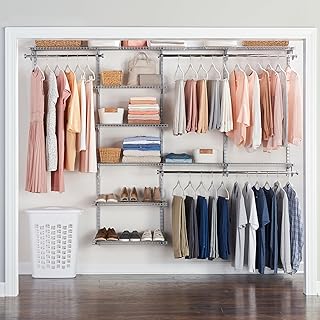
Rubbermaid Configurations Deluxe Custom Closet Kit 4-8 Ft.
Honestly, Rubbermaid Configurations Deluxe Custom Closet Kit 4-8 Ft. Adjustable surprised me — sturdier than it looks in the photos, and over 81 buyers gave it 4.5 stars.
4. Embrace Clear, Labeled Storage Bins for Office Closet Organization

When you’re in the middle of a stressful phone call and need a specific adapter, you don’t have time to open five different opaque boxes. You need to see exactly what you own instantly. Clear storage bins or open-top baskets are absolutely essential for office closet organization. If you prefer a more uniform look and want to hide the visual clutter, fabric cubes are a great alternative, provided you label them meticulously. I use the Amazon Basics Collapsible Fabric Storage Cubes. They measure exactly 11 x 10.5 x 10.5 inches and can hold about 5 pounds of supplies each. A pack of six usually runs about $19.99. You might also like: 15 Inspiring Cozy Home Hacks That Changed Everything
I used to buy solid black plastic tubs from Walmart because they were cheap, but it was a massive mistake. I’d forget what was inside them within a week. I’d end up buying duplicate packs of printer ink because I couldn’t see the three boxes I already owned hidden in the dark bins. If you use fabric cubes, you must label them. I make DIY labels using thick white card stock and self-laminating sheets. I cut the labels into 2×3 inch rectangles and attach them to the fabric bins with small wooden clothespins or sticky tack. The smooth, glossy finish of the laminated label looks professional, and the bold black text makes finding my shipping tape effortless. You might also like: 20 Brilliant Indian Home Makeover Ideas for Any Style
5. Utilize the Back of the Door for Hidden Storage

The back of your closet door is basically free real estate, and most people leave it completely blank. This flat surface is the perfect place to store lightweight, frequently used items that you want to keep out of sight but easily accessible. Over-the-door organizers with clear plastic pockets are great for holding small tech accessories, charging cables, or even a 16 oz bottle of screen cleaning spray. The clear plastic lets you see the contents immediately, and the pockets keep cords from tangling. You might also like: 20 Lovely DIY Home Makeover That Make a Real Difference
If you don’t want a full hanging shoe organizer, Command Hooks are your best friend. I use the medium-sized white Command Hooks, which typically cost $13.49 for a 6-pack and have a 3-pound weight capacity. I stick them directly to the inside of the door to hang my noise-canceling headphones and a lightweight clipboard. The satisfying click of a Command hook locking into its base is one of my favorite sounds. Just make sure you clean the door surface with a little rubbing alcohol first. I skipped that step once, hung a heavy extension cord on a hook, and it peeled a chunk of paint right off the door when it fell.
6. Invest in a Quality Label Maker

You might think writing on a piece of masking tape with a Sharpie is good enough, but trust me, it looks terrible. The ink bleeds, the tape peels at the corners, and it makes your entire closet look like a messy garage. Professional-looking labels significantly upgrade the visual appeal of your space and make it much easier to maintain your system over time. The Brother P-Touch Cube Plus is my absolute favorite tool for this. It costs around $100, but it connects seamlessly to your smartphone via Bluetooth. You can type out the labels on your phone screen, choose from dozens of fonts, and print them instantly.
If you’re on a tighter budget, the Brother PT-N10 is a fantastic basic option available for approximately $25. It has a built-in keyboard and gets the job done perfectly. For small business owners who need to print paper shipping labels alongside their organization labels, the Brother QL-800, priced at about $124.97, is a top-rated choice. The sensory experience of peeling the split backing off a freshly printed glossy label and smoothing it onto a clear acrylic bin is incredibly satisfying. Don’t skip the labeling step. Even if you think you’ll remember where you put the spare staples, you won’t. Label everything.

AMKUFO 6 Pack-Closet-Organizers-and-Storage
Honestly, AMKUFO 6 Pack-Closet-Organizers-and-Storage surprised me — sturdier than it looks in the photos, and over 52 buyers gave it 4.5 stars.
7. Conquer Cable Clutter with Dedicated Solutions

Nothing ruins the look of an organized closet faster than a rat’s nest of black and white wires. Tangled electronics are a universal frustration. If you just throw all your USB cords, HDMI cables, and camera chargers into a single basket, they’ll literally knot themselves together. To fix this, you need small, latched containers. Crafters often call these “bead boxes,” but they’re the ultimate secret weapon for tech storage. I use the ArtBin Super Satchel, which measures 15.25 x 14 x 3.5 inches and costs about $14.99. It has small, removable plastic dividers inside.
I coil each cable individually, secure it with a velcro cable tie, and place it in its own little compartment. I also use these tiny compartments to hold small gadgets like spare USB thumb drives, loose change I find in my laptop bag, or extra keys. Honestly, this took me years to figure out. I used to get so angry trying to untangle a 6-foot phone charger while my battery was dying. Now, I just pop open the clear plastic lid of the ArtBin, grab the exact cord I need, and snap it shut. The hard plastic protects the delicate connectors on the cables, preventing them from bending or snapping under the weight of heavier items.
8. Incorporate Vertical File Storage for Paperwork

Stacking papers horizontally on a shelf is a guaranteed way to lose important documents. The bottom of the stack becomes a black hole, and the papers inevitably slide around, creating a messy, uneven pile. To keep paperwork off your desk and neatly contained inside the closet, you need to integrate vertical file holders or wall-mounted file racks. This approach aligns perfectly with the 2026 trend of utilizing vertical space and hidden storage solutions in home offices.
I use the SimpleHouseware Wall Mount Document Letter Tray, which costs $16.97. I screwed it directly into the side wall of my closet, right at eye level. It holds standard 8.5 x 11 inch printer paper, heavy cardstock, and manila folders perfectly. I have one slot for incoming mail, one for bills to pay, and one for receipts I need to scan. Before I found this metal rack, I bought a cheap plastic file holder from Kroger while grocery shopping. The plastic was so brittle that it cracked down the middle the first time I shoved a heavy medical bill into it. Stick to metal wire or thick, high-quality acrylic for your vertical files. The rigid structure keeps your papers crisp and prevents dog-eared corners.
9. Create Distinct Zones within Your Office Closet Organization

A major trend for workspace design in 2026 is the concept of “multizonal workspaces.” This simply means dividing your space into specific, functional areas rather than just putting things wherever they happen to fit. You need to apply this concept directly to your office closet organization. Treat the closet like a mini-warehouse. Designate the bottom floor space for heavy items like your shredder or bulk boxes of printer paper. Use the middle shelves, which are at eye level, for daily essentials like pens, planners, and sticky notes. Reserve the very top shelves for archival storage or seasonal items you rarely touch.
Professional organizers always suggest sorting items into strict categories. I have a “shipping zone” on my second shelf. It holds a tape dispenser, bubble wrap, and padded envelopes. I used to mix my shipping tape in with my regular office supplies, and I’d always knock over my pencil cup trying to grab the bulky tape gun. By giving shipping supplies their own dedicated zone, everything stays neat. I also have a “reference zone” for heavy textbooks and software manuals. Grouping similar items together means your brain doesn’t have to work as hard to find what it needs. You just look at the correct zone and grab the item.

Ulif E10 Clothes Rack(With Stretchable Hanger
Ulif E10 Clothes Rack(With Stretchable Hanger Rod)Freestanding Clothin punches above its price — 926 buyers rated it 4.5 stars. I would buy it again.
10. Consider Custom or Semi-Custom Closet Systems for Long-Term Value

If you own your home and want a highly tailored, permanent solution, it’s worth exploring custom closet systems. Brands like Elfa from The Container Store or ClosetMaid SuiteSymphony offer modular designs with a very polished, built-in aesthetic. The ClosetMaid kits often feature beautiful faux-wood finishes that make the inside of your closet look like a high-end piece of furniture. A basic ClosetMaid starter kit can run anywhere from $150 to $300, depending on the finish and configuration.
Custom installations from professional companies can range from $1,000 to over $10,000, with many homeowners spending between $1,500 and $4,500 for a fully installed system. While the results are stunning, you don’t necessarily need to spend that much. I once got a quote for a $4,500 custom wood closet for my tiny office, and I honestly laughed out loud. It was way out of my budget. I opted for a semi-custom Elfa system instead, installed it myself in an afternoon, and saved thousands of dollars. Be prepared for a little bit of drywall dust if you install it yourself, but the sturdy feel of a track system bolted directly into your wall studs is completely worth the effort.
11. Integrate Biophilic Design Elements to Soften the Space

This might sound a little weird for a closet, but incorporating biophilic design is a massive home office trend right now. Biophilic design is all about bringing elements of nature indoors to create a calmer, more focused environment. While a plant won’t magically organize your pens, adding natural wood accents or a small, easy-care plant on an open shelf within your closet softens the harsh, sterile look of plastic bins and metal wire.
I bought a beautiful little pothos plant in a 4-inch ceramic pot for $12.99 at Sprouts last month. I placed it on the middle shelf of my office closet, right next to my bamboo drawer organizers. Pothos plants thrive in low light, so it does perfectly fine even though the closet door is closed half the day. I keep a tiny 4 oz glass spray bottle next to it for easy watering. The faint, earthy smell of damp soil when I open the closet door is surprisingly grounding during a stressful workday. It makes the space feel like a curated part of my home, rather than a dark storage cave. Just be careful not to overwater it, or you’ll end up with muddy water dripping onto your important tax documents.
12. Use Shelf Dividers to Maintain Perfect Order

If you store soft items, binders, or large books on wide, flat shelves, you know the struggle of the toppling stack. You pull one binder out, and the three next to it slide over and crash onto the floor. To prevent this, you need rigid shelf dividers. They act like invisible bookends, keeping stacks of items perfectly vertical and separated. I use the Lynk Shelf Dividers, which cost about $17.99 for a set of two. They’re made of heavy-duty steel and slide directly over standard 3/4 inch thick wooden shelves.
The cold steel of the divider grips the wood tightly, so it won’t budge even if you lean a heavy textbook against it. I use these dividers to separate my blank notebooks from my active project binders. Before I discovered these, my shelves always looked sloppy. The books would lean at odd angles, creating a messy, chaotic visual. Slipping a metal divider between the categories forces everything to stand up straight. It’s a tiny, inexpensive tweak, but it drastically improves the longevity of your organized shelves. Just make sure you measure the thickness of your shelves before buying, as some dividers won’t fit over very thick custom wood.

SNSLXH 5 Pack Stackable Closet Storage Basket
SNSLXH 5 Pack Stackable Closet Storage Basket punches above its price — 39 buyers rated it 4.5 stars. I would buy it again.
13. Adopt the KonMari Vertical Folding Method for Soft Goods

You probably have a few soft goods in your office closet. Maybe you keep a spare fleece blanket for chilly mornings, a few microfiber towels for dusting your monitors, or even fabric samples if you work in design. The absolute worst way to store these is stacking them on top of each other. The item at the bottom gets crushed, forgotten, and covered in dust. Instead, you need to employ the KonMari method of vertical folding. This technique allows you to see every single item at a glance, much like files in a filing cabinet.
I use this method for my massive collection of reusable shopping bags. I take a bag I got from Trader Joe’s, fold the handles inside, fold the body in half lengthwise, and then fold it into thirds until it forms a tight, freestanding little rectangle. I line these folded rectangles up vertically inside a shallow fabric bin. It maximizes the storage space perfectly. I used to just wad them up into a giant ball and stuff them onto the top shelf. Every time I reached for one, five others would fall on my head. Vertical folding takes an extra ten seconds per item, but the visual satisfaction of a perfectly aligned row of folded fabric is incredible.
Maintaining your newly organized space is the final piece of the puzzle. A common mistake is waiting for the clutter to become completely overwhelming before you try to fix it again. Instead, dedicate just 5 to 10 minutes every Friday afternoon to a “micro-decluttering” session. Put the stray pens back in their bamboo boxes, throw away the empty tape rolls, and wipe down the shelves. As life changes, your storage needs will shift, and that’s perfectly normal. I hope these tips help you reclaim your space and your sanity. If you found this guide helpful, please save it or pin it so you can reference these exact product measurements the next time you’re standing in the storage aisle!
Frequently Asked Questions
What is the first step in office closet organization?
The very first step is to completely empty the closet. Sort every item into keep, donate, discard, and relocate piles. Never buy storage bins before you know exactly what you’re keeping, or you’ll just end up organizing clutter.
How can I maximize space in a small office closet?
Utilize the full vertical height by installing adjustable modular shelving systems like Elfa or Rubbermaid. Don’t forget to use the back of the closet door with Command hooks or clear pocket organizers for lightweight items and cables.
What is the best way to store charging cables and cords?
Avoid throwing them in a drawer where they will tangle. Use small, latched containers with divided compartments, often called bead boxes or craft organizers. Coil each cord individually and secure it with a velcro tie before storing.
How do I keep my office closet organized long-term?
Implement weekly micro-decluttering sessions. Spend just 5 to 10 minutes every Friday putting items back in their designated zones and throwing away trash. Consistent, small efforts prevent the closet from becoming overwhelming again.
