What’s Inside
- Start a Montessori-Inspired Playroom Toy Storage Rotation
- Invest in the IKEA TROFAST System for Modular Versatility
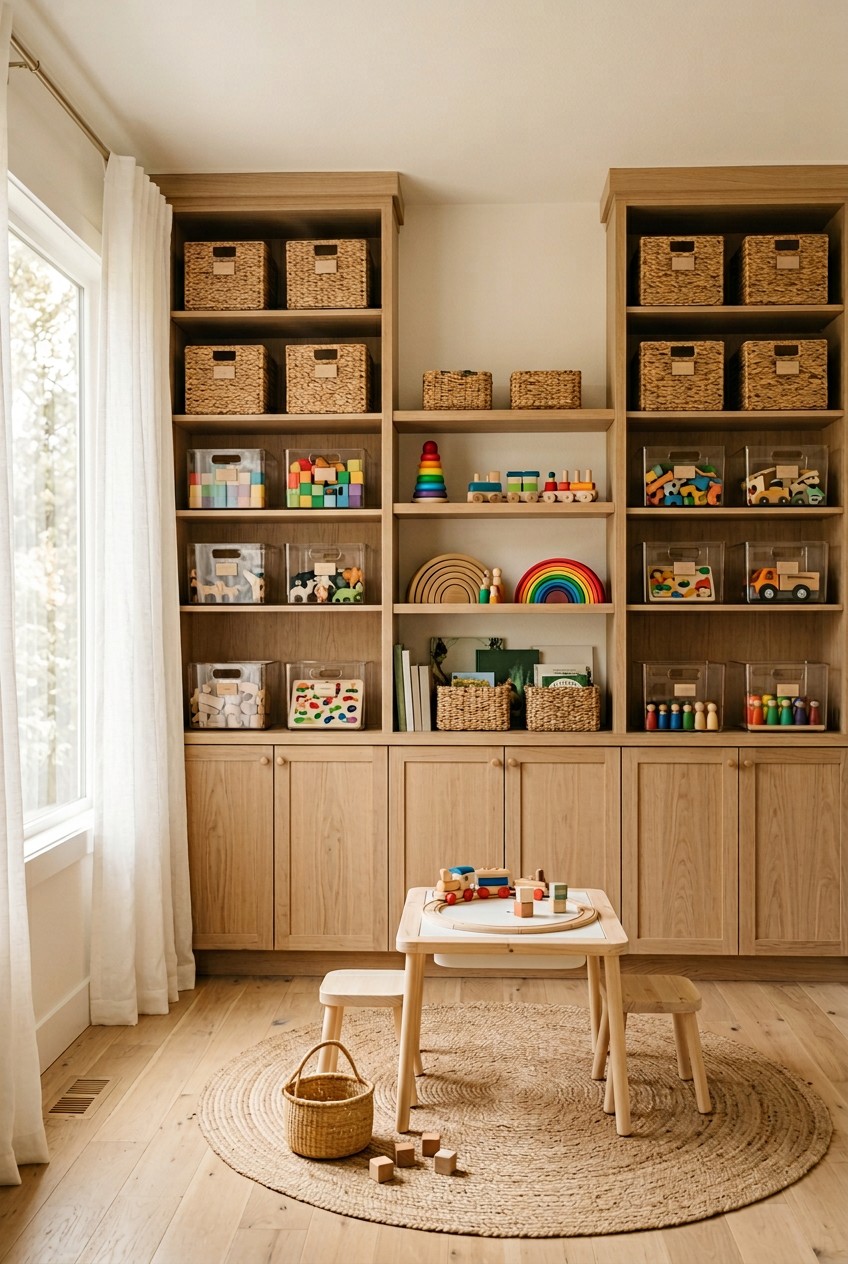
- Utilize Clear, Stackable Bins for Small Parts
- Label Everything with Pictures and Text
- Prioritize Vertical Playroom Toy Storage to Maximize Space
- Categorize Toys by Exact Type or Activity
- Hide Messes in Real Furniture Like the Sorbus Ottoman
- Hang Over-the-Door Organizers for Small Items
- Choose Shallow Bins Over Giant Toy Boxes
- Involve Your Kids in the Sorting Process
- Embrace Sustainable Bamboo and Cotton Storage
- Build a Hidden Toy Library in a Closet
- Roll Out an IKEA RÅSKOG Cart for Art Supplies
Last Tuesday at Whole Foods, I found a rogue plastic dinosaur stuck to the bottom of my shoe right in the produce aisle. I realized my house had become a certified disaster zone. Finding the right playroom toy storage is the only thing keeping me from losing my mind. I used to just kick plastic blocks under the couch and hope for the best. My living room constantly smelled like old playdough and crushed goldfish crackers. I tripped over a wooden train track piece in the dark and bruised my heel so badly I couldn’t wear regular shoes for a week. That was my breaking point. I needed real solutions, not just another giant wicker basket to hide my shame.
If you’re drowning in tiny plastic accessories and stuffed animals, I feel your pain. I tried so many organizing hacks that failed before I finally figured out a system that works. I’m going to walk you through exactly what I do now. We’re talking specific measurements, real prices, and the exact bins I use to keep my floors clear. Grab your coffee, because we’re fixing your toy clutter right now.
1. Start a Montessori-Inspired Playroom Toy Storage Rotation

I tried dumping every toy my kids owned into one giant pile in the center of the room for months. Huge mistake. The kids wouldn’t even play. They’d just stare at the mountain of plastic, pull out one item, and walk away bored. Now I stick to a strict Montessori rotation system for my playroom toy storage. I keep out exactly 5 to 7 distinct toy sets on low, accessible shelves. The rest go into hiding in the guest room closet. Every Sunday after my grocery run to Trader Joe’s, I swap them out.
The beauty of this is the novelty. A wooden puzzle they ignored for three weeks suddenly becomes the most fascinating object in the world when it reappears on a fresh shelf. You don’t need a fancy setup to make this work. Just pick a few key categories like building blocks, a pretend play set, and some books. Hide the rest in opaque bins. It cuts the visual noise in half and forces them to actually focus on what they have. I’ve noticed their independent playtime has doubled since I started doing this. It’s a total win. Plus, cleaning up 5 toys at the end of the day takes exactly three minutes.
2. Invest in the IKEA TROFAST System for Modular Versatility

If you don’t own this yet, you’re missing out. The IKEA TROFAST Storage combination with boxes is $99.99 for the solid pine frame (measuring exactly 36 5/8 by 17 3/8 by 20 1/2 inches). I bought mine two years ago and it fixed my Lego problem. You buy the plastic bins separately for about $4 to $6 each depending on the depth. They come in white, green, pink, or gray. I personally swear by the shallow green ones for tiny magnetic tiles and the deep white ones for bulky wooden blocks.
The open bins mean the kids can just slide them out, dump them on the rug, and slide them back when they’re done. No heavy lids to pinch little fingers. I used to use a giant wooden chest I bought from Target, but everything just sank to the bottom in a tangled mess. The TROFAST keeps everything perfectly separated. It’s sturdy. My toddler frequently climbs on it—which I don’t recommend, but it happens—and it hasn’t wobbled once. You can mix and match the bin sizes as your kids grow and their toys change. It’s the most adaptable piece of furniture I own.
3. Utilize Clear, Stackable Bins for Small Parts

Skip the opaque bins for tiny pieces. I bought a set of thick woven baskets from Sprouts thinking I was being aesthetic. Huge mistake. Nobody knew what was inside, so the kids dumped every single basket onto the rug to find one specific Barbie shoe. Learned that the hard way. Now I only use clear, stackable plastic bins with latching lids for small parts. You can get a 6-pack of 6-quart clear storage bins at Walmart for about $16.98. I use these strictly for building blocks, craft supplies, and tiny doll accessories.
Seeing the contents right through the plastic means they only grab the bin they actually want. The latches keep the lids locked tight. When my youngest drops a bin on the hardwood floor, the lid stays shut. No more spending forty minutes picking up microscopic beads out of the carpet fibers with tweezers. I stack them three high on the shelf. The uniform size makes the closet look neat, and the clear plastic removes all the guesswork. Don’t waste your money on trendy solid-colored bins if you’re storing tiny pieces. Clear plastic is the only way to go.

Sterilite 4 Pack Ultra Latching Box, Storage Bins with Lids
A dependable everyday pick — Sterilite 4 Pack Ultra Latching Box pulls in 126 ratings at 4.5 stars. Not flashy, just solid.
4. Label Everything with Pictures and Text

Most people get this wrong. I certainly did. I spent hours writing beautiful cursive labels on all my canvas bins. My kids are three and five. They can’t read cursive. They couldn’t read at all. So the labels were useless and I was still the one cleaning up every night. You have to use picture labels alongside the text. I bought a pack of waterproof Avery blank labels for $12.49 on Amazon. I printed tiny 2-inch pictures of cars, dolls, and blocks right next to the printed words in a bold, basic font. You might also like: 15 Creative Home Organizing Ideas You Haven’t Thought Of
You can also find customizable sets from Etsy sellers for around $15 to $30 if you don’t want to print them yourself. This simple trick gives kids the power to put things away correctly without asking you where the blue truck goes. They see the picture of the truck on the bin, they put the truck in the bin. It stops the endless questions. Plus, it helps them start associating written words with images. I stick the labels right in the center of the plastic bins so they are at eye level for a toddler. It’s been a massive relief for my daily routine. You might also like: 20 Cozy Aesthetic Organizing Ideas to Inspire Your Next Project
5. Prioritize Vertical Playroom Toy Storage to Maximize Space

Let’s talk about floor space. If you line up all your storage bins along the baseboards, you won’t have any room left for actual playing. I learned this the hard way in our old apartment. The room felt like a cramped, cluttered hallway. You have to go vertical with your playroom toy storage. I installed sturdy wall-mounted shelving from Costco. The heavy-duty metal racks cost me $59.99, and they hold up to 250 pounds per shelf. I put the everyday, safe items at child height, below 3 feet. You might also like: 20 Charming Aesthetic Closet Organization Ideas You Need to See
I keep the messy or supervised things like acrylic paint, loose glitter, and kinetic sand way up high, above 4 feet. You absolutely must anchor these to the wall. I use heavy-duty anti-tip kits on anything taller than 30 inches. I once watched a bookshelf wobble when my oldest tried to scale it like a rock wall to reach a stuffed bear. It terrified me. Anchor everything into the wall studs. It keeps the floor clear so they can actually build their train tracks, and it keeps your kids safe from falling furniture. Don’t skip the wall anchors. They cost $10 and they save lives.
6. Categorize Toys by Exact Type or Activity

The biggest trap is having a catch-all miscellaneous bin. A miscellaneous bin is just a garbage can for toys. I used to have a giant wicker basket where I threw everything at the end of the day. The bottom was a sticky, dusty nightmare of broken crayons, rogue puzzle pieces, and crushed cracker crumbs. It smelled terrible. You have to categorize. Group all the die-cast cars in one specific 4-quart bin. Put all the art supplies in another. Stack the chunky wooden puzzles vertically in a wire rack.
I bought a simple wire kitchen plate rack from Kroger for $8.99 in the baking aisle, and it holds standard wooden peg puzzles perfectly. When you categorize, cleanup becomes intuitive. The kids know exactly where the toy food goes because it lives right next to the toy kitchen. It stops the panic of losing that one specific piece they desperately need right before bedtime. If a toy doesn’t fit into a specific category, it probably belongs in the trash or the donation pile. Stop keeping random, broken plastic junk that doesn’t belong anywhere.

Sakugi Storage Shelves – 5 Tier Shelf Organizer
A dependable everyday pick — Sakugi Storage Shelves – 5 Tier Shelf Organizer pulls in 31 ratings at 4.5 stars. Not flashy, just solid.
7. Hide Messes in Real Furniture Like the Sorbus Ottoman

If your play area is also your main living room, you don’t want it looking like a preschool exploded. I hate staring at neon plastic when I’m trying to relax with a cup of tea at 8 PM. You need real furniture with hidden compartments. I bought the Sorbus Storage Ottoman Bench for $49.99 online. It measures 30 inches long and looks like a normal, stylish tufted gray fabric bench. But the top lifts off, and the inside cavity is massive.
I shove all the bulky stuffed animals, oversized board games, and extra throw blankets in there. When guests come over, I just toss the clutter inside, pop the lid on, and suddenly I have a chic living room again. It doubles as extra seating when we have family over for the holidays. Just skip the cheap cardboard versions of these benches. They cave in if a full-grown adult sits on them. Get something with a solid wood frame. It’s the perfect way to blend adult aesthetics with the chaotic reality of having children in the house.
8. Hang Over-the-Door Organizers for Small Items

The back of the door is entirely wasted space. I started using an over-the-door hanging shoe organizer with clear plastic pockets to fix this. I found a heavy-duty one at Target for $16.00 in the closet aisle. It is brilliant for storing small dolls, action figures, and card games. Each Barbie doll gets her own little clear pocket. The kids can see exactly what’s there without digging through a dark box.
I even use one for organizing art supplies. I stuff thick washable markers in one pocket, crayons in another, and sharp safety scissors up at the very top pockets where the toddler can’t reach them. It keeps the tiny, irritating items off the floor and out of the main storage bins. Just make sure the metal hooks over the door aren’t scraping your door frame when you close it. I put a tiny piece of felt tape under the metal hooks to protect my white paint. It’s a cheap, easy fix that adds 24 pockets of storage instantly.
9. Choose Shallow Bins Over Giant Toy Boxes

I despise traditional toy boxes. They are dark, deep wooden caves where toys go to die. I had a beautiful, expensive wooden chest in our old house. The kids would throw things in, and all the small stuff would filter to the bottom. To find anything, they had to pull every single large toy out and throw it on the floor. It defeated the purpose of cleaning up. Now, I strictly use shallow bins. I’m talking 4 to 6 inches deep at maximum.
I found perfect shallow plastic trays at Walmart for $3.48 each. They are ideal for wooden blocks, sensory items, and loose train tracks. Because the bin is shallow, the kids can see every single piece without digging. It prevents the black hole effect. Save the deep bins strictly for lightweight, bulky items like plush toys, large pillows, or dress-up clothes. If you put heavy toys in a deep bin, you’re just asking for a mess. Shallow trays keep everything visible and accessible, which means they actually get played with.

OKZEST Utility Slim Storage Cart
A dependable everyday pick — OKZEST Utility Slim Storage Cart pulls in 17 ratings at 4.5 stars. Not flashy, just solid.
10. Involve Your Kids in the Sorting Process

If you organize the room while they are sleeping, they won’t respect the system. I tried the surprise reveal method once. I spent five hours organizing on a Saturday night, and they destroyed the entire room in twelve minutes flat the next morning. They didn’t know where anything belonged, so they just tore it all apart looking for a specific toy car. You have to make them do it with you. I sit on the floor with my kids and make them physically sort the piles.
We decide together which bin the plastic dinosaurs should live in. I let them stick the picture labels on the plastic tubs themselves. It takes three times as long, and it requires a massive amount of patience. But it gives them a real sense of ownership over their space. When they help build the system, they are much more likely to actually put the toys back where they belong. They remember that the blue bin is for blocks because they were the ones who put the blocks in there. Don’t exclude them from the process.
11. Embrace Sustainable Bamboo and Cotton Storage

I’m actively trying to phase out the cheap, brittle plastic bins that crack after two months. The sharp cracked plastic edges are awful and dangerous. I’m shifting to sustainable materials instead. I love the organic cotton rope baskets from Land of Nod, now Crate and Kids. They run about $39.00 for a medium size, around 14 inches wide. They are soft, so they don’t scratch my hardwood floors when the kids drag them across the room.
I use the cotton baskets for blankets and soft toys. For small hard parts, I started using Ekobo bamboo bins. A set of small bamboo jars costs around $25.00. They have a nice, smooth matte texture and look gorgeous sitting on an open shelf. Plus, if a cotton basket gets dirty or smells like spilled milk, I just throw it right in the washing machine on the gentle cycle. It beats scrubbing sticky juice off a plastic tub in the kitchen sink with a sponge. Sustainable materials just hold up better over time.
12. Build a Hidden Toy Library in a Closet

This ties into the rotation system, but you need a dedicated space for the out-of-rotation stuff. I cleared out the bottom half of our guest bedroom closet. I call it the toy library. I use heavy-duty 15-gallon canvas totes that I grabbed at Costco for $19.99 a pair. Each tote holds a specific category of toys. One is entirely for train sets, one for loud musical instruments, and one for magnetic building tiles. I zip them up tight so dust doesn’t settle on them.
When a toy is in the library, it is out of sight. Out of sight, out of mind. It keeps the active play area clutter-free. When my kids start acting bored and whiny on a rainy Saturday afternoon, I go to the library closet and pull out a “new” tote. It is literally like Christmas morning without spending a single dime. Having a dedicated storage closet prevents the main living areas from overflowing with unused junk. It’s the best secret weapon a parent can have.

Delamu 2-Tier Multi-Purpose Bathroom Under Sink Organizers
Delamu 2-Tier Multi-Purpose Bathroom Under Sink Organizers and Storage punches above its price — 72 buyers rated it 4.5 stars. I would buy it again.
13. Roll Out an IKEA RÅSKOG Cart for Art Supplies

Art supplies are the bane of my existence. A rogue uncapped permanent marker can ruin a fabric couch in three seconds flat. I keep all our craft stuff on a 3-tier rolling cart. The IKEA RÅSKOG cart is exactly $39.99 and it comes in great matte colors. It measures 13 3/4 by 17 3/4 by 30 3/4 inches. It’s made of powder-coated steel, so it wipes clean easily with a damp rag.
I put heavy playdough tubs on the bottom tier, loose paper and stickers in the middle, and messy paints on the top tier. I roll the cart right up to the kitchen table when it’s art time. When they finish painting, I roll it straight into the hall closet and shut the door. The chaos doesn’t spread through the house. I also keep a 20-gallon plastic storage tote right next to it in the closet. That’s my dedicated donate bin. Every time I find a toy they’ve outgrown or a puzzle missing pieces, I toss it in the bin. We donate it quarterly, and it keeps the clutter from slowly creeping back in.
Honestly, getting your kids’ stuff organized doesn’t have to be a nightmare. You don’t need a massive house or an unlimited budget. You just need clear bins, shallow trays, and a strict rotation system so they aren’t overwhelmed by choices. I’m telling you, implementing these tricks gave me my house back. Trust me on this. I’d love to hear which of these ideas you’re trying first. Pin this article to your home organization board so you can reference the exact measurements and prices the next time you’re standing in the storage aisle feeling lost. You’ve got this!
Frequently Asked Questions
What is the best playroom toy storage for small spaces?
Vertical shelving and over-the-door organizers are your best options. Utilizing tall, narrow bookshelves anchored to the wall keeps floor space open, while hanging pocket organizers can hold hundreds of tiny items behind a door.
How often should I rotate toys in a playroom?
Most experts recommend rotating toys every one to two weeks. This timeframe is long enough for kids to deeply engage with the current selection, but short enough to prevent boredom and keep the play space feeling fresh.
Are clear bins better than opaque toy boxes?
Yes, clear bins are significantly better for small parts. When kids can see exactly what is inside a plastic tub, they won’t dump out every single container just to find one specific toy.
How do I label toy bins for kids who can’t read?
Use picture labels alongside printed text. You can print out small photos of the exact toys, like a picture of a wooden block, and stick it right next to the word. This empowers toddlers to clean up independently.
